Portugal’s customised Dax ‘Furiosa’ named as the 2023 Honda Customs winner
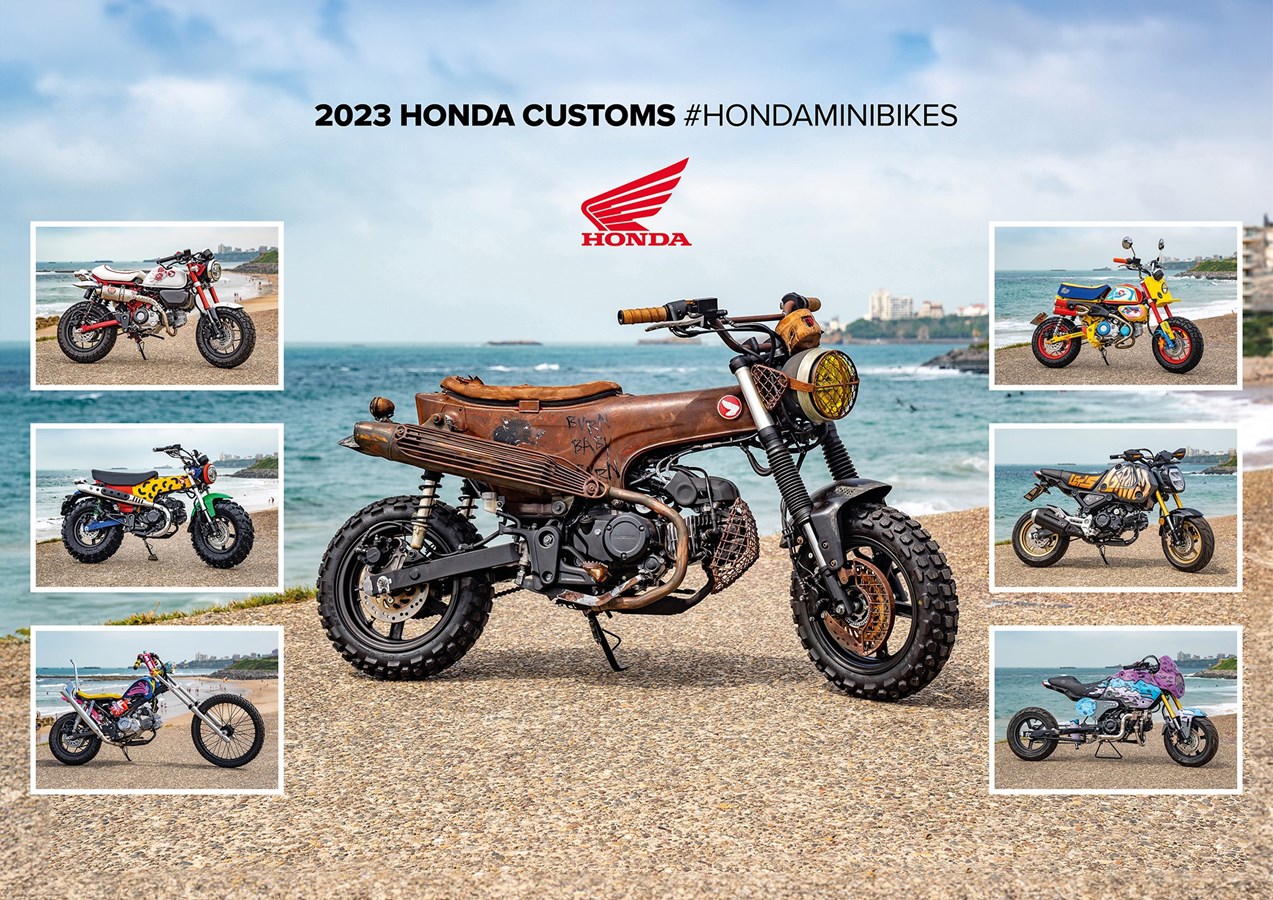
- The customised ‘post-apocalyptic’ Dax ‘Furiosa’ wins the 4th annual Honda Customs competition with 34% of the votes
- ‘Manjushage’ – a classy customised Monkey from Germany is second, with ‘Tokyo’ a French multi-coloured Monkey, in third
- This year the Honda Customs website showcased seven minibikes from seven European countries – each the result of a creative collaboration between a young artist and established bike builder
- com received over 21,000 visitors over the summer – 41% increase over 2022
The ‘post-apocalyptic’ Dax ‘Furiosa’ created by the Portuguese pairing of young artist Tamara Alves (@tamara_aalves) and bike builders at the Art of Wheels Garage (@artonwheelsgarage) has been crowned this year’s Honda Customs winner.
Receiving 34% of the total of 15,924 votes, Furiosa was victorious over six other custom European mini-bikes and follows in the footsteps of previous Honda Customs winners: Italian custom house Motocicli Audaci’s customised Rebel ‘Maanboard’, Portuguese Honda dealer Mototrofa’s ‘Fenix’ – a take on the CB650R, and the ‘CB100R Africa Four’ by Swiss Honda dealer Brivemo Motos.
Inspired by the world of post-apocalyptic movies, Furiosa features block tyres, a wolf motif, graffiti signatures, bespoke exhaust with wire mesh cage, and glimpses of tartan peeping out of the scorched seat cover.
The classy and graceful ‘Manjushage’, a customised Honda Monkey designed and built by the German team of artist @Lanaarts23 and bike builder Maximilian Zech, a technician based at the flagship Honda Centre dealer in Frankfurt, came in a close second with 29% of the total.
The subtle café racer features clip on bars, a Yoshimura end-can and aftermarket remote reservoir rear shocks to boost performance and handling, while Lana’s signature spider lily motifs (Manjushage in Japanese) adorn the fuel tank and fender, with the finishing touch being a tiny cartoon monkey on the downpipe heat shield.
The podium was completed by France’s ‘Tokyo’, a Monkey displaying an absolute riot of colour from the French duo of artist Grems (@insta_grems) and builder George Woodman (@georgewoodman64). What set Tokyo apart from the other entries were the pop-art visuals, pumped with vibrant colour in abstract – and subtly meshed – patterns on every square centimetre. It attracted 12% of the total votes.
This year 21,606 people visited the www.hondacustoms.com webpage over the summer to cast their votes, an increase of 41% from last year, with 5,461 users downloading a wallpaper of the chosen bike for their mobile or desktop.
All seven bikes were on display at the annual Wheels and Waves festival, running from 21st to 25th June in Biarritz, France.
Masayuki Hamamatsu, General Manager of Motorcycles, Honda Motor Europe: ‘Working with young artists to create unique versions of our minibikes has been a fantastic way for us to attract the attention of a younger audience to the fun and accessibility of motorcycles.
The strong reaction to these seven incredibly diverse creations is an encouraging sign of how motorcycles really engage people’s interest when they are given the chance to be ‘in contact’ with them.
Furiosa is a very cool and worthy winner and we are very grateful to all the artists and customisers who were involved from seven different countries – and to the more than 15,000 people who voted.’
For those wishing to take a closer look at all seven customisations, the Honda Customs page www.hondacustoms.com is still available in English, French, German, Italian, Spanish and Portuguese and features bikes from Spain, Austria, France, Italy, Germany, Portugal and the UK . Users are still able to download a wallpaper of their favourite bikes for desktop or mobile.
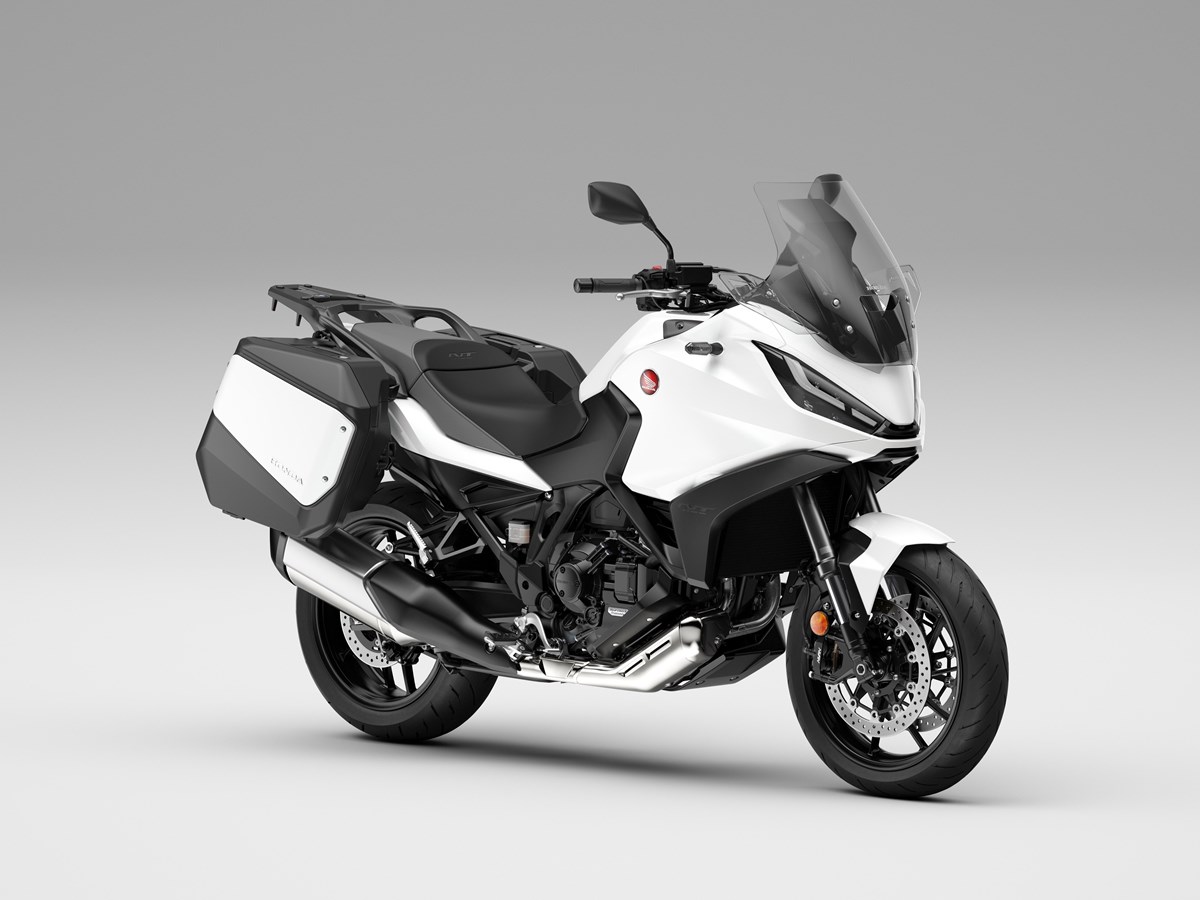
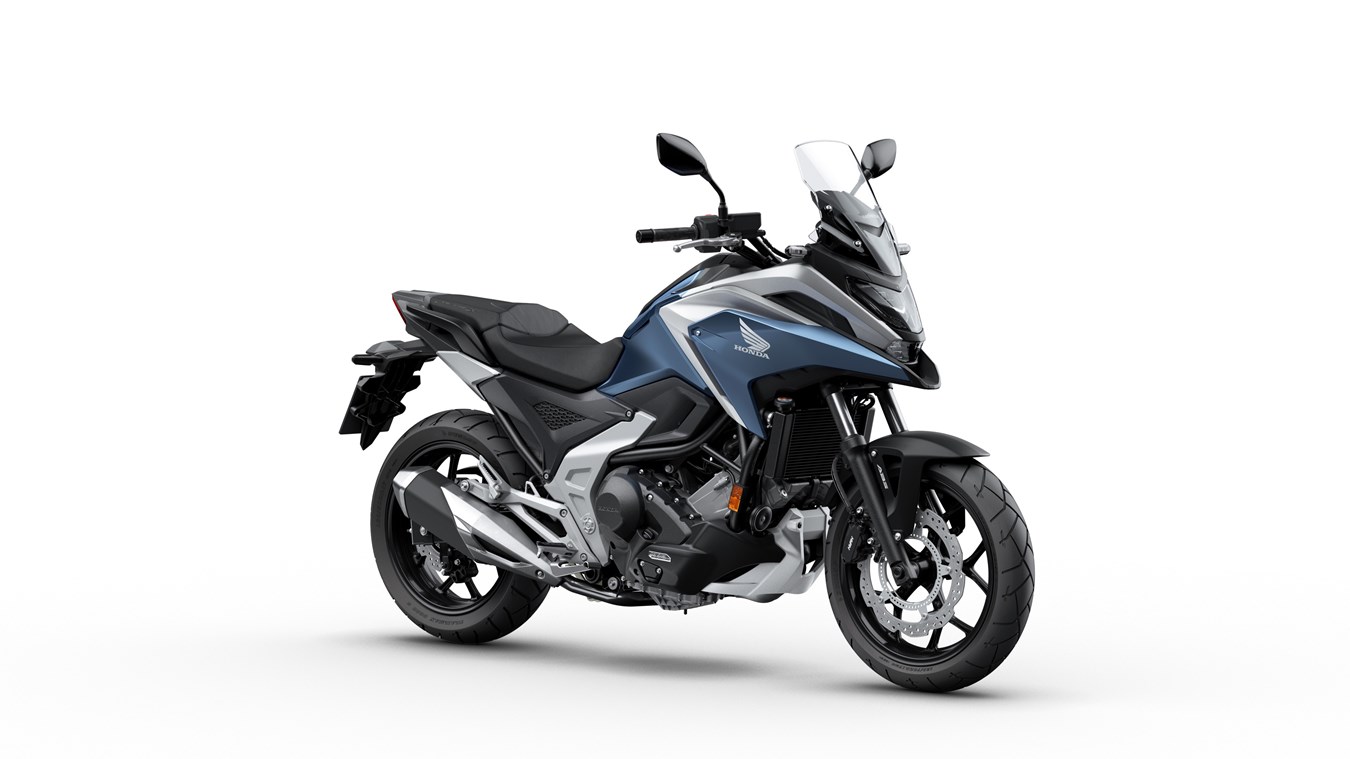
24YM HONDA NT1100
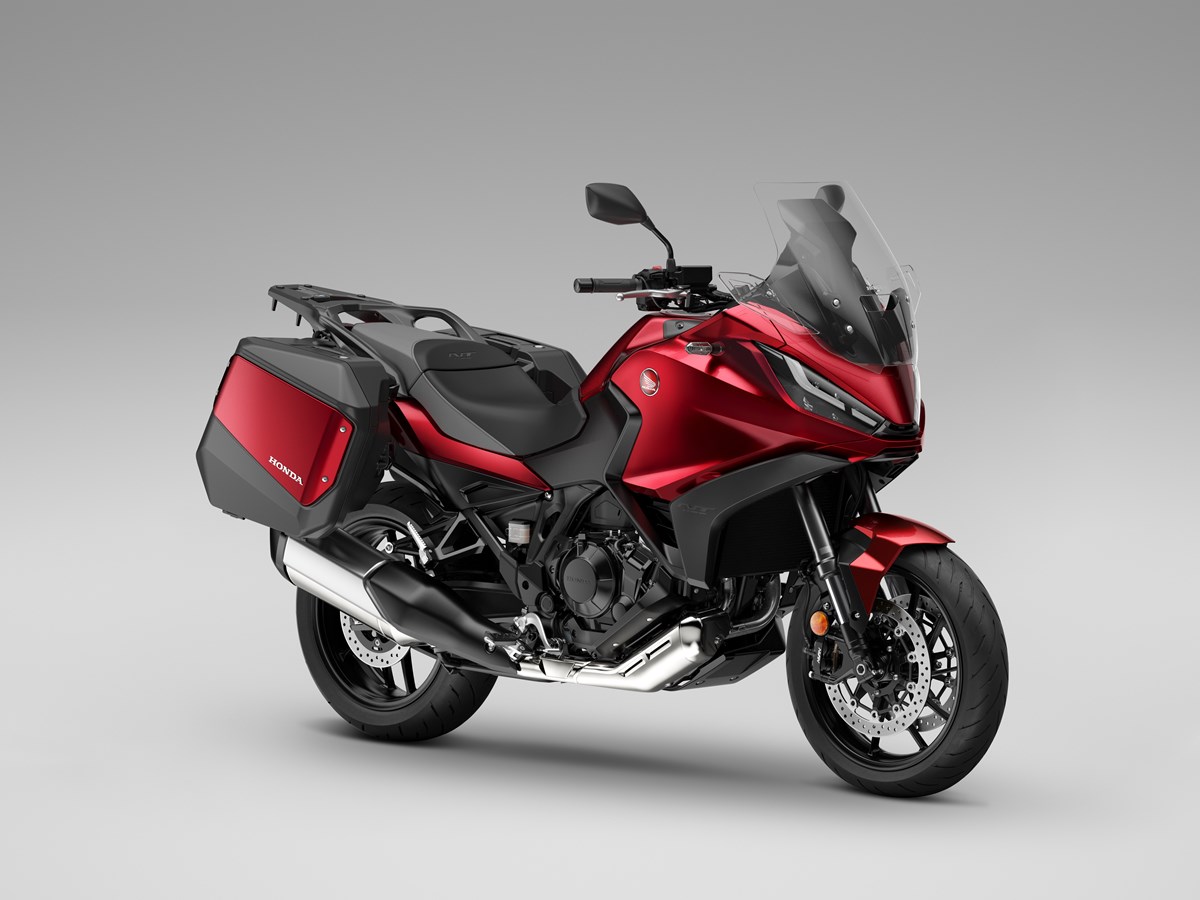
Model updates: Debuting for 22YM and taking the heart of the CRF1100L Africa Twin as a starting point, the NT1100 is a new breed of Honda tourer which offers comfortable, agile, enjoyable performance. A low seat height and sharp steering geometry combine with high specification suspension to create a sporting package. 5-way height and angle adjustable screen and upper/lower wind deflectors ensure high-speed aero efficiency and outstanding weather protection; cruise control is standard, as are slim panniers and heated grips. Rider aids include 3 default riding modes, 2 USER custom options, Honda Selectable Torque Control (HSTC) and Wheelie Control. Radial-mount four-piston front calipers provide the braking power, 120/70-17 and 180/55-17 front and rear tyres the grip. A 6.5-inch TFT touch screen rounds out a premium specification and features Apple CarPlay® and Android Auto® connectivity.
For 24YM the NT1100 will be available in two new striking colour options – Matt Jeans Blue Metallic and Candy Chromosphere Red.
Contents:
1 Introduction
2 Model overview
3 Key features
4 Accessories
5 Technical specifications
- Introduction
In a motorcycling landscape full of adventure-styled bikes many riders desire performance, handling, long range comfort, and technology but not necessarily the image or physical dimensions of ‘adventure’. In other words, what they want is a straightforward touring machine, but one with a rich specification list and a sporty edge to its performance – the sort of bike that deals with the weekday commute efficiently and usefully and is also ready for an extended tour, fully loaded.
The NT1100 is precisely that bike. Introduced in 2022 it’s designed to draw those with a long memory of similar Honda machines of the past, but also attract a much younger rider. Employing the frame and characterful twin-cylinder engine of the CRF1100L Africa Twin as a base, engaging performance is assured. But the NT1100 is also packed with features and technology that build and broaden any motorcycle’s appeal.
With this combination of performance and rich specification, it’s no surprise that the NT1100 was Europe’s most popular Touring bike in 2023 so far, with nearly 12,000 models sold since its introduction.
For 24YM, two new striking paint options further add to its wide-ranging appeal.
2. Model Overview
Comfortable, agile, enjoyable. The NT1100 in a nutshell. Sleek, subtle styling delivers efficient aerodynamic performance with a riding position tailored for touring. Screen height and angle are 5-way adjustable and upper and lower wind deflectors also work to protect the rider. A 6.5-inch TFT touch screen provides full colour, customisable displays and offers Apple CarPlay® and Android Auto® connectivity. Cruise control, heated grips and sizable integrated panniers are standard equipment. A centre stand is also standard fit.
The NT1100’s steel semi-double cradle frame employs a relatively short wheelbase and sharp steering geometry while suspension is via 43mm Showa cartridge-type inverted front forks and single-tube rear shock. Rear spring preload adjusts hydraulically. Dual 310mm front discs are paired with 4-piston radial-mount calipers; tyres are sized 120/70-17 front and 180/55-17 rear.
It also features full-fat performance from the twin-cylinder engine (inherited from the Africa Twin) but with intake and exhaust tuned for super-smooth acceleration and a pleasing low-rpm sound. The performance does not come to the detriment of fuel economy: the engine’s efficiency allows a 400km range from the 20L fuel tank.
The electronic package includes 3-level Honda Selectable Torque Control (HSTC), Wheelie Control, full LED lights, self-cancelling indicators and Emergency Stop Signals. And, finding a natural home in the NT11000, Honda’s six-speed Dual Clutch Transmission (DCT) is an option.
For 24YM, the NT1100 will be available in the following colour options:
**NEW** Matt Jeans Blue Metallic with Matt Ballistic Black Metallic rear carrier
**NEW** Candy Chromosphere Red with Matt Ballistic Black Metallic rear carrier
Matt Iridium Gray Metallic with **NEW** Matt Ballistic Black Metallic rear carrier
3. Key Features
3.1 Styling & Equipment
- Sleek styling offers excellent aerodynamic performance
- 5-stage screen height and angle adjustment plus upper/lower wind deflectors
- Panniers standard equipment, as are heated grips and cruise control
- 5-inch TFT touch screen includes Apple CarPlay®, Android Auto® and Bluetooth connectivity
- USB socket, centre stand and ACC socket as standard
The NT1100 has been designed, from the outset, as a sporting, agile bike but one that’s also enjoyable to ride all day with efficient, protective aerodynamics and easy-going ergonomics centred around rider comfort.
Styling is subtly sophisticated with straightforward surfaces that emphasise key character lines. Dynamic elegance front to back are the defining features of the design language of the NT1100. And of course, this motorcycle’s sleek form is also about function – aimed to elevate the quality of the riding experience.
Fitted as standard, upper and lower deflectors provide wind and weather protection around arms and lower body. The screen offers 5-stage adjustment for height and angle through a total 164mm between the high/low position. Set low, it sends air around the shoulders; set high it moves air over the rider’s helmet. Heated grips are standard equipment, as is cruise control.
The rider integrates into the machine neatly, enveloped by the protection offered by the fairing. A wide, thick seat material offers a luxurious expanse for two; seat height is set at 820mm. A large grabrail for the passenger extends from the rear rack.
The exhaust muffler too is set low to maximise pannier volume. And it’s the standard-fit, detachable panniers that are one of the NT1100’s key features. Deliberately designed to be as slim as possible for around-town riding they are just 901mm across at their widest point. Pannier volume is at 33L left and 32L right.
Bright and easy to read, the 6.5-inch TFT touch screen offers 3 choices of screen display; GOLD shows all numeric and mode information. SILVER centres on the speedometer and rev-counter, BRONZE on the rev-counter. The background colour has a default setting plus the choice of black or white. Apple CarPlay®, Android Auto® and Bluetooth connectivity allows access to smartphone functions via the TFT display.
The premium specification is rounded out by full LED lights – with Daytime Running Lights (DRL) – self-cancelling indicators and Emergency Stop Signals; practicality is further elevated by USB socket, centre stand and ACC socket as standard.
3.2 Chassis
- CRF1100L steel semi-double cradle frame and bolt-on aluminium subframe
- Sharp steering geometry and high spec suspension front and rear
- Showa 43mm inverted front forks and rear shock with hydraulic preload adjustment
- Dual 310mm front discs and 4-piston radial-mount calipers
The NT1100’s underpinnings are well-proven and tough – the Africa Twin CRF1100L’s steel semi-double cradle frame and bolt-on aluminium subframe. To suit the all-round, sporting purpose of the NT1100, the off-road ready suspension of its sibling has been replaced by road-focused equipment matched to sharper steering geometry.
The 43mm Showa cartridge-type inverted front forks feature 150mm travel and are preload adjustable. Like the forks, the single-tube pressurised Showa rear shock offers 150mm axle travel; it uses a 14mm diameter rod. To make carrying a pillion and/or luggage easier spring preload adjusts hydraulically, and remotely.
The wheels are aluminium, fine die-cast with a sand core allowing a hollow hub centre for the front. An intersecting spoke design (with the spokes attaching to the rim diagonally) offers several benefits: it smooths road vibration in a straight line and offers high rigidity for cornering. Tyres are sized 120/70-17 front and 180/55-17 rear.
Wheelbase is set at 1535mm, with rake and trail of 26.5°/108mm and 175mm ground clearance. Kerb weight for the NT1100 with manual transmission is 238kg, 248kg with DCT.
Dual 310mm front discs are squeezed by lightweight, 4-piston radial-mount calipers. The rear 256mm disc uses a 1-piston caliper. All braking is ABS-controlled.
3.3 Engine
- 1,084cc SOHC 8-valve parallel twin-cylinder engine
- Power and torque output of 75kW/104Nm
- Intake and exhaust tuned to deliver smooth, powerful acceleration and pleasing low-rpm ‘throb’
The 1,084cc SOHC 8-valve parallel twin-cylinder engine is the well-proven unit from the CRF1100L Africa Twin, with peak power of 75kW @ 7,250rpm and 104Nm @ 6,250rpm peak torque. Compression ratio is identical at 10.1:1. Another shared feature is the 270° phased crankshaft and uneven firing interval.
Throttle By Wire (TBW) provides engine management and PGM-FI feeds the throttle bodies. Where the engine tune differs to the Africa Twin – and immediately noticeable to the rider – are the optimisation of both air intake duct length and muffler internals to produce a pleasing, low-rpm ‘throb’ and smooth, powerful acceleration married to relaxed highway cruising – perfect for the wide-ranging duties the NT1100 is built for.
The crankcases are split horizontally, and the water pump is housed within the clutch casing with a thermostat integrated into the cylinder head. Manual and DCT versions of the engine share common crankcases with only minor external differences. Secondary vibrations are neutralised by the mutually reciprocating motion of the pistons, while primary inertial and coupling vibrations are cancelled by the use of biaxial balance shafts. The water and oil pumps are driven by the balancer shafts.
A crank pulsar – with relator teeth spaced at 10° intervals – manages misfire detection, important for OBD2/EURO5 compliance. In addition, Linear Air Flow (LAF) sensors in the downpipes give accurate measurement of the air/fuel mixture ratio.
3.4 Engine Electronics
- 3 default riding modes to choose from, plus two customisable USER modes
- 3-level Honda Selectable Torque Control
- 3-level Wheelie Control
TBW manages engine performance and character, plus Honda Selectable Torque Control (HSTC) and Wheelie Control. There are 3 pre-set modes for the rider to choose covering a wide variety of riding conditions and 3 levels of management for Power and Engine Braking, with level 1 delivering the maximum of either parameter. For HSTC and Wheelie Control level 3 provides the highest intervention.
Mode selection is managed from the left-hand switchgear; an indicator in the instrument display activates when HSTC is working.
URBAN is standard and offers an all-round middle setting of engine power and engine braking.
RAIN reduces engine power and engine braking for extra reassurance on wet or slippery surfaces.
TOUR gives full engine power and standard engine braking, for strong acceleration while carrying a pillion and luggage.
USER 1 and 2 modes offer the ability to customise between the settings for the preferred combination. Once set, the USER setting is automatically stored so there’s no need to re-set each time the ignition is turned on.
3.5 Dual Clutch Transmission (DCT)
- DCT offers choice of Automatic (AT) or Manual Transmission (MT)
- 3-levels of S mode for wide-ranging sporty AT shifting performance
Honda has sold over 240,000 DCT-equipped motorcycles across Europe since the system first appeared as an option on the VFR1200F in 2009. Testament to its acceptance in the marketplace, since the NT1100’s introduction, 66% of customer have chosen the DCT option over the manual. The system delivers consistent, seamless gear changes and very quickly becomes second nature in use. It uses two clutches: one for start-up and 1st, 3rd and 5th gears, the other for 2nd, 4th and 6th, with the mainshaft for each clutch located inside the other for compact packaging.
Each clutch is independently controlled by its own electro-hydraulic circuit. When a gear change occurs, the system pre-selects the target gear using the clutch not currently in use. The first clutch is then electronically disengaged as, simultaneously, the second clutch engages.
The result is a consistent, fast and seamless gear change. Furthermore, as the twin clutches transfer drive from one gear to the next with minimal interruption of the drive to the rear wheel, any gear change shock and pitching of the machine is minimised, making the change feel direct as well as smooth. Extra benefits include durability (as the gears cannot be damaged by missing a gear) impossibility of stalling, low stress urban riding, reduced rider fatigue and – crucially – the ability to concentrate more on riding lines, braking and acceleration points.
The DCT system offers two distinct riding approaches – Automatic Transmission (AT), with pre-programmed shift patterns which constantly read vehicle speed, gear selected and engine rpm to decide when a shift should occur, and Manual Transmission (MT), for gear changes using the paddle-shift style triggers on the left handlebar.
There are two settings within AT to choose from; D mode offers effortless riding and maximum fuel efficiency. S mode serves up 3 levels of sports-based shifting. Level 1 is the most modest, changing gears in the medium rpm range. Level 3 is the most aggressive and operates at high rpm with Level 2 is the intermediate point between the two. The preferred selection can also be saved.
4. Accessories
There are a range of accessories tailor made ready for the NT1100, including quickshifter with autoblipper function, and aluminium cosmetic panels for the luggage. To make it easy for an owner to get their NT1100 the way they want it, 3 packs are also available (all items can also be purchased separately):
The Urban Pack has been developed to enhance the NT1100 commuter abilities and features:
- 50L top box with inner bag,
- comfort back rest,
- 5L tank bag.
The Touring Pack increases the luggage capacity of the NT1100, further strengthening the touring comfort and features:
- Rider/pillion comfort seats,
- comfort pillion footpegs
- fog lights.
The Voyage Pack is the ultimate accessory pack for the NT1100 and combines both the Urban and Touring Packs and features
- 50L top box with inner bag,
- comfort back rest,
- 5L tank bag,
- rider/pillion comfort seats,
- comfort pillion footpegs
- fog lights.
Other accessories available for the NT1100 include:
- 38L top box
- Parking lever and cover
- 3L Tank Bag
- Quick Shifter for MT version
- Aluminium pannier and top box panel
- Decorative stripes set
5 Technical Specifications
|
ENGINE |
|
|
Type |
Liquid-cooled 4-stroke 8-valve Parallel Twin with 270° crank and uni-cam |
|
Displacement |
1084cc |
|
Bore x Stroke |
92mm x 81.5mm |
|
Compression Ratio |
10.1:1 |
|
Max. Power Output |
75kW at 7,500rpm |
|
Max. Torque |
104Nm at 6,250rpm |
|
Noise Level |
L-urban73.6dB, L-wot78.4dB – MT; |
|
Oil Capacity |
4.8 – MT |
|
FUEL SYSTEM |
|
|
Carburation |
PGM-FI electronic fuel injection |
|
Fuel Tank Capacity |
20.4L |
|
CO2 Emissions |
116g/km |
|
Fuel Consumption |
5L/100km (20km/L) |
|
ELECTRICAL SYSTEM |
|
|
Battery Capacity |
12V/11.2AH |
|
DRIVETRAIN |
|
|
Clutch Type |
Wet, multiplate clutch |
|
Transmission Type |
MT: 6-speed Manual Transmission |
|
Final Drive |
Chain |
|
FRAME |
|
|
Type |
Semi double cradle |
|
CHASSIS |
|
|
Dimensions (L’W’H) |
2240mm x 865mm x 1360mm (low screen position) |
|
Wheelbase |
1,535mm |
|
Caster Angle |
26.5° |
|
Trail |
108mm |
|
Seat Height |
820mm |
|
Ground Clearance |
175mm |
|
Kerb Weight |
238Kg – MT |
|
SUSPENSION |
|
|
Type Front |
Showa 43mm SFF-BP type inverted telescopic fork with dial-style preload adjuster, 150mm stroke. |
|
Type Rear |
Monoblock aluminium swing arm with Pro-Link with SHOWA gas-charged damper, hydraulic dial-style preload adjuster, 150mm axle travel. |
|
WHEELS |
|
|
Type Front |
Multi-spoke cast aluminium |
|
Type Rear |
Multi-spoke cast aluminium |
|
Tyres Front |
120/70R17 M/C |
|
Tyres Rear |
180/55R17 M/C |
|
BRAKES |
|
|
ABS System Type |
2-channel ABS |
|
Type Front |
Radial mounted four-piston brake caliper, 310mm floating double disc |
|
Type Rear |
Single piston caliper, 256mm single disc |
|
INSTRUMENTS & ELECTRICS |
|
|
Instruments |
6.5inch TFT Touch Panel Multi information display & secondary LCD meter |
|
Security System |
HISS |
|
Headlight |
LED with DRL |
|
Taillight |
LED |
|
Connectivity |
Apple CarPlay & Android Auto |
|
USB |
USB |
|
12V Socket |
Yes |
|
Auto Winker cancel |
Yes |
|
Quickshifter |
Accessory |
|
Cruise Control |
Yes |
|
Additional Features |
5 Riding Modes |
** Please note that the figures provided are results obtained by Honda under standardised testing conditions prescribed by WMTC. Tests are conducted on a rolling road using a standard version of the vehicle with only one rider and no additional optional equipment. Actual fuel consumption may vary depending on how you ride, how you maintain your vehicle, weather, road condi
The new CB750 Hornet lands at Intermot
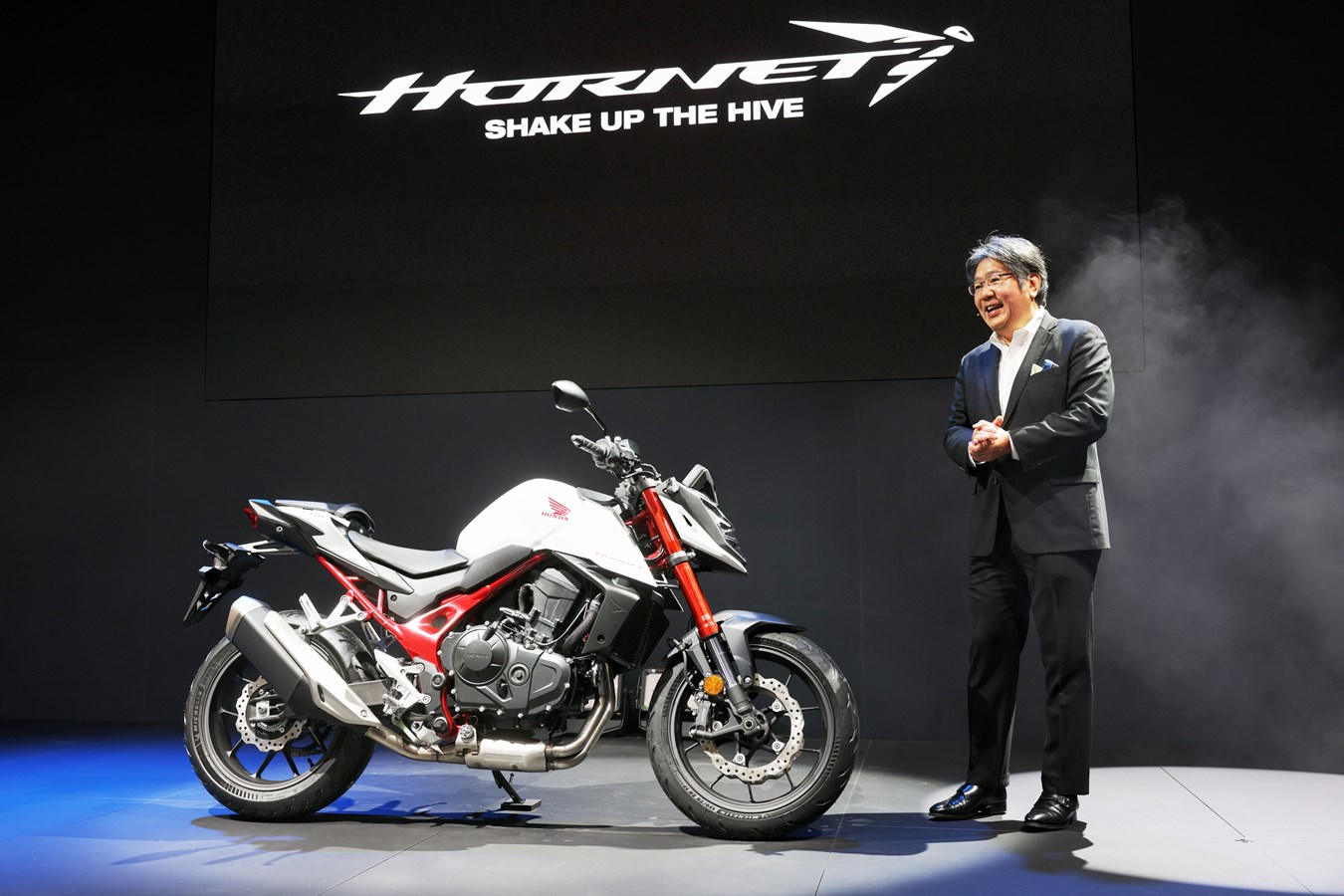
The new CB750 Hornet lands at Intermot
- New CB750 Hornet unveiled at the Intermot Motorcycle Fair in Cologne
- Thrills guaranteed on every ride thanks to class-leading power to weight ratio
- Brand-new 755cc parallel twin-cylinder engine packs maximum power of 67.5kW and torque of 75Nm
- Super-lightweight steel diamond frame also all new
- Sharp streetfighter styling led by Honda R&D design team in Rome
- Four riding modes allow choice of Power, Engine Brake and HSTC levels
- Rich specification list and three ready-to-go accessory packs
Today at Intermot in Cologne, Germany, Honda has unveiled the much-anticipated brand new CB750 Hornet, marking the return to its line-up of one of motorcycling’s most evocative model names.
Fast, agile and fun, the Hornet will guarantee enjoyment in any riding situation thanks to a class-leading power to weight ratio combined with the balance, stability and agile handling for which Honda has long been renowned.
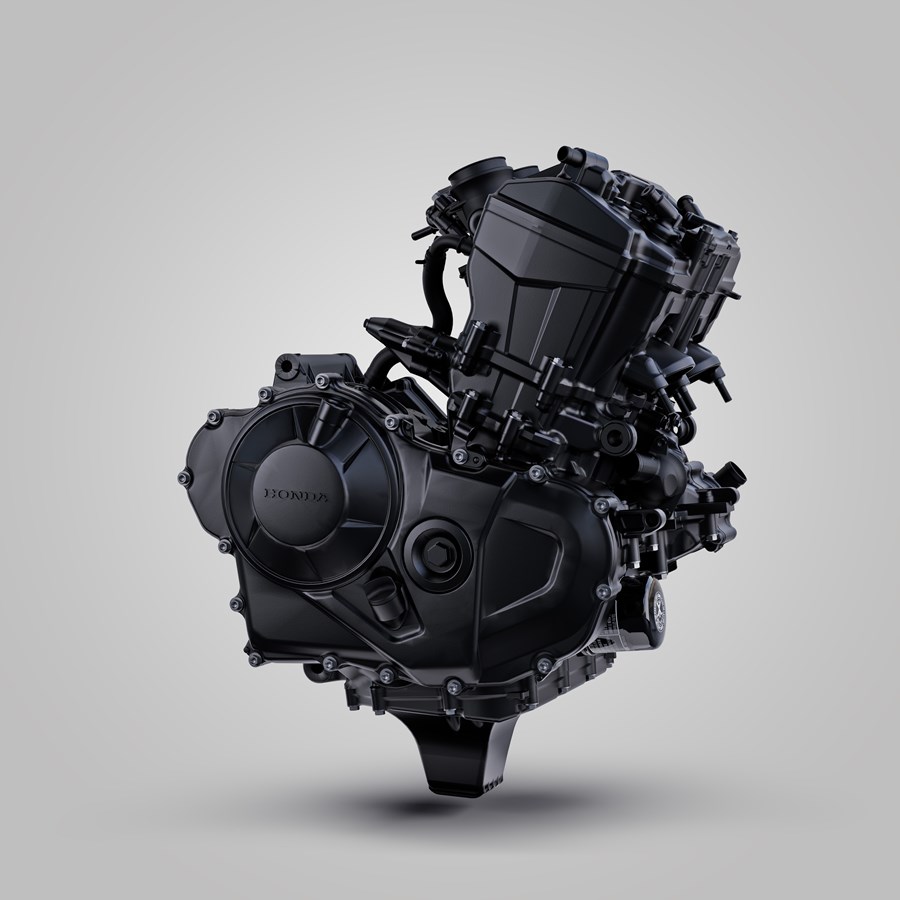
The all-new, compact and lightweight parallel twin-cylinder 755cc engine packs a great deal of Honda engineering prowess into a small space. The traditional top end Hornet ‘sting’ lives on, with peak power of 67.5kW arriving at 9,500rpm. It’s now coupled with hard-hitting torque throughout the rev range (peaking at 75Nm at 7,250pm) to provide the kind of low to mid-range usability that delivers joyful acceleration across a full range of riding situations.
The new engine is replete with Honda’s engineering knowhow. The 270° crank and uneven firing order creates a ‘V-twin-like’ pulse feeling for maximum character and – in tandem with the bespoke exhaust – an engaging soundtrack; patented Vortex Flow Ducts evenly distribute airflow into the airbox to deliver razor sharp throttle response and pick-up; the twin cylinders benefit from a Nickel-Silicon Carbide coating inherited from the CBR1000RR-R Fireblade; intelligent packaging and the 8-valve Unicam head layout deliver all this in an ultra-compact unit.
Cradling the new engine is a brand-new lightweight steel-diamond frame weighing a mere 16.6kg and tuned to give full expression to the new engine’s performance. The agility and feedback is aided by Showa 41mm Separate Function Fork Big Piston (SFF-BPTM) USD forks clamped to the new top and bottom yokes. Also maximising the fun factor is a rear shock with adjustable pre-load operating via Pro-Link together with a new steel swingarm.
Riding enjoyment, practicality and pride of ownership are enhanced with a rich specification list, headlined by a 5-inch TFT colour display which vividly supplies all the crucial information and allows management of all systems. Connectivity is available in the form of Honda Smartphone Voice Control system for both Android and (for the first time) IOS devices. All lighting is LED; the indicators auto-cancel and also include Emergency Stop System for increased rider safety.
The new Hornet also features 3 default riding modes featuring pre-set combinations of Engine Power, Engine Brake and Honda Selectable Torque Control with integrated Wheelie Control. A fourth ‘User’ mode allows the rider to select their preferred combination to match conditions and riding style.
With styling led by Honda’s R&D Centre in Rome – also chiefly responsible for hit products like the Africa Twin, X-ADV and Neo Sports Café naked series – the new Hornet is a sharp, contemporary expression of technical beauty with the silhouette, lines and shaping in compact, aggressive proportion. The sharply chiselled fuel tank, which takes inspiration from the shape of a hornet’s wing, is a signature feature. From the aggressively angled nose-fairing front to the razor-sharp, minimal tail, there are hallmarks of tension and aggression throughout that underline the Hornet’s sporting intent.
A full range of official accessories will be available for the CB750 Hornet, including three packs – Sport, Style and Touring – to suit any rider’s intentions. It will be available in four colours: Pearl Glare White, Graphite Black (which both feature a classy Metallic Red Flame frame and anodised Red forks), Matte Iridium Gray Metallic and Mat Goldfinch Yellow.
The Hornet name is well and truly back, in a package that is sure to open another exciting chapter in its illustrious history.
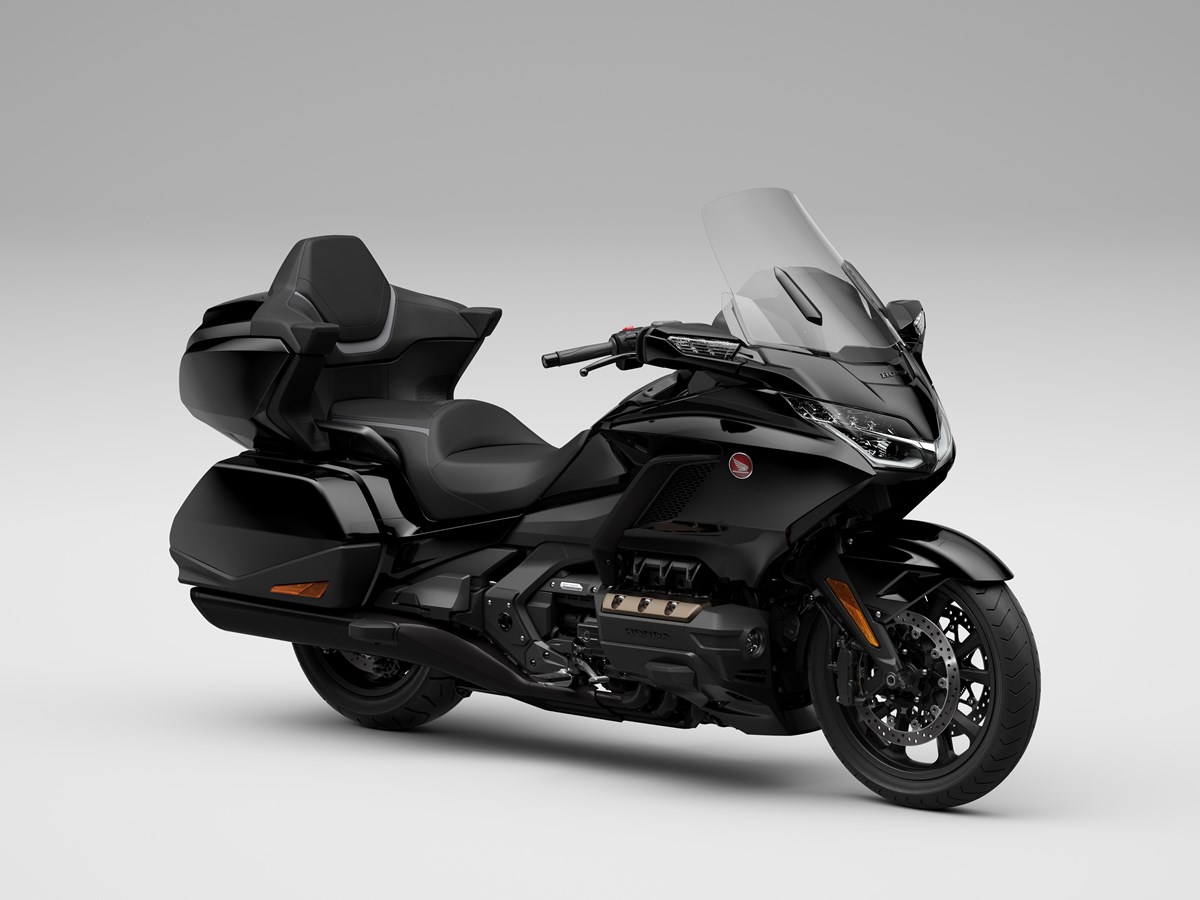
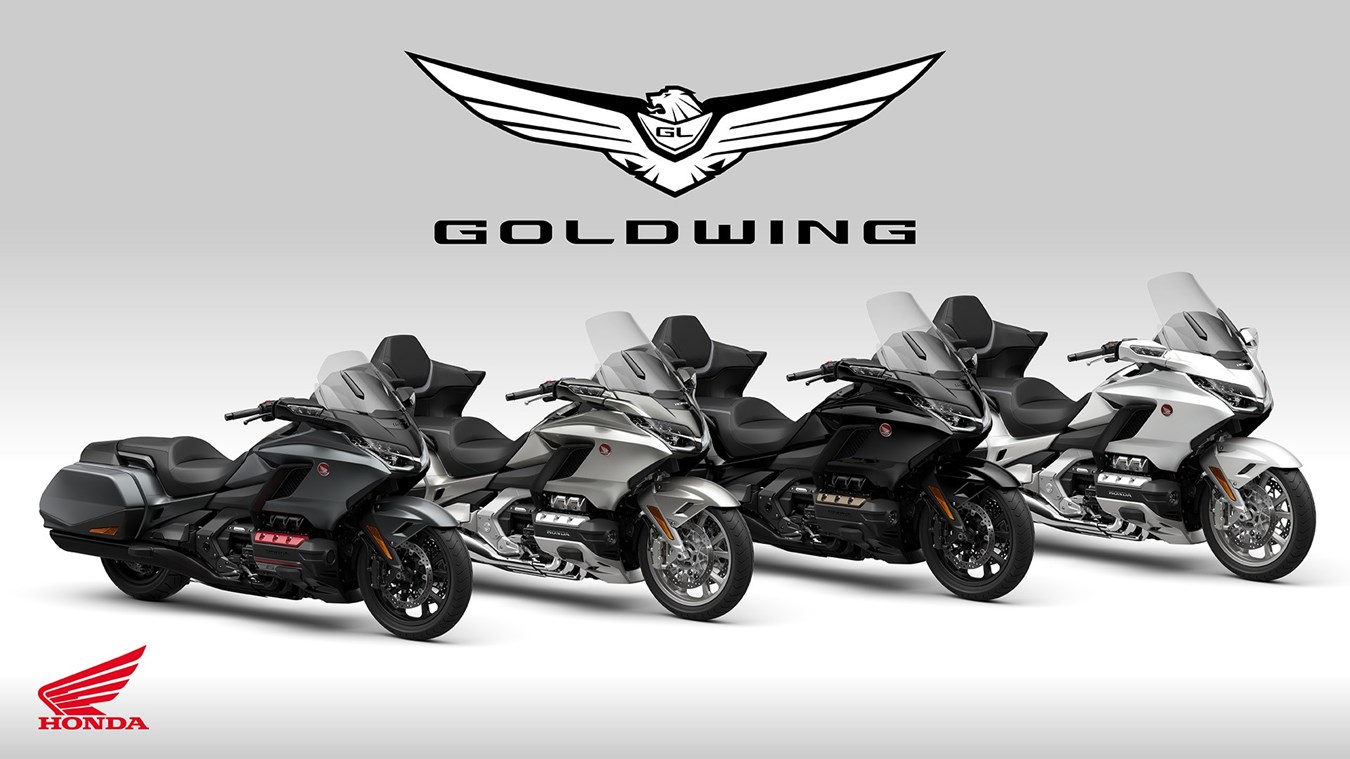
23YM HONDA GOLD WING TOUR
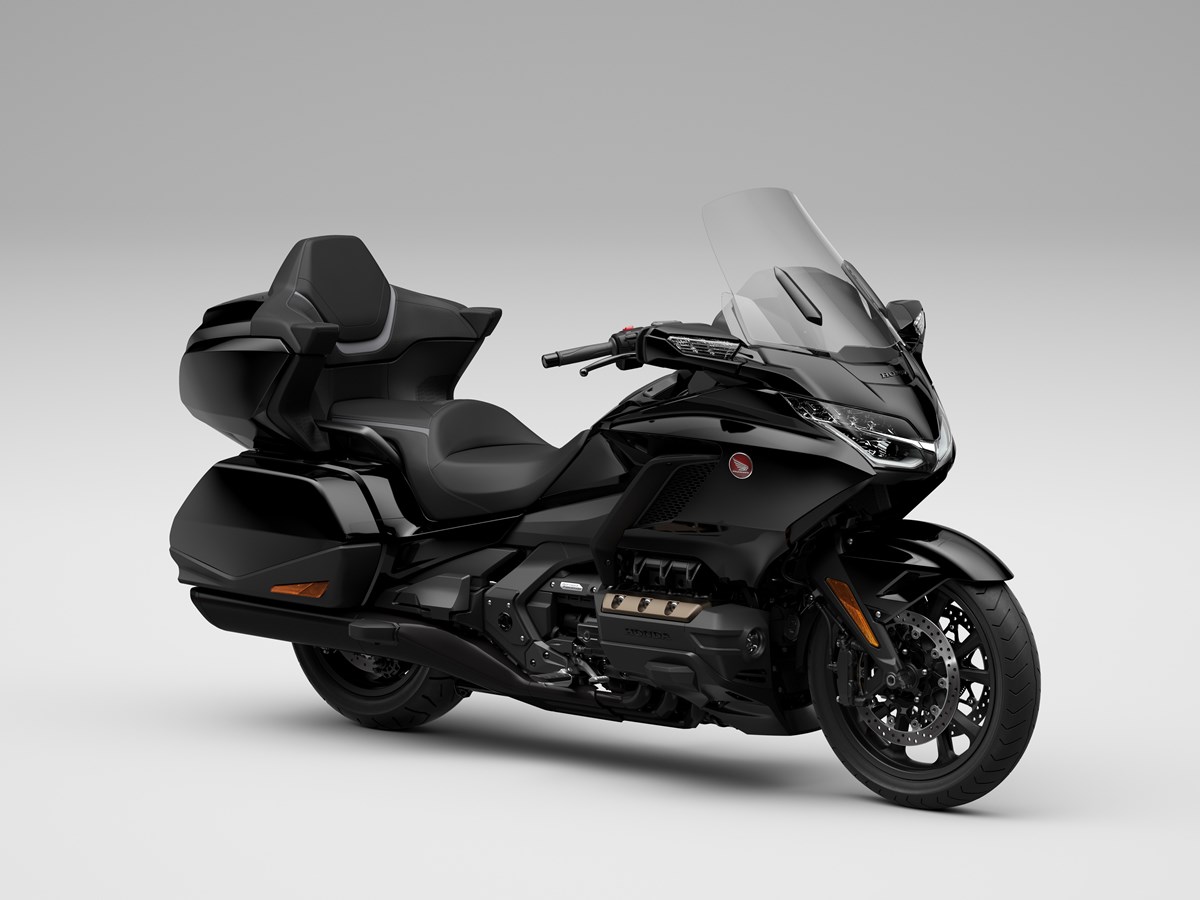
Model updates: Honda’s luxurious Gold Wing Tour – a flagship completely reborn in 18YM – with radical weight reduction, double wishbone front suspension, brand-new, flat six-cylinder engine, glides into 23YM essentially unchanged but wearing three beautiful new paint options. The comprehensive spec. sheet includes 6-speed manual or 7-speed DCT, 7-inch TFT screen, gyrocompass navigation, Apple CarPlay™, Android Auto™, electric screen, Smart Key operation, 4 riding modes, HSTC and Hill Start Assist – underlining its status as a flagbearer for new technology.
For 23YM a new Tyre Pressure Monitoring System (TPMS) warns of sub-optimal pressures and the GL1800 Gold Wing Tour will be available in two new colour combinations.
Contents:
1 Introduction
2 Model overview
3 Key features
4 Accessories
5 Technical specifications
- Introduction
The Honda Gold Wing, since its introduction as a naked 1000cc machine in 1975 has always represented the ultimate in two-wheeled travel. And it’s a motorcycle that’s been very much on its own journey, growing in physical size and displacement over the decades, all the while creating an enduring and unrivalled reputation for luxury, quality and comfort.
For 18YM, in response to the evolution of demographics and the motorcycle market, it made a radical departure from what would have been a traditional update trajectory. The GL1800 Gold Wing* and Gold Wing ‘Tour’ took a new direction and, brand new from the wheels-up, became sleeker, lighter and more agile – very much a rider’s motorcycle – while adding a host of new features to cement the bike’s reputation as a technological flagship, including the option of 7-speed Dual Clutch Transmission (DCT).
And, as a result, the Gold Wing Tour’s appeal became instantly broader, reaching out to a younger generation of motorcyclists that may have overlooked – or simply not been aware of – the previous incarnation. In 20YM, standard-fit LED fog lights, larger pillion grab handles plus improvements to suspension and slow speed manoeuvrability further complemented the evocative, flat six-cylinder engine beating at the heart of Honda’s premium tourer.
For 21YM, the Gold Wing Tour gained carrying capacity, improved pillion comfort and an audio upgrade. Every new model year brings fresh paint choices and 23YM is no exception, with two new colour combinations further cementing its standalone desirability.
*See separate Gold Wing press kit.
2. Model Overview
The Gold Wing Tour’s engine and chassis were designed in unison for the 18YM rebirth, to move the riding position forward and create a much more compact motorcycle. The aluminium beam frame is constructed around a double wishbone front fork, which allows the engine to sit forward in the machine – as the front wheel moves up and down in a more vertical plane – while providing high quality suspension control and front-end stability thanks to its stiffness and reduced friction. Suspension damping adjusts electrically.
Optimised for size, the 24V flat six-cylinder engine lost none of its power, avalanche of torque or addictive power delivery. The addition of Throttle By Wire (TBW) control brought with it 4 rider modes: TOUR, SPORT, ECON and RAIN; the operation of the Dual Combined Brake System (D-CBS) alters depending on the mode selected. Hill Start Assist (HSA) and Idling Stop (on the DCT option) offer ease of use and improved fuel efficiency. Honda Selectable Torque Control (HSTC) maintains rear wheel traction.
The manual transmission is 6-speed, while DCT features 7-speeds, with clutch feel, shift speed and rpm range of up/downshifts tailored specifically to each riding mode. It also features a ‘creep’ forward and back function. The manual machine employs the same electric reverse system as featured on previous designs.
The Gold Wing Tour offers a total sense of freedom, with sheer riding enjoyment and performance matched by stylish design. An aerodynamically efficient fairing channels air around the rider, while the extended electric screen adjusts for preference; the seats, too provide all-day comfort and feature a suede/synthetic leather cover. The angle of the pillion back rest is also relaxed. High quality speakers show off vivid sound quality and features like Smart Key operation, Apple CarPlay™, Android Auto™ and Bluetooth™ add modern-day convenience and connectivity. New for 23YM a Tyre Pressure Monitoring System (TPMS) now provides a low-pressure warning quickly and clearly.
The 23YM GL1800 Gold Wing Tour (DCT and airbag option) is available in the following colour options:
Graphite Black with brown engine cover **NEW**
Beta Silver Metallic/Iridium Gray Metallic **NEW**
Pearl Glare White
The 23YM GL1800 Gold Wing Tour (manual gearbox option) is available exclusively in a
**NEW** Graphite Black colour, with brown engine cover.
3. Key Features
3.1 Styling & Equipment
- 7-inch TFT display provides riding, navigation, audio information featuring the new Tyre Pressure Monitoring System (TPMS)
- Taut lines with a contemporary edge show off the motorcycle underneath
- Ample luggage capacity for weekend touring; top box features 61L storage
- Suede/synthetic leather seats, relaxed pillion back rest angle
- High audio quality
- Electric windscreen adjustable for angle and height
- Cruise control operates smoothly via Throttle By Wire (TBW)
- Apple CarPlay™ and Android Auto™ allow smartphone use
- Full LED lighting, LED fog lights and auto-cancelling indicators
- Smart Key control adds convenience for ignition and luggage
- Two USB Type-C sockets
The Gold Wing Tour’s lines exude a honed, athletic ethos. The styling presents a unique silhouette and counterpoints comfort with the dynamic abilities of chassis and engine, with the traditional Gold Wing premium level of fit, finish and materials. Its ‘face’ is daringly forward-slanting; combined with the compact fairing proportions, it presents an energetic frontal signature.
The key line of the body, stretching front to back, highlights the differing upper and lower bodywork functions. A central element is the fairing, with its sharp and solid flat surfaces, and its nuanced aerodynamic detailing. It adds a tension that hints at the performance potential on offer.
Also on display is the motorcycle itself – the double wishbone front suspension, flat six-cylinder engine, exhausts – in all their functional beauty. Drawn together, the design elements create cutting edge style, underpinned by incredible levels of engineering and electronics
Comfort, heat management and, most importantly, air management are also high on the Gold Wing Tour’s agenda. The fairing channels airflow around the rider and pillion, effectively providing a pleasant cooling breeze.
An extended electric screen operated from the left handlebar provides excellent wind protection yet, at the same time, a sense of space and freedom when required. Screen angle and height adjustment is step-less. Available as options are a larger screen, a fully adjustable deflector for the arms and upper body and fixed deflectors for the lower legs and feet.
From a seating perspective, rider and pillion are separated. The rider can enjoy a total focus on riding the bike. The rider’s seat shape is comfortable and supportive while allowing movement and easy ground reach. Both rider and pillion benefit from a luxurious new suede/synthetic leather seat cover; the angle of the pillion back rest is set at a relaxed 23°.
All lighting is LED, and the Gold Wing Tour is equipped with dual LED fog lights. The lower portion of the headlights use 5 polished optical lenses on both sides to create a Jewel-Eye low beam light signature. Using high beam (in the upper portion) creates a stereoscopic impression. The front indicators are housed in the mirrors and the indicators also auto-cancel; the system compares front and rear wheel speed difference and calculates when to cancel the indication relative to the riding situation.
When riding, the speed that’s been set with the cruise control switch (located on the right handlebar) is shown in the bottom left area of the speedometer. Through TBW the system achieves a smooth transition to the specified speed and an ultra-smooth operation, especially when going uphill. In the case of the manual transmission models, squeezing the clutch or brake, or twisting the throttle cancels cruise control.
For the DCT variant (in AT mode) after completing the deceleration with the cruise control system in operation – and resuming the previous speed – the Gold Wing returns to the pre-set with an appropriate shifting schedule.
Luxurious instrumentation creates a unique cockpit. Different low-contrast colours with dark tones are applied to the dials, of which the peripheral areas form cone-shaped slopes to create a feeling of depth. A ring with a metal texture surrounds each dial, and the graduations glow in LED, giving concrete depth and a calm, cool image.
The 7-inch full-colour TFT liquid crystal display screen provides all the information for the audio and navigation systems, as well as managing riding modes and suspension adjustment. Information is displayed in differentiated segments in a very functional order, so the rider can get all the relevant data with the minimum of eye movement.
Brightness adjusts automatically (with the maximum luminous intensity of the screen being 1000 cd) and the rider can also choose from 8 brightness levels. Tyre pressure is displayed as a numerical figure in the bottom left area of the instruments and, new for 23YM, the Tyre Pressure Monitoring System (TPMS) warns the rider quickly and clearly if tyre pressures becomes sub-optimal.
Pride of place – on the centre console and Smart Key – is the Gold Wing emblem. Its crisp 3D, two-tone chrome design merges the strength and dignity of a lion’s head with the majestic wings of an eagle ready to pounce with open talons. It activates all the motorcycle’s systems and also incorporates the emergency key. The ignition and handlebar lock can be turned on or off while just carrying the Smart Key.
Total carrying capacity is 121L. Exclusively designed inner bags are available as an option. Luggage operation is simple. With the Smart Key present, a push button opens all of the boxes. It’s also possible to temporarily unlock via remote control; the unlock button on the Smart Key enables the passenger instant pannier access. Hydraulic dampers smooth the opening and closing. Pushing and holding the call button results in the indicators flashing.
The Gold Wing Tour is compatible with Apple CarPlay™ and Android Auto™, so the rider can utilise the personalised information and content inside their smartphone, such as telephone numbers and music playlists. Bluetooth connectivity has been adopted and there are two USB Type-C sockets to plug in to.
Lightweight speakers achieve superb sound quality with vivid presence. A passenger audio control switch is available to ensure an even more pleasant riding experience; the switches are located on the upper part of the right pannier and adjusting the volume, switching the source and fast forwarding is possible.
The navigation system is displayed on the 7-inch, full-colour TFT liquid crystal display screen in the central area of the instruments and includes a gyrocompass – which means guidance is continued even inside a tunnel. Cancellation of any waypoint or ‘go home’ instruction operation while riding is also possible. Maps are updated and also offer the possibility of entering up to 99 different waypoints for detailed journey planning.
The capacity of the fuel tank is 21 litres with fuel economy of 5.5litres/100km.
3.2 Chassis
- Diecast, aluminium twin-beam frame
- Double wishbone front suspension and Pro-Arm rear
- Front and rear damping level adjusts to suit riding mode selected
- Rear spring preload electrically adjustable
- ABS and Dual-Combined Braking System (D-CBS)
The Gold Wing Tour’s diecast, aluminium twin-beam frame is designed to package the engine in a tight space; its structural thickness is optimised in each area to deliver a smooth and stable ride, from walking speed upwards, whether on tight city streets or out on the open road.
Aside from moving the front wheel forward under full suspension compression, another benefit of the double wishbone front suspension is the reduction in sliding friction (from bump deflection and steering input) that a standard telescopic fork creates, as the stanchions travel up and down in the fork leg. Bearings are used in all shaft bush areas for steering and suspension stroke, further reducing friction.
The steering input – via the dual fork holders – is also separated from the suspension provided by the single shock absorber, and the Gold Wing Tour’s yaw moment make it nimble and easier to steer. In addition, patented steering cross tie-rods connect the handlebars to the front axle and the handlebar pivot, delivering an entirely natural feel to the rider.
Rake and trail are set at 30.5°/109mm, with wheelbase of 1695mm. The manual Gold Wing Tour weighs 385kg wet; the DCT version 390kg.
The Dual Combined Brake System (D-CBS) optimally distributes braking forces to the front and rear wheels. The use of a single, light circulation type ABS modulator – integrated with the brake ECU – keeps weight down within the braking system. It also operates in linkage with the current riding mode of choice, automatically adjusting the braking characteristics to the riding situation. Dual 320mm front discs are gripped by 6-piston calipers, the rear 316mm disc by a 3-piston caliper.
The Gold Wing Tour also benefits from a Pro-Arm swingarm, which attaches to the frame on its left side. The right side serves as a maintenance access. This allows much greater freedom of design and makes the machine easier to manage; it also contributes to stability. Pro-Link provides progressive suspension action and comfort while spherical joints are used throughout, cancelling out torsion.
Damping level adjusts electrically relative to riding mode. Stepper motors housed within the front and rear shock absorbers move needles to control oil flow, tailoring damping force for the riding situation. Rear spring preload is also electrically adjusted. Separate from the 4 riding modes, there are 4 settings of preload relative to load from soft to hard: single rider; rider with luggage; rider with pillion, and rider with pillion fully loaded with luggage. The setting is displayed on the TFT screen and adjusted via switch.
3.3 Engine
- Horizontally opposed, flat six-cylinder SOHC 24-valve engine
- Throttle By Wire (TBW) with 4 rider modes to tailor power output
- Honda Selectable Torque Control (HSTC)
- Riding modes also manage HSTC, suspension damping and brake force
- Idling Stop and Integrated Starter Generator (ISG) on DCT version
- Hill Start Assist (HSA)
- 6-speed manual gearbox option with assist/slipper clutch and electric reverse
To realise the handling potential of the chassis – and maintain the addictive power delivery and feel that’s so much part of this icon’s appeal – the Gold Wing Tour’s 1,833cc engine was completely redrawn for its rebirth back in 2018. Still as a horizontally opposed flat six, but with four valves per cylinder rather than two, much more compact in size and 6.2kg lighter.
Peak power of 93kW arrives @ 5,500rpm, with peak torque of 170Nm delivered @ 4,500rpm. The bore size of 73mm matches the stroke of 73mm; the left and right cylinders are offset 4mm and the cylinder sleeves are aluminium. Compression ratio is set at 10.5:1.
The Unicam cylinder heads – the inlet valves are operated by finger-follower rocker arm, the exhaust valves by roller rocker arms – also employ a co-axial rocker-arm shaft for both inlet and exhaust.
The combustion chambers are a 4-valve ‘pentroof’ design with the inlet ports designed to promote ‘tumble’ flows inside the cylinders thus improving efficiency. The piston skirts wear a molybdenum coating to reduce friction. Throttle By Wire (TBW) engine management adds 4 rider modes to alter character and power delivery, linked to suspension damping and the Dual Combined Brake System (D-CBS):
TOUR mode is the base setting for comfort and power. It gives a direct 100% opening ratio between throttle grip and throttle body butterfly, with ‘default’ damping and front/rear brake force distribution.
SPORT serves up the highest throttle to butterfly ratio and delivers strong acceleration, with firmer damping and rear brake lever pressure.
ECON mode offers maximum fuel economy and easy cruising, with lower throttle to butterfly ratio and default damping and brake force.
RAIN turns the dial down to suit wet and slippery conditions, with lowest throttle to butterfly ratio, default braking force distribution and soft suspension damping.
Honda Selectable Torque Control (HSTC) also seamlessly monitors and maintains rear wheel traction, in all riding conditions, for an extra layer of riding confidence. Its level of input too adjusts via TBW relative to riding mode selection.
There are two air intake ducts sited front left and right rear. This structure generates swirling as the air is drawn in – the result is more effective use of the air filter’s entire surface area and reduction in resistance. The internal shaping of both ducts is optimised to align with the intake pulses of the engine’s low-rpm range, improving response and torque from smaller throttle openings. A single throttle body speeds up airflow and improves response.
To complement the engine’s deep bass signature the exhausts emit a powerful throb, without excessive noise. The cross-sectional areas of the exhaust pipes for two out of the six cylinders are reduced 20%, bringing the sound volume and depth.
The ISG (Integrated Starter Generator) combines the generator and starter motor into one component, with the generator effectively becoming the starter motor when supplied with reverse power. Its 2.4 kg lighter than a standard system. Helical gears are employed for the ISG driving gears, reducing mechanical noise.
Key characteristics of Idling Stop (on the DCT option) are the ultra-quiet start-up of the engine thanks to the use of ISG, and the smooth starting feeling achieved through a combination of DCT and TBW control. When stopping at a traffic light with Idling Stop on, the engine automatically stops after 3 seconds and, when restarting, the rider only needs to turn the throttle, which immediately starts the engine.
The system is controlled so that hydraulic oil pressure is applied in advance to the DCT line that activates the clutch when the engine starts, so the time lag from when the rider opens the throttle to movement is reduced. To curb any abruptness the TBW makes the throttle butterfly open gradually following the throttle opening – thus the smooth acceleration befitting of a Gold Wing Tour. Idling Stop can be turned ON or OFF from the right handlebar switch.
Hill starts on a conventional motorcycle often involve simultaneously releasing the brakes, opening the throttle and engaging the clutch according to the grade of the slope. To ease this effort, the Gold Wing Tour has Hill Start Assist (HSA) on both Manual and DCT versions.
After stopping on a slope, further squeezing the brake lever quickly results in the ABS modulator generating hydraulic pressure for the rear brake caliper. When setting off – even when the brake lever is released – the hydraulic pressure temporarily retains braking force (for about 3 seconds) so starting on the uphill slope with the throttle is possible. When in operation, the HSA indicator is switched on to inform the rider.
The 6-speed manual gearbox is also fitted with a ‘cam damper’ between the clutch and transmission, separating each inertial mass, reducing noise and improving shift quality/durability. A cam assist and slipper clutch (with fewer discs and reduced hydraulic friction in the release mechanism) replace the traditional hydraulic assist clutch. This reduces clutch load at the lever by 20% and also smooths downshifts; the slipper mechanism also contributes to the high-quality downshift feel. An electric reverse is a familiar feature from the previous design.
3.4. Dual Clutch Transmission (DCT)
- Third-generation 7-speed DCT
- Smoother and quiet, with fast upshifts and downshifts
- Walking mode allows machine to ‘creep’ forward or back
- The 4 riding modes also manage DCT for optimised response
- Optimised low speed manoeuvrability
First introduced in 2009, Honda’s DCT technology is now in its 14th year of production, and over 200,000 units of DCT-equipped Honda two-wheelers have been sold in Europe. It delivers consistent, seamless gear changes up or down and very quickly becomes second nature in use. It uses two clutches: one for start-up and 1st, 3rd, 5th & 7th the other for 2nd, 4th and 6th, with the mainshaft for each clutch located inside the other for compact packaging.
Each clutch is independently controlled by its own electro-hydraulic circuit. When a gear change occurs, the system pre-selects the target gear using the clutch not currently in use. The first clutch is then electronically disengaged as, simultaneously, the second clutch engages.
The result is a consistent, fast and seamless gear change. Furthermore, as the twin clutches transfer drive from one gear to the next with minimal interruption of the drive to the rear wheel, any gear change shock and pitching of the machine is minimised, making the change feel direct as well as smooth. Extra benefits include durability (as the gears cannot be damaged by missing a gear) impossibility of stalling, low stress urban riding, reduced rider fatigue and increased ability to focus on riding lines, braking and acceleration points.
The DCT system offers two distinct riding approaches – the Automatic settings, with pre-programmed shift patterns which constantly read vehicle speed, gear selected and engine rpm to decide when a shift should occur, and the Manual Transmission setting for gear changes using the paddle-shift style triggers on the left handlebar.
Employing the third generation – and the first to have 7-speeds – the Gold Wing’s DCT is specifically designed for long-distance cruising; it’s also extremely smooth and fast shifting.
It is also optimised for low-speed manoeuvrability, with close ratios reducing shift-shock. In the higher speed range, they are set wider apart to reduce engine rpm. In both speed ranges comfort is improved as shifting up or down is of the highest quality.
Shift noise and shock were addressed throughout the development of the third generation, with noise damper rubbers on both ends of the fork guide and the master arm greatly reducing any impact sound during gear changes.
A spring damper is installed between the clutch and the main shaft in order to absorb the torque in the rotational direction, thus reducing the noise and shock of the contact between the clutch and main shaft when shifting gears.
The Gold Wing’s DCT features a 1.8km/h forward Walking Mode with reverse of 1.2km/h, operated instantly from a +/- switch on the left handlebar.
The main shaft has a double tube structure, with the outer main shaft (connected with the even-number gears) linked to the inner shaft with a chain, by way of the gears on the counter shaft. This structure gives the outer main shaft the role of the reverse idle shaft, which has resulted in a lightweight reverse mechanism with a compact structure – with no need for any reverse idle shaft.
When activating Walking Mode, the two clutches of DCT are utilised to enable moving backward with clutch #1 and moving forward with clutch #2. In this way, moving forward or backward at walking speed is now possible with only clutch control, without any need for gear shifting. Furthermore, the throttle-by-wire system controls speed by minutely controlling the clutch capacity, while maintaining a certain engine speed, assuring controllability with a sense of security in wide-ranging situations.
The 4 riding modes are interleaved with DCT. All share the same engine character, delivery and suspension settings as the MT model but add extra DCT-specific parameters:
TOUR uses the default setting for smooth clutch engagement and gearshifts in AT mode, with a low-to-high rpm range for gear shifts.
SPORT deploys a more direct clutch engagement, with gear shifts programmed in a mid-to-high rev range.
ECON has a soft clutch engagement, with low-to-mid rpm gear hold and default shifting feel.
RAIN also operates a soft clutch, low-to-high rpm gear hold range and slower shifting in AT mode.
4. Accessories
The Honda Goldwing Tour has been complemented with a wide range of premium-feel accessories, available either as a pack or individually.
A Full Option Goldwing Tour pack has been created to further complement the standard equipment and enhance the Gold Wing experience:
- Pannier Inner Bags & Mats
- Trunk Inner Bag, Mat, and Lid Organizer
- Chrome Trunk Rack
- Main Stand
- Passenger Backrest
- High Wind Screen
- 12V Socket
- Led Trunk light, Led Brake Light & Trunk Sub-Harness kit
- Full Size Cover
The following accessories are also available individually.
- Passenger Audio Switch
- Power Amplifier
- Rear Speaker
- Auxiliary Cord
- Wheel Stripes (available in 3 different colours)
- Trunk Removal Kit, Rear Carrier and colour matching bodywork.
- Front Caliper Covers (Available in Chrome / Black)
- Chrome Side Stand
- Passenger Armrests (standard fitment on the DCT version)
- Custom Seat
- Upper and Lower Air Deflectors
- Wider Rider Footpegs
- Rider Backrest
- DCT Foot Shifter (only available on DCT equipped versions)
5. Technical Specifications
|
ENGINE |
|
||||||||||||||||||||||||||||||||||||||||||||||||||||||||||||||||||||||||||||||||||||||||||||||||||||||||||||||||||||||||||||||||||||||||||||||||||||||||||||||||||||||||||||||||||||||||||||||||||||||||||||||||||||||||||||||||||||||||||||||||||||||||||||||||||||||||||||||||||||||||||||||||||||||||||||||||||||||||||||||||||||||||||||||||||||||||||||||||||||||||||||||||||||||||||||||||||||||||||||||||||||||||||||||||||||||||||||||||||||||||||||||||||||||||||||||||||||||||||||||||||||||||||||||||||||||||||||||||||||||||||||||||||||||||||||||||||||||||||||||||||||||||||||||||||||||||||||||||||||||||||||||||||||||||||||||||||||||||||||||||||||||||||||||||||||||||||||||||||||||||||||||||||||||||||||||||||||||||||||||||||||||||||||||||||||||||||||||||||||||||||||||||||||||||||||||||||||||||||||||||||||||||||||||||||||||||||||||||||||||||||||||||||||||||||||||||||||||||||||||||||||||||||||||||||||||||||||||||||||||||||||||||||||||||||||||||||||||||||||||||||||||||||||||||||||||||||||||||||||||
|
Type |
Liquid-cooled 4-stroke 24 valve SOHC flat-6 |
||||||||||||||||||||||||||||||||||||||||||||||||||||||||||||||||||||||||||||||||||||||||||||||||||||||||||||||||||||||||||||||||||||||||||||||||||||||||||||||||||||||||||||||||||||||||||||||||||||||||||||||||||||||||||||||||||||||||||||||||||||||||||||||||||||||||||||||||||||||||||||||||||||||||||||||||||||||||||||||||||||||||||||||||||||||||||||||||||||||||||||||||||||||||||||||||||||||||||||||||||||||||||||||||||||||||||||||||||||||||||||||||||||||||||||||||||||||||||||||||||||||||||||||||||||||||||||||||||||||||||||||||||||||||||||||||||||||||||||||||||||||||||||||||||||||||||||||||||||||||||||||||||||||||||||||||||||||||||||||||||||||||||||||||||||||||||||||||||||||||||||||||||||||||||||||||||||||||||||||||||||||||||||||||||||||||||||||||||||||||||||||||||||||||||||||||||||||||||||||||||||||||||||||||||||||||||||||||||||||||||||||||||||||||||||||||||||||||||||||||||||||||||||||||||||||||||||||||||||||||||||||||||||||||||||||||||||||||||||||||||||||||||||||||||||||||||||||||||||||
|
Displacement |
1,833cc |
||||||||||||||||||||||||||||||||||||||||||||||||||||||||||||||||||||||||||||||||||||||||||||||||||||||||||||||||||||||||||||||||||||||||||||||||||||||||||||||||||||||||||||||||||||||||||||||||||||||||||||||||||||||||||||||||||||||||||||||||||||||||||||||||||||||||||||||||||||||||||||||||||||||||||||||||||||||||||||||||||||||||||||||||||||||||||||||||||||||||||||||||||||||||||||||||||||||||||||||||||||||||||||||||||||||||||||||||||||||||||||||||||||||||||||||||||||||||||||||||||||||||||||||||||||||||||||||||||||||||||||||||||||||||||||||||||||||||||||||||||||||||||||||||||||||||||||||||||||||||||||||||||||||||||||||||||||||||||||||||||||||||||||||||||||||||||||||||||||||||||||||||||||||||||||||||||||||||||||||||||||||||||||||||||||||||||||||||||||||||||||||||||||||||||||||||||||||||||||||||||||||||||||||||||||||||||||||||||||||||||||||||||||||||||||||||||||||||||||||||||||||||||||||||||||||||||||||||||||||||||||||||||||||||||||||||||||||||||||||||||||||||||||||||||||||||||||||||||||||
|
Valves per cylinder |
4 |
||||||||||||||||||||||||||||||||||||||||||||||||||||||||||||||||||||||||||||||||||||||||||||||||||||||||||||||||||||||||||||||||||||||||||||||||||||||||||||||||||||||||||||||||||||||||||||||||||||||||||||||||||||||||||||||||||||||||||||||||||||||||||||||||||||||||||||||||||||||||||||||||||||||||||||||||||||||||||||||||||||||||||||||||||||||||||||||||||||||||||||||||||||||||||||||||||||||||||||||||||||||||||||||||||||||||||||||||||||||||||||||||||||||||||||||||||||||||||||||||||||||||||||||||||||||||||||||||||||||||||||||||||||||||||||||||||||||||||||||||||||||||||||||||||||||||||||||||||||||||||||||||||||||||||||||||||||||||||||||||||||||||||||||||||||||||||||||||||||||||||||||||||||||||||||||||||||||||||||||||||||||||||||||||||||||||||||||||||||||||||||||||||||||||||||||||||||||||||||||||||||||||||||||||||||||||||||||||||||||||||||||||||||||||||||||||||||||||||||||||||||||||||||||||||||||||||||||||||||||||||||||||||||||||||||||||||||||||||||||||||||||||||||||||||||||||||||||||||||||
|
Bore x Stroke |
73mm x 73mm |
||||||||||||||||||||||||||||||||||||||||||||||||||||||||||||||||||||||||||||||||||||||||||||||||||||||||||||||||||||||||||||||||||||||||||||||||||||||||||||||||||||||||||||||||||||||||||||||||||||||||||||||||||||||||||||||||||||||||||||||||||||||||||||||||||||||||||||||||||||||||||||||||||||||||||||||||||||||||||||||||||||||||||||||||||||||||||||||||||||||||||||||||||||||||||||||||||||||||||||||||||||||||||||||||||||||||||||||||||||||||||||||||||||||||||||||||||||||||||||||||||||||||||||||||||||||||||||||||||||||||||||||||||||||||||||||||||||||||||||||||||||||||||||||||||||||||||||||||||||||||||||||||||||||||||||||||||||||||||||||||||||||||||||||||||||||||||||||||||||||||||||||||||||||||||||||||||||||||||||||||||||||||||||||||||||||||||||||||||||||||||||||||||||||||||||||||||||||||||||||||||||||||||||||||||||||||||||||||||||||||||||||||||||||||||||||||||||||||||||||||||||||||||||||||||||||||||||||||||||||||||||||||||||||||||||||||||||||||||||||||||||||||||||||||||||||||||||||||||||||
|
Compression Ratio |
10.5:1 |
||||||||||||||||||||||||||||||||||||||||||||||||||||||||||||||||||||||||||||||||||||||||||||||||||||||||||||||||||||||||||||||||||||||||||||||||||||||||||||||||||||||||||||||||||||||||||||||||||||||||||||||||||||||||||||||||||||||||||||||||||||||||||||||||||||||||||||||||||||||||||||||||||||||||||||||||||||||||||||||||||||||||||||||||||||||||||||||||||||||||||||||||||||||||||||||||||||||||||||||||||||||||||||||||||||||||||||||||||||||||||||||||||||||||||||||||||||||||||||||||||||||||||||||||||||||||||||||||||||||||||||||||||||||||||||||||||||||||||||||||||||||||||||||||||||||||||||||||||||||||||||||||||||||||||||||||||||||||||||||||||||||||||||||||||||||||||||||||||||||||||||||||||||||||||||||||||||||||||||||||||||||||||||||||||||||||||||||||||||||||||||||||||||||||||||||||||||||||||||||||||||||||||||||||||||||||||||||||||||||||||||||||||||||||||||||||||||||||||||||||||||||||||||||||||||||||||||||||||||||||||||||||||||||||||||||||||||||||||||||||||||||||||||||||||||||||||||||||||||||
|
Max. Power Output |
93kW/5,500rpm |
||||||||||||||||||||||||||||||||||||||||||||||||||||||||||||||||||||||||||||||||||||||||||||||||||||||||||||||||||||||||||||||||||||||||||||||||||||||||||||||||||||||||||||||||||||||||||||||||||||||||||||||||||||||||||||||||||||||||||||||||||||||||||||||||||||||||||||||||||||||||||||||||||||||||||||||||||||||||||||||||||||||||||||||||||||||||||||||||||||||||||||||||||||||||||||||||||||||||||||||||||||||||||||||||||||||||||||||||||||||||||||||||||||||||||||||||||||||||||||||||||||||||||||||||||||||||||||||||||||||||||||||||||||||||||||||||||||||||||||||||||||||||||||||||||||||||||||||||||||||||||||||||||||||||||||||||||||||||||||||||||||||||||||||||||||||||||||||||||||||||||||||||||||||||||||||||||||||||||||||||||||||||||||||||||||||||||||||||||||||||||||||||||||||||||||||||||||||||||||||||||||||||||||||||||||||||||||||||||||||||||||||||||||||||||||||||||||||||||||||||||||||||||||||||||||||||||||||||||||||||||||||||||||||||||||||||||||||||||||||||||||||||||||||||||||||||||||||||||||||
|
Max. Torque |
170Nm/4,500rpm |
||||||||||||||||||||||||||||||||||||||||||||||||||||||||||||||||||||||||||||||||||||||||||||||||||||||||||||||||||||||||||||||||||||||||||||||||||||||||||||||||||||||||||||||||||||||||||||||||||||||||||||||||||||||||||||||||||||||||||||||||||||||||||||||||||||||||||||||||||||||||||||||||||||||||||||||||||||||||||||||||||||||||||||||||||||||||||||||||||||||||||||||||||||||||||||||||||||||||||||||||||||||||||||||||||||||||||||||||||||||||||||||||||||||||||||||||||||||||||||||||||||||||||||||||||||||||||||||||||||||||||||||||||||||||||||||||||||||||||||||||||||||||||||||||||||||||||||||||||||||||||||||||||||||||||||||||||||||||||||||||||||||||||||||||||||||||||||||||||||||||||||||||||||||||||||||||||||||||||||||||||||||||||||||||||||||||||||||||||||||||||||||||||||||||||||||||||||||||||||||||||||||||||||||||||||||||||||||||||||||||||||||||||||||||||||||||||||||||||||||||||||||||||||||||||||||||||||||||||||||||||||||||||||||||||||||||||||||||||||||||||||||||||||||||||||||||||||||||||||||
|
Oil Capacity |
4.4 litres (MT) / 5.6 litres (DCT) |
||||||||||||||||||||||||||||||||||||||||||||||||||||||||||||||||||||||||||||||||||||||||||||||||||||||||||||||||||||||||||||||||||||||||||||||||||||||||||||||||||||||||||||||||||||||||||||||||||||||||||||||||||||||||||||||||||||||||||||||||||||||||||||||||||||||||||||||||||||||||||||||||||||||||||||||||||||||||||||||||||||||||||||||||||||||||||||||||||||||||||||||||||||||||||||||||||||||||||||||||||||||||||||||||||||||||||||||||||||||||||||||||||||||||||||||||||||||||||||||||||||||||||||||||||||||||||||||||||||||||||||||||||||||||||||||||||||||||||||||||||||||||||||||||||||||||||||||||||||||||||||||||||||||||||||||||||||||||||||||||||||||||||||||||||||||||||||||||||||||||||||||||||||||||||||||||||||||||||||||||||||||||||||||||||||||||||||||||||||||||||||||||||||||||||||||||||||||||||||||||||||||||||||||||||||||||||||||||||||||||||||||||||||||||||||||||||||||||||||||||||||||||||||||||||||||||||||||||||||||||||||||||||||||||||||||||||||||||||||||||||||||||||||||||||||||||||||||||||||||
|
Noise Level (dB) |
Lwot 76, Lurban 69 |
||||||||||||||||||||||||||||||||||||||||||||||||||||||||||||||||||||||||||||||||||||||||||||||||||||||||||||||||||||||||||||||||||||||||||||||||||||||||||||||||||||||||||||||||||||||||||||||||||||||||||||||||||||||||||||||||||||||||||||||||||||||||||||||||||||||||||||||||||||||||||||||||||||||||||||||||||||||||||||||||||||||||||||||||||||||||||||||||||||||||||||||||||||||||||||||||||||||||||||||||||||||||||||||||||||||||||||||||||||||||||||||||||||||||||||||||||||||||||||||||||||||||||||||||||||||||||||||||||||||||||||||||||||||||||||||||||||||||||||||||||||||||||||||||||||||||||||||||||||||||||||||||||||||||||||||||||||||||||||||||||||||||||||||||||||||||||||||||||||||||||||||||||||||||||||||||||||||||||||||||||||||||||||||||||||||||||||||||||||||||||||||||||||||||||||||||||||||||||||||||||||||||||||||||||||||||||||||||||||||||||||||||||||||||||||||||||||||||||||||||||||||||||||||||||||||||||||||||||||||||||||||||||||||||||||||||||||||||||||||||||||||||||||||||||||||||||||||||||||||
|
CO2 emissions |
127g/km |
||||||||||||||||||||||||||||||||||||||||||||||||||||||||||||||||||||||||||||||||||||||||||||||||||||||||||||||||||||||||||||||||||||||||||||||||||||||||||||||||||||||||||||||||||||||||||||||||||||||||||||||||||||||||||||||||||||||||||||||||||||||||||||||||||||||||||||||||||||||||||||||||||||||||||||||||||||||||||||||||||||||||||||||||||||||||||||||||||||||||||||||||||||||||||||||||||||||||||||||||||||||||||||||||||||||||||||||||||||||||||||||||||||||||||||||||||||||||||||||||||||||||||||||||||||||||||||||||||||||||||||||||||||||||||||||||||||||||||||||||||||||||||||||||||||||||||||||||||||||||||||||||||||||||||||||||||||||||||||||||||||||||||||||||||||||||||||||||||||||||||||||||||||||||||||||||||||||||||||||||||||||||||||||||||||||||||||||||||||||||||||||||||||||||||||||||||||||||||||||||||||||||||||||||||||||||||||||||||||||||||||||||||||||||||||||||||||||||||||||||||||||||||||||||||||||||||||||||||||||||||||||||||||||||||||||||||||||||||||||||||||||||||||||||||||||||||||||||||||||
|
FUEL SYSTEM |
|
||||||||||||||||||||||||||||||||||||||||||||||||||||||||||||||||||||||||||||||||||||||||||||||||||||||||||||||||||||||||||||||||||||||||||||||||||||||||||||||||||||||||||||||||||||||||||||||||||||||||||||||||||||||||||||||||||||||||||||||||||||||||||||||||||||||||||||||||||||||||||||||||||||||||||||||||||||||||||||||||||||||||||||||||||||||||||||||||||||||||||||||||||||||||||||||||||||||||||||||||||||||||||||||||||||||||||||||||||||||||||||||||||||||||||||||||||||||||||||||||||||||||||||||||||||||||||||||||||||||||||||||||||||||||||||||||||||||||||||||||||||||||||||||||||||||||||||||||||||||||||||||||||||||||||||||||||||||||||||||||||||||||||||||||||||||||||||||||||||||||||||||||||||||||||||||||||||||||||||||||||||||||||||||||||||||||||||||||||||||||||||||||||||||||||||||||||||||||||||||||||||||||||||||||||||||||||||||||||||||||||||||||||||||||||||||||||||||||||||||||||||||||||||||||||||||||||||||||||||||||||||||||||||||||||||||||||||||||||||||||||||||||||||||||||||||||||||||||||||||
|
Carburation |
PGM-FI electronic fuel injection |
||||||||||||||||||||||||||||||||||||||||||||||||||||||||||||||||||||||||||||||||||||||||||||||||||||||||||||||||||||||||||||||||||||||||||||||||||||||||||||||||||||||||||||||||||||||||||||||||||||||||||||||||||||||||||||||||||||||||||||||||||||||||||||||||||||||||||||||||||||||||||||||||||||||||||||||||||||||||||||||||||||||||||||||||||||||||||||||||||||||||||||||||||||||||||||||||||||||||||||||||||||||||||||||||||||||||||||||||||||||||||||||||||||||||||||||||||||||||||||||||||||||||||||||||||||||||||||||||||||||||||||||||||||||||||||||||||||||||||||||||||||||||||||||||||||||||||||||||||||||||||||||||||||||||||||||||||||||||||||||||||||||||||||||||||||||||||||||||||||||||||||||||||||||||||||||||||||||||||||||||||||||||||||||||||||||||||||||||||||||||||||||||||||||||||||||||||||||||||||||||||||||||||||||||||||||||||||||||||||||||||||||||||||||||||||||||||||||||||||||||||||||||||||||||||||||||||||||||||||||||||||||||||||||||||||||||||||||||||||||||||||||||||||||||||||||||||||||||||||||
|
Throttle Bore |
50mm |
||||||||||||||||||||||||||||||||||||||||||||||||||||||||||||||||||||||||||||||||||||||||||||||||||||||||||||||||||||||||||||||||||||||||||||||||||||||||||||||||||||||||||||||||||||||||||||||||||||||||||||||||||||||||||||||||||||||||||||||||||||||||||||||||||||||||||||||||||||||||||||||||||||||||||||||||||||||||||||||||||||||||||||||||||||||||||||||||||||||||||||||||||||||||||||||||||||||||||||||||||||||||||||||||||||||||||||||||||||||||||||||||||||||||||||||||||||||||||||||||||||||||||||||||||||||||||||||||||||||||||||||||||||||||||||||||||||||||||||||||||||||||||||||||||||||||||||||||||||||||||||||||||||||||||||||||||||||||||||||||||||||||||||||||||||||||||||||||||||||||||||||||||||||||||||||||||||||||||||||||||||||||||||||||||||||||||||||||||||||||||||||||||||||||||||||||||||||||||||||||||||||||||||||||||||||||||||||||||||||||||||||||||||||||||||||||||||||||||||||||||||||||||||||||||||||||||||||||||||||||||||||||||||||||||||||||||||||||||||||||||||||||||||||||||||||||||||||||||||||
|
Air cleaner |
Viscous, cartridge type paper filter |
||||||||||||||||||||||||||||||||||||||||||||||||||||||||||||||||||||||||||||||||||||||||||||||||||||||||||||||||||||||||||||||||||||||||||||||||||||||||||||||||||||||||||||||||||||||||||||||||||||||||||||||||||||||||||||||||||||||||||||||||||||||||||||||||||||||||||||||||||||||||||||||||||||||||||||||||||||||||||||||||||||||||||||||||||||||||||||||||||||||||||||||||||||||||||||||||||||||||||||||||||||||||||||||||||||||||||||||||||||||||||||||||||||||||||||||||||||||||||||||||||||||||||||||||||||||||||||||||||||||||||||||||||||||||||||||||||||||||||||||||||||||||||||||||||||||||||||||||||||||||||||||||||||||||||||||||||||||||||||||||||||||||||||||||||||||||||||||||||||||||||||||||||||||||||||||||||||||||||||||||||||||||||||||||||||||||||||||||||||||||||||||||||||||||||||||||||||||||||||||||||||||||||||||||||||||||||||||||||||||||||||||||||||||||||||||||||||||||||||||||||||||||||||||||||||||||||||||||||||||||||||||||||||||||||||||||||||||||||||||||||||||||||||||||||||||||||||||||||||||
|
Fuel Tank Capacity |
21.1 litres |
||||||||||||||||||||||||||||||||||||||||||||||||||||||||||||||||||||||||||||||||||||||||||||||||||||||||||||||||||||||||||||||||||||||||||||||||||||||||||||||||||||||||||||||||||||||||||||||||||||||||||||||||||||||||||||||||||||||||||||||||||||||||||||||||||||||||||||||||||||||||||||||||||||||||||||||||||||||||||||||||||||||||||||||||||||||||||||||||||||||||||||||||||||||||||||||||||||||||||||||||||||||||||||||||||||||||||||||||||||||||||||||||||||||||||||||||||||||||||||||||||||||||||||||||||||||||||||||||||||||||||||||||||||||||||||||||||||||||||||||||||||||||||||||||||||||||||||||||||||||||||||||||||||||||||||||||||||||||||||||||||||||||||||||||||||||||||||||||||||||||||||||||||||||||||||||||||||||||||||||||||||||||||||||||||||||||||||||||||||||||||||||||||||||||||||||||||||||||||||||||||||||||||||||||||||||||||||||||||||||||||||||||||||||||||||||||||||||||||||||||||||||||||||||||||||||||||||||||||||||||||||||||||||||||||||||||||||||||||||||||||||||||||||||||||||||||||||||||||||||
|
Fuel Consumption |
5.5 litres/100km |
||||||||||||||||||||||||||||||||||||||||||||||||||||||||||||||||||||||||||||||||||||||||||||||||||||||||||||||||||||||||||||||||||||||||||||||||||||||||||||||||||||||||||||||||||||||||||||||||||||||||||||||||||||||||||||||||||||||||||||||||||||||||||||||||||||||||||||||||||||||||||||||||||||||||||||||||||||||||||||||||||||||||||||||||||||||||||||||||||||||||||||||||||||||||||||||||||||||||||||||||||||||||||||||||||||||||||||||||||||||||||||||||||||||||||||||||||||||||||||||||||||||||||||||||||||||||||||||||||||||||||||||||||||||||||||||||||||||||||||||||||||||||||||||||||||||||||||||||||||||||||||||||||||||||||||||||||||||||||||||||||||||||||||||||||||||||||||||||||||||||||||||||||||||||||||||||||||||||||||||||||||||||||||||||||||||||||||||||||||||||||||||||||||||||||||||||||||||||||||||||||||||||||||||||||||||||||||||||||||||||||||||||||||||||||||||||||||||||||||||||||||||||||||||||||||||||||||||||||||||||||||||||||||||||||||||||||||||||||||||||||||||||||||||||||||||||||||||||||||||
|
ELECTRICAL SYSTEM |
|
||||||||||||||||||||||||||||||||||||||||||||||||||||||||||||||||||||||||||||||||||||||||||||||||||||||||||||||||||||||||||||||||||||||||||||||||||||||||||||||||||||||||||||||||||||||||||||||||||||||||||||||||||||||||||||||||||||||||||||||||||||||||||||||||||||||||||||||||||||||||||||||||||||||||||||||||||||||||||||||||||||||||||||||||||||||||||||||||||||||||||||||||||||||||||||||||||||||||||||||||||||||||||||||||||||||||||||||||||||||||||||||||||||||||||||||||||||||||||||||||||||||||||||||||||||||||||||||||||||||||||||||||||||||||||||||||||||||||||||||||||||||||||||||||||||||||||||||||||||||||||||||||||||||||||||||||||||||||||||||||||||||||||||||||||||||||||||||||||||||||||||||||||||||||||||||||||||||||||||||||||||||||||||||||||||||||||||||||||||||||||||||||||||||||||||||||||||||||||||||||||||||||||||||||||||||||||||||||||||||||||||||||||||||||||||||||||||||||||||||||||||||||||||||||||||||||||||||||||||||||||||||||||||||||||||||||||||||||||||||||||||||||||||||||||||||||||||||||||||||
|
Starter |
Integrated Starter Generator system |
||||||||||||||||||||||||||||||||||||||||||||||||||||||||||||||||||||||||||||||||||||||||||||||||||||||||||||||||||||||||||||||||||||||||||||||||||||||||||||||||||||||||||||||||||||||||||||||||||||||||||||||||||||||||||||||||||||||||||||||||||||||||||||||||||||||||||||||||||||||||||||||||||||||||||||||||||||||||||||||||||||||||||||||||||||||||||||||||||||||||||||||||||||||||||||||||||||||||||||||||||||||||||||||||||||||||||||||||||||||||||||||||||||||||||||||||||||||||||||||||||||||||||||||||||||||||||||||||||||||||||||||||||||||||||||||||||||||||||||||||||||||||||||||||||||||||||||||||||||||||||||||||||||||||||||||||||||||||||||||||||||||||||||||||||||||||||||||||||||||||||||||||||||||||||||||||||||||||||||||||||||||||||||||||||||||||||||||||||||||||||||||||||||||||||||||||||||||||||||||||||||||||||||||||||||||||||||||||||||||||||||||||||||||||||||||||||||||||||||||||||||||||||||||||||||||||||||||||||||||||||||||||||||||||||||||||||||||||||||||||||||||||||||||||||||||||||||||||||||||
|
Battery Capacity |
12V/20AH |
||||||||||||||||||||||||||||||||||||||||||||||||||||||||||||||||||||||||||||||||||||||||||||||||||||||||||||||||||||||||||||||||||||||||||||||||||||||||||||||||||||||||||||||||||||||||||||||||||||||||||||||||||||||||||||||||||||||||||||||||||||||||||||||||||||||||||||||||||||||||||||||||||||||||||||||||||||||||||||||||||||||||||||||||||||||||||||||||||||||||||||||||||||||||||||||||||||||||||||||||||||||||||||||||||||||||||||||||||||||||||||||||||||||||||||||||||||||||||||||||||||||||||||||||||||||||||||||||||||||||||||||||||||||||||||||||||||||||||||||||||||||||||||||||||||||||||||||||||||||||||||||||||||||||||||||||||||||||||||||||||||||||||||||||||||||||||||||||||||||||||||||||||||||||||||||||||||||||||||||||||||||||||||||||||||||||||||||||||||||||||||||||||||||||||||||||||||||||||||||||||||||||||||||||||||||||||||||||||||||||||||||||||||||||||||||||||||||||||||||||||||||||||||||||||||||||||||||||||||||||||||||||||||||||||||||||||||||||||||||||||||||||||||||||||||||||||||||||||||||
|
ACG Power Generation Capacity |
12V/120A |
||||||||||||||||||||||||||||||||||||||||||||||||||||||||||||||||||||||||||||||||||||||||||||||||||||||||||||||||||||||||||||||||||||||||||||||||||||||||||||||||||||||||||||||||||||||||||||||||||||||||||||||||||||||||||||||||||||||||||||||||||||||||||||||||||||||||||||||||||||||||||||||||||||||||||||||||||||||||||||||||||||||||||||||||||||||||||||||||||||||||||||||||||||||||||||||||||||||||||||||||||||||||||||||||||||||||||||||||||||||||||||||||||||||||||||||||||||||||||||||||||||||||||||||||||||||||||||||||||||||||||||||||||||||||||||||||||||||||||||||||||||||||||||||||||||||||||||||||||||||||||||||||||||||||||||||||||||||||||||||||||||||||||||||||||||||||||||||||||||||||||||||||||||||||||||||||||||||||||||||||||||||||||||||||||||||||||||||||||||||||||||||||||||||||||||||||||||||||||||||||||||||||||||||||||||||||||||||||||||||||||||||||||||||||||||||||||||||||||||||||||||||||||||||||||||||||||||||||||||||||||||||||||||||||||||||||||||||||||||||||||||||||||||||||||||||||||||||||||||||
|
DRIVETRAIN |
|
||||||||||||||||||||||||||||||||||||||||||||||||||||||||||||||||||||||||||||||||||||||||||||||||||||||||||||||||||||||||||||||||||||||||||||||||||||||||||||||||||||||||||||||||||||||||||||||||||||||||||||||||||||||||||||||||||||||||||||||||||||||||||||||||||||||||||||||||||||||||||||||||||||||||||||||||||||||||||||||||||||||||||||||||||||||||||||||||||||||||||||||||||||||||||||||||||||||||||||||||||||||||||||||||||||||||||||||||||||||||||||||||||||||||||||||||||||||||||||||||||||||||||||||||||||||||||||||||||||||||||||||||||||||||||||||||||||||||||||||||||||||||||||||||||||||||||||||||||||||||||||||||||||||||||||||||||||||||||||||||||||||||||||||||||||||||||||||||||||||||||||||||||||||||||||||||||||||||||||||||||||||||||||||||||||||||||||||||||||||||||||||||||||||||||||||||||||||||||||||||||||||||||||||||||||||||||||||||||||||||||||||||||||||||||||||||||||||||||||||||||||||||||||||||||||||||||||||||||||||||||||||||||||||||||||||||||||||||||||||||||||||||||||||||||||||||||||||||||||||
|
Clutch Type |
(MT) Hydraulic, wet, multiplate with coil springs, assist slipper cam (DCT) Hydraulic, wet, multiplate with oil pressure |
||||||||||||||||||||||||||||||||||||||||||||||||||||||||||||||||||||||||||||||||||||||||||||||||||||||||||||||||||||||||||||||||||||||||||||||||||||||||||||||||||||||||||||||||||||||||||||||||||||||||||||||||||||||||||||||||||||||||||||||||||||||||||||||||||||||||||||||||||||||||||||||||||||||||||||||||||||||||||||||||||||||||||||||||||||||||||||||||||||||||||||||||||||||||||||||||||||||||||||||||||||||||||||||||||||||||||||||||||||||||||||||||||||||||||||||||||||||||||||||||||||||||||||||||||||||||||||||||||||||||||||||||||||||||||||||||||||||||||||||||||||||||||||||||||||||||||||||||||||||||||||||||||||||||||||||||||||||||||||||||||||||||||||||||||||||||||||||||||||||||||||||||||||||||||||||||||||||||||||||||||||||||||||||||||||||||||||||||||||||||||||||||||||||||||||||||||||||||||||||||||||||||||||||||||||||||||||||||||||||||||||||||||||||||||||||||||||||||||||||||||||||||||||||||||||||||||||||||||||||||||||||||||||||||||||||||||||||||||||||||||||||||||||||||||||||||||||||||||||||
|
ENGINE |
|
|
Type |
Liquid-cooled 4-stroke 24 valve SOHC flat-6 |
|
Displacement |
1,833cc |
|
Valves per cylinder |
4 |
|
Bore x Stroke |
73mm x 73mm |
|
Compression Ratio |
10.5:1 |
|
Max. Power Output |
93kW/5,500rpm |
|
Max. Torque |
170Nm/4,500rpm |
|
Oil Capacity |
5.6 litres (DCT) |
|
Noise Level (dB) |
Lwot 76, Lurban 69 |
|
CO2 emissions |
127g/km |
|
FUEL SYSTEM |
|
|
Carburation |
PGM-FI electronic fuel injection |
|
Throttle Bore |
50mm |
|
Air cleaner |
Viscous, cartridge type paper filter |
|
Fuel Tank Capacity |
21.1 litres |
|
Fuel Consumption |
5.5 litres/100km |
|
ELECTRICAL SYSTEM |
|
|
Starter |
Integrated Starter Generator system |
|
Battery Capacity |
12V/20AH |
|
ACG Power Generation Capacity |
12V/120A |
|
DRIVETRAIN |
|
|
Clutch Type |
(DCT) Hydraulic, wet, multiplate with oil pressure |
|
Transmission Type |
7-speed forward and reverse DCT |
|
Primary Reduction |
1.795 (79/44) |
|
Gear Ratios |
(DCT) 1st: 2.167 2nd: 1.696 3rd: 1.304 4th: 1.038 5th: 0.821 6th: 0.667 7th: 0.522 Rev: 1.190 |
|
Final Reduction |
Engine side 0.972 Rear Wheel side 2.615 |
|
Final Drive |
Enclosed shaft |
|
FRAME |
|
|
Type |
Aluminium die-cast, twin tube |
|
CHASSIS |
|
|
Dimensions (L´W´H) |
L: 2,475mm W: 925mm (DCT) H: 1,340mm |
|
Wheelbase |
1,695mm |
|
Caster Angle |
30.5° |
|
Trail |
109mm |
|
Turning radius |
3.4m |
|
Seat Height |
745mm |
|
Ground Clearance |
130mm |
|
Kerb Weight |
DCT: 367kg
|
|
SUSPENSION |
|
|
Type Front |
Double Wishbone |
|
Type Rear |
Pro Link |
|
WHEELS |
|
|
Type Front |
130/70R 18 |
|
Type Rear |
200/55R 16 |
|
Rim Size Front |
18 x MT3.5 |
|
Rim Size Rear |
16 x MT6.0 |
|
BRAKES |
|
|
System Type |
Electronically-controlled combined ABS system |
|
Type Front |
320mm x 4.5mm dual hydraulic disc with 6-piston calliper, floating rotors and sintered metal pads |
|
Type Rear |
316mm x 11mm ventilated disc with 3-piston calliper and sintered metal pads |
All specifications are provisional and subject to change without notice.
** Please note that the figures provided are results obtained by Honda under standardised testing conditions prescribed by WMTC. Tests are conducted on a rolling road using a standard version of the vehicle with only one rider and no additional optional equipment. Actual fuel consumption may vary depending on how you ride, how you maintain your vehicle, weather, road conditions, tire pressure, installation of accessories, cargo, rider and passenger weight, and other factors.
New 23YM colours for CB1000R, CMX500 Rebel and Monkey

- The CB1000R Black Edition is now also available in Mat Jeans Blue Metallic
- New Bordeaux Red Metallic for CB1000R itself
- The CMX500 Rebel line-up features a new Titanium Metallic ‘S’ Edition and three new colours
- New colours for the Monkey pay homage to the classic original of the 1960s
Three of Honda’s most visually distinctive models receive updates for their 2023 year model iterations. A new CB1000R Black Edition joins the Neo Sports Café family line up; the CMX500 Rebel, Europe’s most popular model in the custom category for the last two years, receives a complete new range of contemporary colours and the ‘S’ Edition is available in a new dynamic colour. The delightful Monkey receives colour updates that pay homage to the classic designs of the 1960s.
A new Mat Jeans Blue Metallic CB1000R ‘Black Edition’ joins the existing Black Edition version at the head of Honda’s Neo Sports Café family. Both colours feature a new silver accent on the tank to match the carefully selected machined aluminium details on the wheel spokes, swingarm plates, engine covers and handlebar clamps. The sleek and aggressive final look is completed with the colour matched pillion seat cover. The standard CB1000R also features a new look for 2023, available in a classy new Bordeaux Red Metallic paint scheme.
The CMX500 Rebel, Honda’s A2 licence-friendly 500cc parallel twin-cylinder compact cruiser, has been Europe’s best-selling model in the custom category for two years. Accessible, easy to ride and easy to live with, the Rebel features an attractive standard specification that includes assist/slipper clutch, LED lighting and gear position indicator.
For 2023 the CMX500 Rebel receives three brand new contemporary paint options: Mat Gunpowder Black Metallic, Pearl Smoky Gray and Candy Diesel Red. The CMX500 Rebel ‘S’ version, which features a range of practical and attractive factory-fitted accessories including a headlight cowl, all-black fork covers and gaiters plus diamond-stitch style seat, is now available in dynamic new Titanium Metallic.
The Honda Monkey has been continuing to cheer up roads across Europe since its reintroduction last year. For 2023 the Monkey will be available in new Pearl Shining Black and updated Banana Yellow and Pearl Nebula Red. All three feature colour-matched frame, forks, swingarm and rear suspension, plus tartan seat cover and stylish tank infills that reference the classic Monkey style from the late 1960s.
23YM HONDA CB1000R
Model updates: The flagship of Honda’s Neo Sports Café shows off a sleekly aggressive stance highlighting the unique motorcycling proposition it represents. Its four-cylinder engine delivers a smooth rush of torque and is matched to a sharp-handling chassis with spec. that includes full Showa suspension and four-piston, radial-mount front brakes. The colour TFT instrument display connects the rider to their smartphone via Honda Smartphone Voice Control system, and there’s a USB charging socket under the seat. Alongside the standard CB1000R, the Black Edition is exactly that: accessorised with fly screen, pillion seat cover and quickshifter it is as blacked-out as a motorcycle can be – now wearing just the hint of a silver tank accent stripe – with just the merest hint of aluminium on show.
For 23YM the CB1000R will be available in new Bordeaux Red Metallic. The Black Edition will now also be available in new Mat Jeans Blue Metallic.
Contents:
1 Introduction
2 Model overview
3 Key features
4 Accessories
5 Technical specifications
- Introduction
Motorcycling has seen many shifts in riders’ expectations of their bikes – what they do, how they look and how they make them feel – over the last decade. And Honda has never been afraid to apply its technology, engineering and ‘what if…?’ imagination to create motorcycles that inhabit new spaces in the marketplace.
The CB1000R is one such bike. Introduced through a major model change in 2018, Honda’s development engineers re-assessed the hard-core streetfighter underpinnings of the previous model and, steered by retro-industrial minimalism, stripped everything back. The resulting machine, born under the banner of ‘Neo Sports Café’, was a new fusion of sport naked and bare-boned Café Racer inspiration.
It stood out from the crowd by moving away from the standard super sports-derived big naked formula, melding exhilarating function to a form that offered a radically fresh, visually stunning two-wheeled aesthetic. Combining more with less, the reborn CB1000R gave its rider a huge amount of usable engine performance, with the control of a super sports machine.
Exciting to ride, and fully capable of chasing much more focused machinery down on a twisting back road, from whichever way it’s approached – aesthetics, emotions, performance or technology – the CB1000R has proved itself a hard motorcycle to ignore.
Mechanically unchanged for 23YM, two new colours schemes, one for the standard model and one for The Black Edition both of which feature a jet black aluminium rear sub frame, complement the CB1000R’s hard-edged minimalism.
- Model Overview
The CB1000R’s lines are aggressive, forward-set with shrink-wrapped details like the exposed aluminium subframe, radiator shrouds and airbox covers, flowing in holistic, dynamic harmony. The headlight, too, slants back while intricately crafted wheels add to the engineering prowess on display.
For 21YM, the engine received revised PGM-FI settings, smoothing power delivery, and EURO5 compliance. The full colour TFT instrument display offers Honda Smartphone Voice Control System, linking the rider to their smartphone function, and there’s also a USB charging socket under the seat.
The 23YM CB1000R will be available in the following colour option:
Bordeaux Red Metallic **NEW**
The Black Edition
While the CB1000R is a motorcycle hewn into purposeful beauty, the Black Edition goes several steps further. It starts out on the same manufacturing line as the standard CB1000R, then takes a detour into a moodier aesthetic territory and adds some extra, desirable, accessories.
Apart from carefully selected machined aluminium details – on the wheel spokes, swingarm plates, engine covers and handlebar clamps – everything on show is black: the headlight bezel, flyscreen, fork stanchions, radiator shrouds, and airbox covers (with an anodized finish), exhaust and muffler. For 23YM the paint on the fuel tank is adorned with a new silver accent stripe to match the aluminium details – and a colour matched pillion seat cover. A quickshifter, too is standard-fit. A machined ‘CB’ logo adds a finishing touch,
The 23YM CB1000R Black Edition will be available in the following colour options:
Deep Graphite Black
Mat Jeans Blue Metallic **NEW**
- Key Features
3.1 Styling & Equipment
- Aggressive, ‘mass-forward’ stance, with sleek styling front to back and cast aluminium wheels
- Honda Smartphone Voice Control system links the rider to their smartphone via Bluetooth and 5-inch colour TFT screen
- USB charging socket under the seat
- Two new colour options
Honda’s ‘Neo Sports Café’ design aesthetic was created not only with a fondness for the past, but with an eye on the future as well, with ample scope for variations to the theme.
From tip to tail the CB1000R’s flow is harmonious: the instantly recognisable round headlight sits in a teardrop style surround and lays backwards between the forks; the burnished aluminium radiator shrouds are much more compact and angled into the direction of travel, a design cue mirrored by the airbox covers. The sinuous aluminium subframe is finished in jet black for 23YM highlighting the stark minimalism of the rear. And not to miss an aesthetic detail, the number plate mount is as small as it can be.
While it may turn heads and stop traffic with its style, day-to-day practicalities have not been overlooked, and real-world ease-of-use is a key factor in the design. The instruments comprise a 5-inch, full colour high-visibility TFT screen, which offers four types of speed/rpm display – according to rider preference – as well as fuel gauge/consumption, riding mode selection/engine parameters and Shift Up indicator. Management is via the buttons on the left handlebar.
Also incorporated into the interface is the Honda Smartphone Voice Control system, which links the rider to their smartphone while on the move and allows voice management of phone calls, email, music and navigation. A helmet-mounted headset is needed, and the smartphone connects to the dash via Bluetooth; management is also possible using buttons the left switchgear. There’s also a USB socket under the seat, for smartphone charging.
The CB1000R’s indicators also have an Emergency Stop Signal (ESS) function. Under hard braking, the hazard lights flash to warn other road users a hard stop is in process. The indicators also auto-cancel; rather than using a simple timer, the system compares front and rear wheel speed difference and calculates when to cancel the indication relative to the situation.
3.2 Engine
- CBR1000RR derived four-cylinder engine with Throttle By Wire
- PGM-FI set for smooth delivery and response
- Assist/slipper clutch control
The CB1000R’s 998cc DOHC four-cylinder engine provides a healthy dose of both power and torque: 107 kW @ 10,500rpm and 104Nm @ 8,250 pm. Bore and stroke are set at 75mm x 56.5 mm with compression ratio 11.6:1. The redline begins at 11,500rpm and the rev-limiter cuts in at 12,000rpm. PGM-FI settings are optimised for smooth power and crisp response.
This engine is tuned to deliver its torque with a characteristic ‘ramp’ in the 6-8,000rpm range, where it bulges significantly, generating an exciting and engaging riding experience. It’s also a useful aid for rapid roll-on acceleration in real-world overtaking conditions.
The airbox, ducting and air filter present a smooth route for airflow into the engine, reducing pressure loss all the way from the outer ducts; a 44mm diameter throttle body feeds air/fuel mixture into large diameter inlet ports and carefully shaped combustion chambers. Inlet valve lift is set at 8.3mm, exhaust 8.1mm. The pistons are constructed from forged aluminium.
Short gear ratios ensure exhilarating acceleration through the gears between 30-130km/h. The assist/slipper clutch is super-light and helps manage hard, rapid downshifts.
The exhaust adds to the CB1000R’s mid-range muscle and light weight. It’s a 4-2-1 design, feeding via 4 short catalysers into a main chamber, which then feeds a dual chamber muffler. The exhaust note has been tuned internally, meaning that as the revs rise past 5,500rpm it takes on a significantly deeper, more raw tone.
For EURO5 compliance Linear Air Flow (LAF) sensors in the downpipes allow accurate measurement of the spent gases. The engine returns fuel efficiency of 17.1km/L.
3.3 Engine electronics
- Three default rider modes plus USER customisation option
- Three levels of Power, Engine Brake and Honda Selectable Torque Control
Throttle By Wire (TBW) allows the rider maximum control over the CB1000R’s powerful engine via 3 default riding modes plus 1 USER mode, managed between the left handlebar and the TFT screen.
There are 3 levels of Engine Power (P), Engine Brake (EB) and Honda Selectable Torque Control (HSTC) available; HSTC can also be switched off. The riding modes offer different combinations of each parameter.
RAIN mode employs the lowest Power setting for the least aggressive power delivery, medium amount of EB and high HSTC. The lower levels of power and torque delivery are focused on the first 3 gears.
STANDARD mode uses the middle setting for Power, HSTC and EB. It softens the power delivery a little out of first and second gear and uses a power delivery just below that of SPORT mode, with reduced torque at partial throttle openings.
SPORT uses the highest Power delivery and lowest levels of EB and HSTC to deliver 100% performance through all six gears, maximum torque and power at all throttle positions and minor intervention from HSTC.
USER mode allows the rider to choose between the 3 settings for each parameter and save the setting for future use.
3.3 Chassis
- Strong, lightweight mono-backbone steel frame
- Adjustable Showa SFF-BP forks and rear monoshock
- Dual, radial-mount four-piston calipers and 310mm floating front discs
The CB1000R’s chassis employs a mono-backbone steel frame and uses split-tightening aluminium pivot plates to grip the signature 574.2mm single-sided swingarm. Rake is set at 25° with trail of 100mm. Wheelbase is 1455mm with wet weight of 212kg. Weight bias is 48.5%/ 51.5% front/rear.
A ‘natural crouch’ is afforded by the relaxed rider triangle of wide, tapered aluminium handlebars matched to an 830mm seat height. The flangeless fuel tank too, is broad-shouldered, but heavily cut-away to allow plenty of knee room.
The adjustable front fork is a Showa Separate Function Fork Big Piston unit (SFF-BP). It contains all the damping function in one leg, reducing weight, while delivering compliance, comfort and control across a broad range of riding conditions. The Showa rear shock adjusts for spring preload and rebound damping.
Up front, dual radial-mount four-piston front calipers bite 310mm floating discs, matched to a twin-piston caliper and 256mm rear, and 2-channel ABS. The intricately designed cast aluminium seven-spoke wheels exude bold elegance; the rear tyre (sitting on a 6-inch rim) is sized 190/55 ZR17, the front a 120/70 ZR17.
4. Accessories
A full range of Honda Genuine Accessories have been developed to complement the sportiness of the CB1000R and enhancing the practicality and comfort. These are available either in specially developed packs or as single items.
The Design Pack is available for both the standard and Black Editions and includes a range of accessories that complement the visual appeal of the motorcycle and includes:
- Front Fender Panel
- Radiator Grill
- Bar Ends
- Alcantara Main & Pillion Seats
- Meter Visor / Fly Screen (only available for the standard version)
- Rear Seat Cowl (only available for the standard version)
The Sports Pack only available for the Black Edition enhances the performance and protection of the CB1000R and includes:
- Clutch Cover
- Quick Shifter
- Tank Pad
The Plus Pack add daily practicality to the CB1000R by adding the following accessories:
- Grip Heaters
- Luggage Base
The Journey Pack maximises the carrying capacity of the CB1000R and includes all the available luggage accessories
- 3 L Tank Bag & Attachment
- Expandable Rear Seat Bag (15-22L)
The FOP Pack is only available for the standard edition CB1000R and includes:
- Meter Visor / Fly Screen
- Rear Seat Cowl
- Quick Shifter
The following accessories are also available individually:
- Wheel Stripes
- Crankcase Ring
- Indoor Body Cover
5. Technical Specifications
|
ENGINE |
|
|
Type |
Liquid-cooled DOHC In-line 4 cylinder |
|
Valves per cylinder |
4 |
|
Engine Displacement (cm³) |
998cc |
|
Bore and Stroke (mm) |
75mm x 56.5mm |
|
Compression Ratio |
11.6:1 |
|
Max. Power Output |
107kW @ 10,500rpm |
|
Max. Torque |
104Nm @ 8,250rpm |
|
Noise Level (dB) |
Lurban75/Lwot80 |
|
FUEL SYSTEM |
|
|
Carburation |
PGM-FI |
|
Fuel Tank Capacity |
16.2 litres |
|
Fuel Consumption |
17.1km/litre |
|
ELECTRICAL SYSTEM |
|
|
Starter |
Electric |
|
Battery Capacity |
12V/8.6AH |
|
DRIVETRAIN |
|
|
Clutch Type |
Wet, multiplate clutch |
|
Transmission Type |
6-speed |
|
Final Drive |
Chain |
|
FRAME |
|
|
Type |
Steel mono backbone |
|
CHASSIS |
|
|
Dimensions (LxWxH) |
2120mm x 789mm x 1090mm |
|
Wheelbase |
1455mm |
|
Caster Angle |
25° |
|
Trail |
100mm |
|
Seat Height |
830mm |
|
Ground Clearance |
135mm |
|
Kerb Weight |
212kg |
|
SUSPENSION |
|
|
Type Front |
Showa SFF-BP USD fork |
|
Type Rear |
Showa monoshock (axle travel 131mm) |
|
WHEELS |
|
|
Rim Size Front |
Cast aluminium |
|
Rim Size Rear |
Cast aluminium |
|
Tyres Front |
120/70 ZR17 |
|
Tyres Rear |
190/55 ZR17 |
|
BRAKES |
|
|
ABS System Type |
2 channel |
|
Front |
310mm double disc |
|
Rear |
256mm single disc |
|
INSTRUMENTS & ELECTRICS |
|
|
Instruments |
5” TFT screen |
|
Headlight |
LED |
|
Taillight |
LED |
All specifications are provisional and subject to change without notice.
# Please note that the figures provided are results obtained by Honda under standardised testing conditions prescribed by WMTC. Tests are conducted on a rolling road using a standard version of the vehicle with only one rider and no additional optional equipment. Actual fuel consumption may vary depending on how you ride, how you maintain your vehicle, weather, road conditions, tire pressure, installation of accessories, cargo, rider and passenger weight, and other factors.
23YM HONDA MONKEY 125
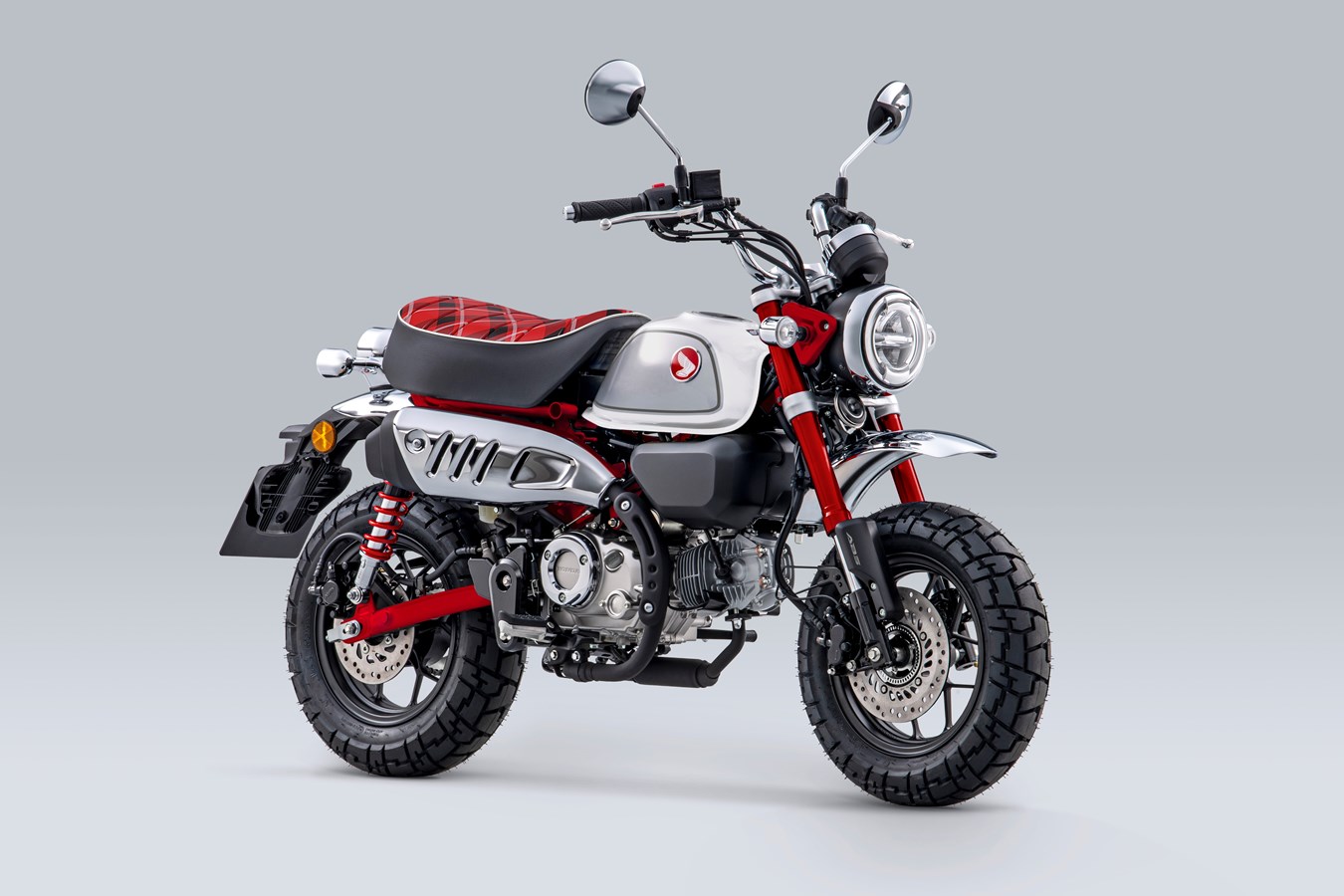
Model updates: Honda’s pocket-sized grin machine is set and ready to cheer up 2023. Specification includes air-cooled 124cc engine, five-speed gearbox, steel frame, USD forks, 12-inch wheels and IMU-controlled ABS braking. Full LED lighting and neat LCD dash are the premium finishing touches.
For 23YM the Monkey will be available in the new Pearl Shining Black and updated Banana Yellow and Pearl Nebula Red that all feature colour-matched frame, forks, swingarm and rear springs, plus the classic tartan seat cover and stylish tank infills that reference the classic Monkey style from the late 1960s
Contents:
1 Introduction
2 Model overview
3 Key features
4 Milestones
5 Technical specifications
- Introduction
The Honda Monkey bike is perhaps most widely known as a groovy icon of the 1970s, but it first saw the light of day in 1961. Originally developed as a 49cc child’s plaything for Tama Tech, an amusement park in Tokyo, it proved so popular that a road-going version was developed, which was initially exported to America and Europe in 1963, with a distinctive chrome tank, folding handlebars and 5-inch diameter rigidly mounted wheels.
Its popularity was based on a cute, instantly-likable design, tiny dimensions and ultra-light weight – which made it a whole load of fun around town. By 1969 its wheels had increased to 8-inch in diameter and from 1970 it gained even greater popularity, when the addition of quick-detach forks meant it would fit into the trunk of a small car.
By 1978 – a point that marked the start of real prime time for the Monkey – the bike had been re-styled with a teardrop style fuel tank and became hugely popular with legions of RV (Recreational Vehicle) drivers in need of convenient transport to use once they were parked up. And this is where and when the cheeky Monkey really cemented its place in millions of hearts; with its 3-speed gearbox and centrifugal clutch (which needed no ‘traditional’ motorcycle skill to operate) it gave thousands of riders their first experience of twisting the throttle on a powered two-wheeler.
Because it was so much fun, and so easy to ride, it did more to sell the concept of motorcycles to a wider public than perhaps any other machine. With its chunky tyres, mini-‘ape’ style handlebars, miniscule fuel tank and big, squashy seat the Monkey look is unmistakably of its time, but – just like the affection in which it is held – also timeless.
And in 2018 the Monkey’s time came around once again. Inspired by the original (but also as a usefully fun 125cc motorcycle fit for the 21st century) a brand-new Monkey cheered up the roads of Europe. For 2022 the Monkey got an engine upgrade, an extra gear for the transmission, suspension refinements and detail improvements, widening its ‘smile’ factor and building-in extra day-to-day usability.
Nothing changes mechanically for 2023 (23YM) but three brand-new, ultra-retro paint options mean that pocket-sized Monkey fun has never looked so good.
2. Model Overview
Drawn from the MSX Grom the Monkey’s two-valve air-cooled engine produces 6.9kW power with 11Nm torque. It’s durable and easy to use while a 5-speed gearbox opens up longer rides. The steel frame, USD forks, twin rear shocks and 12-inch wheels roll smoothly; for extra safety the ABS braking is Inertial Measurement Unit (IMU) controlled.
Then, of course, there’s the inimitable Monkey look, correct from the mini-ape ’bars to upswept exhaust. 23YM sees the Monkey pay proper homage to the 1967 version, with its chequered seat pattern and classic Honda style of the time. This is the first version of the Monkey ever sold in Japan (see 4. Monkey Milestones below).
3. Key Features
3.1 Engine
- 124cc air-cooled engine delivers 6.9kW power and 11Nm torque
- 5-speed gearbox for easy cruising speed
- EURO5 compliance
The Monkey is equipped with an engine designed to ride and have fun on; 124cc, SOHC with 50mm bore, 63.1mm stroke and compression ratio of 10:0:1. It produces peak power of 6.9kW @ 6,750rpm with peak torque of 11Nm @ 5,500rpm.
A correcting plate manages the path of fresh air drawn in and feeds an intake duct inlet and connecting tube designed to smooth airflow. The shape of the airbox also promotes smooth airflow, smooth torque output and flexible drivability. For EURO5 compliance a compact catalyser deals with spent gasses efficiently; the exhaust downpipe length is optimised to the intake side, while the muffler uses a one-chamber design for efficient performance and characterful exhaust note.
The 5-speed gearbox spreads its ratios apart for longer journey ease and provides a more relaxed cruising ability. Top speed is 91km/h. Manual clutch operation imparts a full-sized motorcycle experience while 12-inch wheels deliver agile around-town response. Naturally, the Monkey’s small stature and assured low-speed balance allow it an easy passage through jammed traffic.
It’s also an economical engine, returning 1.5 litres/100km (WMTC mode) by using low-friction technologies, such as an offset cylinder and roller-rocker arm for the valve gear. Sophisticated PGM-FI guarantees highly efficient combustion.
3.2 Chassis & Styling
- Steel frame, USD forks and 12-inch diameter tyres
- Twin rear shocks feature two-stage springs to deal with rough surfaces
- Easy-to-manage 775mm seat height
The Monkey’s steel backbone frame is tuned for a suitable balance between rigidity and supple feel – perfect for the wide variety of conditions the machine is designed to be ridden in. Oval in cross-section, the swingarm echoes the circular design theme that runs through the bike.
Wheelbase is set at 1,145mm with rake and trail of 25°/82mm and a minimum turning radius of just 1.9m. Wet weight is 104kg, with a seat height of 775mm. The plush seat is made of high-density urethane for maximum comfort.
USD front forks employ 100mm travel and wear a premium Alumite finish. The dual rear shocks feature two-stage colour matched springs to maintain ride quality on bumper roads and reduced bottoming. They have 102mm of axle travel; maximum ground clearance is 175mm.
A single 220mm front disc and 190mm rear provide secure stopping performance, managed by the IMU-based ABS. Fat, block pattern tyres make for a smooth ride and are sized 120/80-12 65J front and 130/80-12 69J rear.
Classic Monkey style (mini-ape handlebars, chromed mudguards, upswept exhaust with stamped heat shield, chunky tyres, padded seat and ‘peanut’ tank) pays loyal homage to the original and provides all the cues required to chime both with those of a certain age, and a much younger generation.
Older riders connect to a certain ’70s irreverence – maybe matched to a memory of their first feel of motorcycling freedom – innate in the design while newer riders, already turned on to all things retro, get both that and something undeniably funky to set them apart from their friends. One thing that unites everybody, whether riding a Monkey or simply passing one by, is the ‘smile’ factor. It’s that sort of bike.
A stylish tubular steel rear carrier is available as an official accessory – usefully suitable for heavier loads of up to 3.0kg. The glossy 5.6L fuel tank proudly wears a historical 3-D Classic Wing design Honda logo.
For 23YM the Monkey is available in the following paint options:
Banana Yellow with new yellow frame, swingarm, rear fork springs, black/white tartan seat and white tank infill
Pearl Nebula Red with new red frame, swingarm rear fork springs, black/white/red tartan seat and silver tank infill
**NEW** Pearl Shining Black with black frame, swingarm, rear fork springs, black/white tartan seat and white tank infill
3.3 Electronics
- Circular LCD display and full LED lighting
- Wave pattern key with answer back
- Inertial Measurement Unit (IMU) controlled ABS braking
Modern technology is fully present amongst the classic looks: a digital full-LCD circular display features speedometer (which winks playfully when the ignition is turned on), odometer with two trip meters and six-segment fuel level indicator; all lighting is LED.
A ‘wave’ pattern key (which also wears the Classic Wing motif) features an ‘answer back’ system that makes the lights flash at the push of a button to allow easy location in crowded car parks. The single channel ABS system operates with an IMU to mitigate rear ‘lift’ under strong braking.
4. Monkey milestones
1961 Z100
First model – made for use at amusement parks, with 5 inch wheels, rigid suspension, foldable handlebars and Super Cub (C50) 3.1kW OHV 49cc engine. Backbone frame, triangular tank.
1963 CZ100
First road-going model – exported to North America and Europe.
1967 Z50M
First model sold in Japan – with ‘fold-down’ seat, handlebars and pegs to fit in the back of the car (the new fuel cap also added to prevent leaks when stored on its side during transport). Centrifugal clutch.
1969 Z50A
Telescopic front fork, 8” front wheels, low slung exhaust and indicators for the first time.
1970 Z50Z
Quick-detach front suspension to make it fold down even smaller to fit in the trunk of a small car. Centre stand to support the bike during the removal of forks
1974 Z50J
Rear suspension and independent swing arm. First trapezium fuel tank and block tyres
1978 (Z50J-I)
First model with custom bike style ‘tear drop’ fuel tank with increased capacity of 5L
1979 (Z50J-I)
Chrome plated edition
1984 (Z50J-I)
Limited edition ‘Gold’ model
1985 A-Z50J
First appearance of hand operated clutch
1987 A-AB22
‘R’ model with twin tube frame, single shock rear suspension and hydraulic front brake disc. 10in Comstar wheels with box section swingarm
1988 A-Z50JDual mirrors for the first time 1991 A-Z50JOff-road styled ‘Baja’ model with twin headlights
2000
Millennium model
2004 Freddie Spencer SpecialIn colours based on the CB750F ridden to victory in the Daytona 100 by Freddie Spencer 200640th Anniversary 2009 Monkey Limited Edition JBH-AB27First fuel-injected version, with roller rocker arm and off-set cylinder. Trapezium shaped fuel tank 2017 50th Anniversary EditionNew version commemorates 50th anniversary of sales in Japan
2018 Monkey 125
An all-new Monkey 125, re-imagined for the 21st century, takes to the roads of Europe
5. Technical Specifications
|
ENGINE |
|
||||||||||||||||||||||||||||||||||||||||||||||||||||||||||||||||||||||||||||||||||||||||||||||||||||||||||||||||||||||||||||||||||||||||||||||||||||||||||||||||||||||||||||||||||||||||||||||||||||||||||||||||||||||||||||||||||||||||||||||||||||||||||||||||||||||||||||||||||||||||||||||||||||||||||||||||||||||||||||||||||||||||||||||||||||||||||||||||||||||||||||||||||||||||||||||||||||||||||||||||||||||||||||||||||||||||||||||||||||||||||||||||||||||||||||||||||||||||||||||||||||||||||||||||||||||||||||||||||||||||||||||||||||||||||||||||||||||||||||||||||||||||||||||||||||||||||||||||||||||||||||||||||||||||||||||||||||||||||||||||||||||||||||||||||||||||||||||||||||||||||||||||||||||||||||||||||||||||||||||||||||||||||||||||||||||||||||||||||||||||||||||||||||||||||||||||||||||||||||||||||||||||||||||||||||||||||||||||||||||||||||||||||||||||||||||||||||||||||||||||||||||||||||||||||||||||||||||||||||||||||||||||||||||||||||||||||||||||||||||||||||||||||||||||||||||||||||||||||||||
|
Type |
Air-cooled SOHC 4-stroke 2-valve |
||||||||||||||||||||||||||||||||||||||||||||||||||||||||||||||||||||||||||||||||||||||||||||||||||||||||||||||||||||||||||||||||||||||||||||||||||||||||||||||||||||||||||||||||||||||||||||||||||||||||||||||||||||||||||||||||||||||||||||||||||||||||||||||||||||||||||||||||||||||||||||||||||||||||||||||||||||||||||||||||||||||||||||||||||||||||||||||||||||||||||||||||||||||||||||||||||||||||||||||||||||||||||||||||||||||||||||||||||||||||||||||||||||||||||||||||||||||||||||||||||||||||||||||||||||||||||||||||||||||||||||||||||||||||||||||||||||||||||||||||||||||||||||||||||||||||||||||||||||||||||||||||||||||||||||||||||||||||||||||||||||||||||||||||||||||||||||||||||||||||||||||||||||||||||||||||||||||||||||||||||||||||||||||||||||||||||||||||||||||||||||||||||||||||||||||||||||||||||||||||||||||||||||||||||||||||||||||||||||||||||||||||||||||||||||||||||||||||||||||||||||||||||||||||||||||||||||||||||||||||||||||||||||||||||||||||||||||||||||||||||||||||||||||||||||||||||||||||||||||
|
Displacement |
124cc |
||||||||||||||||||||||||||||||||||||||||||||||||||||||||||||||||||||||||||||||||||||||||||||||||||||||||||||||||||||||||||||||||||||||||||||||||||||||||||||||||||||||||||||||||||||||||||||||||||||||||||||||||||||||||||||||||||||||||||||||||||||||||||||||||||||||||||||||||||||||||||||||||||||||||||||||||||||||||||||||||||||||||||||||||||||||||||||||||||||||||||||||||||||||||||||||||||||||||||||||||||||||||||||||||||||||||||||||||||||||||||||||||||||||||||||||||||||||||||||||||||||||||||||||||||||||||||||||||||||||||||||||||||||||||||||||||||||||||||||||||||||||||||||||||||||||||||||||||||||||||||||||||||||||||||||||||||||||||||||||||||||||||||||||||||||||||||||||||||||||||||||||||||||||||||||||||||||||||||||||||||||||||||||||||||||||||||||||||||||||||||||||||||||||||||||||||||||||||||||||||||||||||||||||||||||||||||||||||||||||||||||||||||||||||||||||||||||||||||||||||||||||||||||||||||||||||||||||||||||||||||||||||||||||||||||||||||||||||||||||||||||||||||||||||||||||||||||||||||||||
|
Bore x Stroke |
50 x 63.1mm |
||||||||||||||||||||||||||||||||||||||||||||||||||||||||||||||||||||||||||||||||||||||||||||||||||||||||||||||||||||||||||||||||||||||||||||||||||||||||||||||||||||||||||||||||||||||||||||||||||||||||||||||||||||||||||||||||||||||||||||||||||||||||||||||||||||||||||||||||||||||||||||||||||||||||||||||||||||||||||||||||||||||||||||||||||||||||||||||||||||||||||||||||||||||||||||||||||||||||||||||||||||||||||||||||||||||||||||||||||||||||||||||||||||||||||||||||||||||||||||||||||||||||||||||||||||||||||||||||||||||||||||||||||||||||||||||||||||||||||||||||||||||||||||||||||||||||||||||||||||||||||||||||||||||||||||||||||||||||||||||||||||||||||||||||||||||||||||||||||||||||||||||||||||||||||||||||||||||||||||||||||||||||||||||||||||||||||||||||||||||||||||||||||||||||||||||||||||||||||||||||||||||||||||||||||||||||||||||||||||||||||||||||||||||||||||||||||||||||||||||||||||||||||||||||||||||||||||||||||||||||||||||||||||||||||||||||||||||||||||||||||||||||||||||||||||||||||||||||||||||
|
Compression Ratio |
10.0:1 |
||||||||||||||||||||||||||||||||||||||||||||||||||||||||||||||||||||||||||||||||||||||||||||||||||||||||||||||||||||||||||||||||||||||||||||||||||||||||||||||||||||||||||||||||||||||||||||||||||||||||||||||||||||||||||||||||||||||||||||||||||||||||||||||||||||||||||||||||||||||||||||||||||||||||||||||||||||||||||||||||||||||||||||||||||||||||||||||||||||||||||||||||||||||||||||||||||||||||||||||||||||||||||||||||||||||||||||||||||||||||||||||||||||||||||||||||||||||||||||||||||||||||||||||||||||||||||||||||||||||||||||||||||||||||||||||||||||||||||||||||||||||||||||||||||||||||||||||||||||||||||||||||||||||||||||||||||||||||||||||||||||||||||||||||||||||||||||||||||||||||||||||||||||||||||||||||||||||||||||||||||||||||||||||||||||||||||||||||||||||||||||||||||||||||||||||||||||||||||||||||||||||||||||||||||||||||||||||||||||||||||||||||||||||||||||||||||||||||||||||||||||||||||||||||||||||||||||||||||||||||||||||||||||||||||||||||||||||||||||||||||||||||||||||||||||||||||||||||||||||
|
Max. Power Output |
6.9Kw / 6,750rpm |
||||||||||||||||||||||||||||||||||||||||||||||||||||||||||||||||||||||||||||||||||||||||||||||||||||||||||||||||||||||||||||||||||||||||||||||||||||||||||||||||||||||||||||||||||||||||||||||||||||||||||||||||||||||||||||||||||||||||||||||||||||||||||||||||||||||||||||||||||||||||||||||||||||||||||||||||||||||||||||||||||||||||||||||||||||||||||||||||||||||||||||||||||||||||||||||||||||||||||||||||||||||||||||||||||||||||||||||||||||||||||||||||||||||||||||||||||||||||||||||||||||||||||||||||||||||||||||||||||||||||||||||||||||||||||||||||||||||||||||||||||||||||||||||||||||||||||||||||||||||||||||||||||||||||||||||||||||||||||||||||||||||||||||||||||||||||||||||||||||||||||||||||||||||||||||||||||||||||||||||||||||||||||||||||||||||||||||||||||||||||||||||||||||||||||||||||||||||||||||||||||||||||||||||||||||||||||||||||||||||||||||||||||||||||||||||||||||||||||||||||||||||||||||||||||||||||||||||||||||||||||||||||||||||||||||||||||||||||||||||||||||||||||||||||||||||||||||||||||||||
|
Max. Torque |
11Nm/5,500rpm |
||||||||||||||||||||||||||||||||||||||||||||||||||||||||||||||||||||||||||||||||||||||||||||||||||||||||||||||||||||||||||||||||||||||||||||||||||||||||||||||||||||||||||||||||||||||||||||||||||||||||||||||||||||||||||||||||||||||||||||||||||||||||||||||||||||||||||||||||||||||||||||||||||||||||||||||||||||||||||||||||||||||||||||||||||||||||||||||||||||||||||||||||||||||||||||||||||||||||||||||||||||||||||||||||||||||||||||||||||||||||||||||||||||||||||||||||||||||||||||||||||||||||||||||||||||||||||||||||||||||||||||||||||||||||||||||||||||||||||||||||||||||||||||||||||||||||||||||||||||||||||||||||||||||||||||||||||||||||||||||||||||||||||||||||||||||||||||||||||||||||||||||||||||||||||||||||||||||||||||||||||||||||||||||||||||||||||||||||||||||||||||||||||||||||||||||||||||||||||||||||||||||||||||||||||||||||||||||||||||||||||||||||||||||||||||||||||||||||||||||||||||||||||||||||||||||||||||||||||||||||||||||||||||||||||||||||||||||||||||||||||||||||||||||||||||||||||||||||||||||
|
Oil Capacity |
1.1 litres |
||||||||||||||||||||||||||||||||||||||||||||||||||||||||||||||||||||||||||||||||||||||||||||||||||||||||||||||||||||||||||||||||||||||||||||||||||||||||||||||||||||||||||||||||||||||||||||||||||||||||||||||||||||||||||||||||||||||||||||||||||||||||||||||||||||||||||||||||||||||||||||||||||||||||||||||||||||||||||||||||||||||||||||||||||||||||||||||||||||||||||||||||||||||||||||||||||||||||||||||||||||||||||||||||||||||||||||||||||||||||||||||||||||||||||||||||||||||||||||||||||||||||||||||||||||||||||||||||||||||||||||||||||||||||||||||||||||||||||||||||||||||||||||||||||||||||||||||||||||||||||||||||||||||||||||||||||||||||||||||||||||||||||||||||||||||||||||||||||||||||||||||||||||||||||||||||||||||||||||||||||||||||||||||||||||||||||||||||||||||||||||||||||||||||||||||||||||||||||||||||||||||||||||||||||||||||||||||||||||||||||||||||||||||||||||||||||||||||||||||||||||||||||||||||||||||||||||||||||||||||||||||||||||||||||||||||||||||||||||||||||||||||||||||||||||||||||||||||||||||
|
Noise Level (dB) |
Lwot – 75 |
||||||||||||||||||||||||||||||||||||||||||||||||||||||||||||||||||||||||||||||||||||||||||||||||||||||||||||||||||||||||||||||||||||||||||||||||||||||||||||||||||||||||||||||||||||||||||||||||||||||||||||||||||||||||||||||||||||||||||||||||||||||||||||||||||||||||||||||||||||||||||||||||||||||||||||||||||||||||||||||||||||||||||||||||||||||||||||||||||||||||||||||||||||||||||||||||||||||||||||||||||||||||||||||||||||||||||||||||||||||||||||||||||||||||||||||||||||||||||||||||||||||||||||||||||||||||||||||||||||||||||||||||||||||||||||||||||||||||||||||||||||||||||||||||||||||||||||||||||||||||||||||||||||||||||||||||||||||||||||||||||||||||||||||||||||||||||||||||||||||||||||||||||||||||||||||||||||||||||||||||||||||||||||||||||||||||||||||||||||||||||||||||||||||||||||||||||||||||||||||||||||||||||||||||||||||||||||||||||||||||||||||||||||||||||||||||||||||||||||||||||||||||||||||||||||||||||||||||||||||||||||||||||||||||||||||||||||||||||||||||||||||||||||||||||||||||||||||||||||||
|
FUEL SYSTEM |
|
||||||||||||||||||||||||||||||||||||||||||||||||||||||||||||||||||||||||||||||||||||||||||||||||||||||||||||||||||||||||||||||||||||||||||||||||||||||||||||||||||||||||||||||||||||||||||||||||||||||||||||||||||||||||||||||||||||||||||||||||||||||||||||||||||||||||||||||||||||||||||||||||||||||||||||||||||||||||||||||||||||||||||||||||||||||||||||||||||||||||||||||||||||||||||||||||||||||||||||||||||||||||||||||||||||||||||||||||||||||||||||||||||||||||||||||||||||||||||||||||||||||||||||||||||||||||||||||||||||||||||||||||||||||||||||||||||||||||||||||||||||||||||||||||||||||||||||||||||||||||||||||||||||||||||||||||||||||||||||||||||||||||||||||||||||||||||||||||||||||||||||||||||||||||||||||||||||||||||||||||||||||||||||||||||||||||||||||||||||||||||||||||||||||||||||||||||||||||||||||||||||||||||||||||||||||||||||||||||||||||||||||||||||||||||||||||||||||||||||||||||||||||||||||||||||||||||||||||||||||||||||||||||||||||||||||||||||||||||||||||||||||||||||||||||||||||||||||||||||||
|
Carburation |
PGM-FI electronic fuel injection |
||||||||||||||||||||||||||||||||||||||||||||||||||||||||||||||||||||||||||||||||||||||||||||||||||||||||||||||||||||||||||||||||||||||||||||||||||||||||||||||||||||||||||||||||||||||||||||||||||||||||||||||||||||||||||||||||||||||||||||||||||||||||||||||||||||||||||||||||||||||||||||||||||||||||||||||||||||||||||||||||||||||||||||||||||||||||||||||||||||||||||||||||||||||||||||||||||||||||||||||||||||||||||||||||||||||||||||||||||||||||||||||||||||||||||||||||||||||||||||||||||||||||||||||||||||||||||||||||||||||||||||||||||||||||||||||||||||||||||||||||||||||||||||||||||||||||||||||||||||||||||||||||||||||||||||||||||||||||||||||||||||||||||||||||||||||||||||||||||||||||||||||||||||||||||||||||||||||||||||||||||||||||||||||||||||||||||||||||||||||||||||||||||||||||||||||||||||||||||||||||||||||||||||||||||||||||||||||||||||||||||||||||||||||||||||||||||||||||||||||||||||||||||||||||||||||||||||||||||||||||||||||||||||||||||||||||||||||||||||||||||||||||||||||||||||||||||||||||||||||
|
Fuel Tank Capacity |
5.6 litres |
||||||||||||||||||||||||||||||||||||||||||||||||||||||||||||||||||||||||||||||||||||||||||||||||||||||||||||||||||||||||||||||||||||||||||||||||||||||||||||||||||||||||||||||||||||||||||||||||||||||||||||||||||||||||||||||||||||||||||||||||||||||||||||||||||||||||||||||||||||||||||||||||||||||||||||||||||||||||||||||||||||||||||||||||||||||||||||||||||||||||||||||||||||||||||||||||||||||||||||||||||||||||||||||||||||||||||||||||||||||||||||||||||||||||||||||||||||||||||||||||||||||||||||||||||||||||||||||||||||||||||||||||||||||||||||||||||||||||||||||||||||||||||||||||||||||||||||||||||||||||||||||||||||||||||||||||||||||||||||||||||||||||||||||||||||||||||||||||||||||||||||||||||||||||||||||||||||||||||||||||||||||||||||||||||||||||||||||||||||||||||||||||||||||||||||||||||||||||||||||||||||||||||||||||||||||||||||||||||||||||||||||||||||||||||||||||||||||||||||||||||||||||||||||||||||||||||||||||||||||||||||||||||||||||||||||||||||||||||||||||||||||||||||||||||||||||||||||||||||||
|
Fuel Consumption |
1.5 litres/100km |
||||||||||||||||||||||||||||||||||||||||||||||||||||||||||||||||||||||||||||||||||||||||||||||||||||||||||||||||||||||||||||||||||||||||||||||||||||||||||||||||||||||||||||||||||||||||||||||||||||||||||||||||||||||||||||||||||||||||||||||||||||||||||||||||||||||||||||||||||||||||||||||||||||||||||||||||||||||||||||||||||||||||||||||||||||||||||||||||||||||||||||||||||||||||||||||||||||||||||||||||||||||||||||||||||||||||||||||||||||||||||||||||||||||||||||||||||||||||||||||||||||||||||||||||||||||||||||||||||||||||||||||||||||||||||||||||||||||||||||||||||||||||||||||||||||||||||||||||||||||||||||||||||||||||||||||||||||||||||||||||||||||||||||||||||||||||||||||||||||||||||||||||||||||||||||||||||||||||||||||||||||||||||||||||||||||||||||||||||||||||||||||||||||||||||||||||||||||||||||||||||||||||||||||||||||||||||||||||||||||||||||||||||||||||||||||||||||||||||||||||||||||||||||||||||||||||||||||||||||||||||||||||||||||||||||||||||||||||||||||||||||||||||||||||||||||||||||||||||||||
|
ELECTRICAL SYSTEM |
|
||||||||||||||||||||||||||||||||||||||||||||||||||||||||||||||||||||||||||||||||||||||||||||||||||||||||||||||||||||||||||||||||||||||||||||||||||||||||||||||||||||||||||||||||||||||||||||||||||||||||||||||||||||||||||||||||||||||||||||||||||||||||||||||||||||||||||||||||||||||||||||||||||||||||||||||||||||||||||||||||||||||||||||||||||||||||||||||||||||||||||||||||||||||||||||||||||||||||||||||||||||||||||||||||||||||||||||||||||||||||||||||||||||||||||||||||||||||||||||||||||||||||||||||||||||||||||||||||||||||||||||||||||||||||||||||||||||||||||||||||||||||||||||||||||||||||||||||||||||||||||||||||||||||||||||||||||||||||||||||||||||||||||||||||||||||||||||||||||||||||||||||||||||||||||||||||||||||||||||||||||||||||||||||||||||||||||||||||||||||||||||||||||||||||||||||||||||||||||||||||||||||||||||||||||||||||||||||||||||||||||||||||||||||||||||||||||||||||||||||||||||||||||||||||||||||||||||||||||||||||||||||||||||||||||||||||||||||||||||||||||||||||||||||||||||||||||||||||||||||
|
Starter |
Electric |
||||||||||||||||||||||||||||||||||||||||||||||||||||||||||||||||||||||||||||||||||||||||||||||||||||||||||||||||||||||||||||||||||||||||||||||||||||||||||||||||||||||||||||||||||||||||||||||||||||||||||||||||||||||||||||||||||||||||||||||||||||||||||||||||||||||||||||||||||||||||||||||||||||||||||||||||||||||||||||||||||||||||||||||||||||||||||||||||||||||||||||||||||||||||||||||||||||||||||||||||||||||||||||||||||||||||||||||||||||||||||||||||||||||||||||||||||||||||||||||||||||||||||||||||||||||||||||||||||||||||||||||||||||||||||||||||||||||||||||||||||||||||||||||||||||||||||||||||||||||||||||||||||||||||||||||||||||||||||||||||||||||||||||||||||||||||||||||||||||||||||||||||||||||||||||||||||||||||||||||||||||||||||||||||||||||||||||||||||||||||||||||||||||||||||||||||||||||||||||||||||||||||||||||||||||||||||||||||||||||||||||||||||||||||||||||||||||||||||||||||||||||||||||||||||||||||||||||||||||||||||||||||||||||||||||||||||||||||||||||||||||||||||||||||||||||||||||||||||||||
|
Battery |
12V 3.5Ah |
||||||||||||||||||||||||||||||||||||||||||||||||||||||||||||||||||||||||||||||||||||||||||||||||||||||||||||||||||||||||||||||||||||||||||||||||||||||||||||||||||||||||||||||||||||||||||||||||||||||||||||||||||||||||||||||||||||||||||||||||||||||||||||||||||||||||||||||||||||||||||||||||||||||||||||||||||||||||||||||||||||||||||||||||||||||||||||||||||||||||||||||||||||||||||||||||||||||||||||||||||||||||||||||||||||||||||||||||||||||||||||||||||||||||||||||||||||||||||||||||||||||||||||||||||||||||||||||||||||||||||||||||||||||||||||||||||||||||||||||||||||||||||||||||||||||||||||||||||||||||||||||||||||||||||||||||||||||||||||||||||||||||||||||||||||||||||||||||||||||||||||||||||||||||||||||||||||||||||||||||||||||||||||||||||||||||||||||||||||||||||||||||||||||||||||||||||||||||||||||||||||||||||||||||||||||||||||||||||||||||||||||||||||||||||||||||||||||||||||||||||||||||||||||||||||||||||||||||||||||||||||||||||||||||||||||||||||||||||||||||||||||||||||||||||||||||||||||||||||||
|
DRIVETRAIN |
|
||||||||||||||||||||||||||||||||||||||||||||||||||||||||||||||||||||||||||||||||||||||||||||||||||||||||||||||||||||||||||||||||||||||||||||||||||||||||||||||||||||||||||||||||||||||||||||||||||||||||||||||||||||||||||||||||||||||||||||||||||||||||||||||||||||||||||||||||||||||||||||||||||||||||||||||||||||||||||||||||||||||||||||||||||||||||||||||||||||||||||||||||||||||||||||||||||||||||||||||||||||||||||||||||||||||||||||||||||||||||||||||||||||||||||||||||||||||||||||||||||||||||||||||||||||||||||||||||||||||||||||||||||||||||||||||||||||||||||||||||||||||||||||||||||||||||||||||||||||||||||||||||||||||||||||||||||||||||||||||||||||||||||||||||||||||||||||||||||||||||||||||||||||||||||||||||||||||||||||||||||||||||||||||||||||||||||||||||||||||||||||||||||||||||||||||||||||||||||||||||||||||||||||||||||||||||||||||||||||||||||||||||||||||||||||||||||||||||||||||||||||||||||||||||||||||||||||||||||||||||||||||||||||||||||||||||||||||||||||||||||||||||||||||||||||||||||||||||||||||
|
Clutch Type |
Wet multi plate clutch |
||||||||||||||||||||||||||||||||||||||||||||||||||||||||||||||||||||||||||||||||||||||||||||||||||||||||||||||||||||||||||||||||||||||||||||||||||||||||||||||||||||||||||||||||||||||||||||||||||||||||||||||||||||||||||||||||||||||||||||||||||||||||||||||||||||||||||||||||||||||||||||||||||||||||||||||||||||||||||||||||||||||||||||||||||||||||||||||||||||||||||||||||||||||||||||||||||||||||||||||||||||||||||||||||||||||||||||||||||||||||||||||||||||||||||||||||||||||||||||||||||||||||||||||||||||||||||||||||||||||||||||||||||||||||||||||||||||||||||||||||||||||||||||||||||||||||||||||||||||||||||||||||||||||||||||||||||||||||||||||||||||||||||||||||||||||||||||||||||||||||||||||||||||||||||||||||||||||||||||||||||||||||||||||||||||||||||||||||||||||||||||||||||||||||||||||||||||||||||||||||||||||||||||||||||||||||||||||||||||||||||||||||||||||||||||||||||||||||||||||||||||||||||||||||||||||||||||||||||||||||||||||||||||||||||||||||||||||||||||||||||||||||||||||||||||||||||||||||||||||
|
Transmission Type |
5 speed |
||||||||||||||||||||||||||||||||||||||||||||||||||||||||||||||||||||||||||||||||||||||||||||||||||||||||||||||||||||||||||||||||||||||||||||||||||||||||||||||||||||||||||||||||||||||||||||||||||||||||||||||||||||||||||||||||||||||||||||||||||||||||||||||||||||||||||||||||||||||||||||||||||||||||||||||||||||||||||||||||||||||||||||||||||||||||||||||||||||||||||||||||||||||||||||||||||||||||||||||||||||||||||||||||||||||||||||||||||||||||||||||||||||||||||||||||||||||||||||||||||||||||||||||||||||||||||||||||||||||||||||||||||||||||||||||||||||||||||||||||||||||||||||||||||||||||||||||||||||||||||||||||||||||||||||||||||||||||||||||||||||||||||||||||||||||||||||||||||||||||||||||||||||||||||||||||||||||||||||||||||||||||||||||||||||||||||||||||||||||||||||||||||||||||||||||||||||||||||||||||||||||||||||||||||||||||||||||||||||||||||||||||||||||||||||||||||||||||||||||||||||||||||||||||||||||||||||||||||||||||||||||||||||||||||||||||||||||||||||||||||||||||||||||||||||||||||||||||||||||
|
FRAME |
|
||||||||||||||||||||||||||||||||||||||||||||||||||||||||||||||||||||||||||||||||||||||||||||||||||||||||||||||||||||||||||||||||||||||||||||||||||||||||||||||||||||||||||||||||||||||||||||||||||||||||||||||||||||||||||||||||||||||||||||||||||||||||||||||||||||||||||||||||||||||||||||||||||||||||||||||||||||||||||||||||||||||||||||||||||||||||||||||||||||||||||||||||||||||||||||||||||||||||||||||||||||||||||||||||||||||||||||||||||||||||||||||||||||||||||||||||||||||||||||||||||||||||||||||||||||||||||||||||||||||||||||||||||||||||||||||||||||||||||||||||||||||||||||||||||||||||||||||||||||||||||||||||||||||||||||||||||||||||||||||||||||||||||||||||||||||||||||||||||||||||||||||||||||||||||||||||||||||||||||||||||||||||||||||||||||||||||||||||||||||||||||||||||||||||||||||||||||||||||||||||||||||||||||||||||||||||||||||||||||||||||||||||||||||||||||||||||||||||||||||||||||||||||||||||||||||||||||||||||||||||||||||||||||||||||||||||||||||||||||||||||||||||||||||||||||||||||||||||||||||
|
Type |
Steel backbone frame |
||||||||||||||||||||||||||||||||||||||||||||||||||||||||||||||||||||||||||||||||||||||||||||||||||||||||||||||||||||||||||||||||||||||||||||||||||||||||||||||||||||||||||||||||||||||||||||||||||||||||||||||||||||||||||||||||||||||||||||||||||||||||||||||||||||||||||||||||||||||||||||||||||||||||||||||||||||||||||||||||||||||||||||||||||||||||||||||||||||||||||||||||||||||||||||||||||||||||||||||||||||||||||||||||||||||||||||||||||||||||||||||||||||||||||||||||||||||||||||||||||||||||||||||||||||||||||||||||||||||||||||||||||||||||||||||||||||||||||||||||||||||||||||||||||||||||||||||||||||||||||||||||||||||||||||||||||||||||||||||||||||||||||||||||||||||||||||||||||||||||||||||||||||||||||||||||||||||||||||||||||||||||||||||||||||||||||||||||||||||||||||||||||||||||||||||||||||||||||||||||||||||||||||||||||||||||||||||||||||||||||||||||||||||||||||||||||||||||||||||||||||||||||||||||||||||||||||||||||||||||||||||||||||||||||||||||||||||||||||||||||||||||||||||||||||||||||||||||||||||
|
CHASSIS |
|
||||||||||||||||||||||||||||||||||||||||||||||||||||||||||||||||||||||||||||||||||||||||||||||||||||||||||||||||||||||||||||||||||||||||||||||||||||||||||||||||||||||||||||||||||||||||||||||||||||||||||||||||||||||||||||||||||||||||||||||||||||||||||||||||||||||||||||||||||||||||||||||||||||||||||||||||||||||||||||||||||||||||||||||||||||||||||||||||||||||||||||||||||||||||||||||||||||||||||||||||||||||||||||||||||||||||||||||||||||||||||||||||||||||||||||||||||||||||||||||||||||||||||||||||||||||||||||||||||||||||||||||||||||||||||||||||||||||||||||||||||||||||||||||||||||||||||||||||||||||||||||||||||||||||||||||||||||||||||||||||||||||||||||||||||||||||||||||||||||||||||||||||||||||||||||||||||||||||||||||||||||||||||||||||||||||||||||||||||||||||||||||||||||||||||||||||||||||||||||||||||||||||||||||||||||||||||||||||||||||||||||||||||||||||||||||||||||||||||||||||||||||||||||||||||||||||||||||||||||||||||||||||||||||||||||||||||||||||||||||||||||||||||||||||||||||||||||||||||||||
|
Dimensions (LxWxH) |
1,710 x 755 x 1,030mm |
||||||||||||||||||||||||||||||||||||||||||||||||||||||||||||||||||||||||||||||||||||||||||||||||||||||||||||||||||||||||||||||||||||||||||||||||||||||||||||||||||||||||||||||||||||||||||||||||||||||||||||||||||||||||||||||||||||||||||||||||||||||||||||||||||||||||||||||||||||||||||||||||||||||||||||||||||||||||||||||||||||||||||||||||||||||||||||||||||||||||||||||||||||||||||||||||||||||||||||||||||||||||||||||||||||||||||||||||||||||||||||||||||||||||||||||||||||||||||||||||||||||||||||||||||||||||||||||||||||||||||||||||||||||||||||||||||||||||||||||||||||||||||||||||||||||||||||||||||||||||||||||||||||||||||||||||||||||||||||||||||||||||||||||||||||||||||||||||||||||||||||||||||||||||||||||||||||||||||||||||||||||||||||||||||||||||||||||||||||||||||||||||||||||||||||||||||||||||||||||||||||||||||||||||||||||||||||||||||||||||||||||||||||||||||||||||||||||||||||||||||||||||||||||||||||||||||||||||||||||||||||||||||||||||||||||||||||||||||||||||||||||||||||||||||||||||||||||||||||||
|
Wheelbase |
1,145mm |
||||||||||||||||||||||||||||||||||||||||||||||||||||||||||||||||||||||||||||||||||||||||||||||||||||||||||||||||||||||||||||||||||||||||||||||||||||||||||||||||||||||||||||||||||||||||||||||||||||||||||||||||||||||||||||||||||||||||||||||||||||||||||||||||||||||||||||||||||||||||||||||||||||||||||||||||||||||||||||||||||||||||||||||||||||||||||||||||||||||||||||||||||||||||||||||||||||||||||||||||||||||||||||||||||||||||||||||||||||||||||||||||||||||||||||||||||||||||||||||||||||||||||||||||||||||||||||||||||||||||||||||||||||||||||||||||||||||||||||||||||||||||||||||||||||||||||||||||||||||||||||||||||||||||||||||||||||||||||||||||||||||||||||||||||||||||||||||||||||||||||||||||||||||||||||||||||||||||||||||||||||||||||||||||||||||||||||||||||||||||||||||||||||||||||||||||||||||||||||||||||||||||||||||||||||||||||||||||||||||||||||||||||||||||||||||||||||||||||||||||||||||||||||||||||||||||||||||||||||||||||||||||||||||||||||||||||||||||||||||||||||||||||||||||||||||||||||||||||||||
|
Caster Angle |
25° |
||||||||||||||||||||||||||||||||||||||||||||||||||||||||||||||||||||||||||||||||||||||||||||||||||||||||||||||||||||||||||||||||||||||||||||||||||||||||||||||||||||||||||||||||||||||||||||||||||||||||||||||||||||||||||||||||||||||||||||||||||||||||||||||||||||||||||||||||||||||||||||||||||||||||||||||||||||||||||||||||||||||||||||||||||||||||||||||||||||||||||||||||||||||||||||||||||||||||||||||||||||||||||||||||||||||||||||||||||||||||||||||||||||||||||||||||||||||||||||||||||||||||||||||||||||||||||||||||||||||||||||||||||||||||||||||||||||||||||||||||||||||||||||||||||||||||||||||||||||||||||||||||||||||||||||||||||||||||||||||||||||||||||||||||||||||||||||||||||||||||||||||||||||||||||||||||||||||||||||||||||||||||||||||||||||||||||||||||||||||||||||||||||||||||||||||||||||||||||||||||||||||||||||||||||||||||||||||||||||||||||||||||||||||||||||||||||||||||||||||||||||||||||||||||||||||||||||||||||||||||||||||||||||||||||||||||||||||||||||||||||||||||||||||||||||||||||||||||||||||
|
Trail |
82mm |
||||||||||||||||||||||||||||||||||||||||||||||||||||||||||||||||||||||||||||||||||||||||||||||||||||||||||||||||||||||||||||||||||||||||||||||||||||||||||||||||||||||||||||||||||||||||||||||||||||||||||||||||||||||||||||||||||||||||||||||||||||||||||||||||||||||||||||||||||||||||||||||||||||||||||||||||||||||||||||||||||||||||||||||||||||||||||||||||||||||||||||||||||||||||||||||||||||||||||||||||||||||||||||||||||||||||||||||||||||||||||||||||||||||||||||||||||||||||||||||||||||||||||||||||||||||||||||||||||||||||||||||||||||||||||||||||||||||||||||||||||||||||||||||||||||||||||||||||||||||||||||||||||||||||||||||||||||||||||||||||||||||||||||||||||||||||||||||||||||||||||||||||||||||||||||||||||||||||||||||||||||||||||||||||||||||||||||||||||||||||||||||||||||||||||||||||||||||||||||||||||||||||||||||||||||||||||||||||||||||||||||||||||||||||||||||||||||||||||||||||||||||||||||||||||||||||||||||||||||||||||||||||||||||||||||||||||||||||||||||||||||||||||||||||||||||||||||||||||||||
|
Seat Height</p%3 2023 CMX500 REBEL
Model updates: The Rebel, Honda’s hugely popular A2 licence-friendly 500cc parallel twin-cylinder compact cruiser, receives three brand-new paint options for 23YM. Standard specification includes assist/slipper clutch, LED lighting and gear position indicator. A Rebel S version with factory-fitted accessories (headlight cowl, all-black fork covers and gaiters plus diamond-stitch style seat) now finished in Titanium Metallic paint for 23YM remains available.
Contents: 1 Introduction 2 Model overview 3 Key features 4 Accessories 5 Technical specifications
For many riders in their early 20s – Generation Z, who have grown up through the digital age – motorcycles mean so much more than just transport. They need to represent a lifestyle, an attitude, and allow them to express their own individual identity. These riders’ expectations are different to those of the motorcycling mainstream and the machines that speak to them reflect this. They have to fit in with their life but must also contain the potential for further individualisation. Fusing tradition and ground-breaking new ideas and perspectives, the CMX500 Rebel set out to be that motorcycle.
Showcasing a classic, timeless look, but imbuing it with a forward-looking, contemporary style all of its own, the CMX500 Rebel was an instant hit on its introduction for the 2017 season. Its continued popularity ever since – including among female riders, who accounted for 17% of new buyers in 2021 – has helped make it the best-selling European model in the ‘custom’ category for the last two years.
For 20YM, the Rebel received more comfort and practicality thanks to a revised seat and suspension settings, plus a gear position indicator. Both the headlight and taillight were new, and the addition of LED indicators meant all lighting became LED. A refined exhaust system, including new exhaust sensor, ensured EURO5 compliance.
Accessible, easy to ride and easy to live with, the Rebel goes its own way but is also a blank canvas, ready for whatever its owner’s imagination has in store. It carries on mechanically unchanged for 23YM but gets three brand new – and suitably cool – standard paint choices and a new contemporary colour for the ‘S’ Edition.
2. Model Overview
Development of the Rebel began in North America, with an outlook geared toward firing the imagination of a younger generation of riders in a different way to traditional cruiser motorcycles. Powered by a 471cc parallel twin-cylinder engine, with strong bottom end torque and a smooth, linear power delivery, the Rebel is A2 licence friendly. It’s also slim, with a low seat height and therefore easy to manage at low speeds. The riding position is relaxed and neutral, with gently outstretched arms matched to mid-mounted footpegs.
The Rebel’s tubular steel frame draws fresh, contemporary lines into stripped-back, fat-tyred ‘bobber’ style. Blacked out to the maximum, with the minimum of paint, it also switches from solo-only to pillion-possible via two bolts.
The 23YM Rebel will be available in the following colour options:
Mat Gunpowder Black Metallic **NEW** Pearl Smoky Gray **NEW** Candy Diesel Red **NEW**
The 23YM Rebel ‘S’ Edition will be available in the following colour options
Titanium Metallic **NEW**
3. Key Features
3.1 Styling & Equipment
Two key words ran headlined throughout the Rebel’s development programme: ‘SIMPLE’ and ‘RAW’. But to do so much with so little is an art form in itself, an exercise in minimalist design where every detail matters.
And the Rebel does not disappoint; rolling on fat tyres, its low and lean ‘bobber’ silhouette – crowned by the steeply raked 11.2L fuel tank and fat handlebars – sits the rider firmly ‘in’ the machine. From every angle of its stripped form, it expresses an off-beat individuality.
Everything that can be is blacked out, which highlights the Rebel’s lithe design as well as underlining the subtle paintwork. All lighting is LED, and the evocative round headlight features a compact 175mm diameter lens and die-cast aluminium mount. The ultra-thin oval tail-light and licence plate light match the Rebel’s low-down stance; mini circular LED indicators measure only 55mm in diameter, with a circular position light included in the front indicators.
The speedo is a compact 100mm dial with negative LCD display and white backlight and is both striking and effective and features a gear position indicator and fuel consumption display. The ignition is housed below the left side of the fuel tank
The pillion pad and rear footpegs are easily removed and the accessories line-up includes a rear rack, backrest, tank pads and flyscreen, a nylon saddlebag also available alongside the leather items.
An ‘S’ edition – now finished in new Titanium Metallic paint for 23YM – comes complete with factory-fit headlight cowl with smoke screen, retro front fork covers and gaiters and a special diamond-stitch style seat.
3.2 Engine
The Rebel’s 471cc 8-valve, liquid-cooled parallel twin-cylinder engine is drawn from the sporty CBR500R. For cruising duties, revised PGM-FI fuel injection mapping and different valve and ignition timings mean its character is shifted away from the high rpm-focused performance of the CBR to a torque-heavy bottom-end output, with smooth and linear delivery throughout the rev-range. Punchy maximum torque of 43.3Nm torque @ 6,000rpm combines with peak power of 34kW @ 8,500rpm.
It’s a power unit that strikes a great balance between physical size and flexible output. Bore and stroke is set at 67mm x 66.8mm with compression ratio of 10.7:1. Internally the cylinder head uses roller rocker arms; shim-type valve adjustment allows them to be light, for lower valve-spring load and reduced friction.
A silent (SV Chain) cam chain has the surface of its pins treated with Vanadium, reducing friction with increased protection against dust. Inlet valve diameter is 26.0mm with exhaust valve diameter of 21.5mm.
Friction is reduced by the addition of striations on the piston skirt (a finish that increases surface area, introducing gaps in which oil can flow for better lubrication). An AB 1 salt bath process, used after isonite nitriding, forms a protective oxidisation membrane.
The crankshaft pins are phased at 180° and a primary couple-balancer sits behind the cylinders, close to the bike’s centre of gravity. The primary and balancer gears use scissor gears, reducing noise. The crank counterweight is specifically shaped for couple-balance and its light weight allows the engine to spin freely, with reduced inertia.
The crankcases use centrifugally cast thin-walled sleeves. Their internal design reduces the ‘pumping’ losses that can occur with a 180° phased firing order. A deep oil sump holds 3.2L. Slick to use up or down the six-speed gearbox is designed to offer effortless changes, especially around town. An assist/slipper clutch makes the shift lighter and smoother, and controls rear wheel ‘hop’ on rapid downshifting.
The 2-1 exhaust scrubs spent gases in its catalyser, which then speeds them through its first chamber into the second resonator chamber; the sound produced has a heavy-duty pulsing feel that fits the torque delivery. A Linear Air Flow (LAF) sensor and internal adjustments to the 120mm diameter ‘shotgun’ style muffler help the engine’s EURO5 compliance.
3.3 Chassis
To support the Rebel’s low-slung, look its attractive tubular steel frame grips the engine in three places and is designed to be as narrow as possible around the rider’s inseam. The fork spring rates and oil volume are optimised to give compliant damping and a smooth ride. Trail is set at 110mm with 28° rake; the 30° off-set of the forks, combined with 1490mm wheelbase, allows a low 690mm seat height. Mid-mounted footpegs help ensure a natural riding position, with balanced and neutral steering.
The frame includes an innovative rear loop that separates the thicker seat from the textured metal mudguard; the bolt-on cast aluminium subframe provides further scope for customisation.
At 230mm apart the 41mm front fork stanchions are set wide for handling rigidity, comfort and style. The tubular steel swingarm has a 45mm diameter and works twin, nitrogen-charged shock absorbers that feature 5 step preload settings.
Dunlop tyres are fitted as standard sized 130/90-16 front and 150/80-16 rear. The style of the 16-inch cast aluminium wheels is crisp and simple, with the 296mm front disc acting as mirror to the spoke pattern. A twin-piston front caliper is matched by a single-piston rear. 4. Accessories
As a motorcycle born to be accessorised, there is an extensive range of Honda Genuine Accessories available both individually or as part of a specially developed pack, that are ready to bolt straight on to the CMX500 Rebel.
The Comfort Pack is intended to enhance the practicality of the Rebel, by adding the following accessories:
The Travel Pack increases the carrying capacity of the Rebel and includes
The Special Pack is available in two colours and includes accessories that emphasize the “rebel” style:
The following accessories are also available
5. Technical Specifications
** Please note that the figures provided are results obtained by Honda under standardised testing conditions prescribed by WMTC. Tests are conducted on a rolling road using a standard version of the vehicle with only one rider and no additional optional equipment. Actual fuel consumption may vary depending on how you ride, how you maintain your vehicle, weather, road conditions, tire pressure, installation of accessories, cargo, rider and passenger weight, and other factors. 2023 HONDA X-ADV
2023 HONDA X-ADV Model updates: The X-ADV has broken new ground with its unique mix of adventure bike ability and big-scooter usefulness and practicality. Its rich specification includes Throttle By Wire management, 4 default riding modes, 3 level Honda Selectable Torque Control. The 22L seat storage compartment includes a USB charger while a glovebox adds further convenience. Twin LED headlights feature Daytime Running Lights and a 5-inch TFT display allows smartphone connectivity via the Honda Smartphone Voice Control System. For 23YM a sharp sporty new Shasta White paint option is guaranteed to turn heads across Europe.
Contents: 1 Introduction 2 Model overview 3 Key features 4 Technical specifications
It’s not often in the world of motorcycling that a fresh line of thinking emerges to create a new breed of machine. But Honda specializes in innovation and in 16YM unveiled a completely new concept, straight out of left field – the X-ADV.
The thought processes that led to its birth? Consider the attributes of the average adventure-style motorcycle – tough go-anywhere appeal, an upright riding position giving superb visibility and remarkable all-round usefulness, work or play. Then take a look at the typical commuter; it might be a scooter or motorcycle, but in either case it will be easy to manage, nimble and loaded with convenience, efficiency and useful storage space. Honda’s forward-thinking engineers combined the two together, and something special happened.
The machine they created had a rugged, stylish SUV image fully at home navigating the urban sprawl. And while it was loaded with all of the premium features that enable easy life in the big city, it also had the looks, engine power and chassis ability to inject every ride with the promise of adventure.
The X-ADV captured the essence of two-wheeled freedom in an exciting new form and garnered the attention of an army of riders around Europe, eager for something new, and has proved itself a genuine sales success. And, proving its off-road credentials, in the hands of seasoned Italian racer Renato Zocchi a lightly modified version took overall Class 2 victory in the gruelling 7,000km 2019 Gibraltar Rally.
And it has not stood still. In 21YM Honda upped the X-ADV’s engine performance, trimmed weight, enhanced style and added even more usefulness.
In 2021 the X-ADV was Honda’s second-best selling motorcycle over 350cc, only out-sold by the equally dynamic CB650R.
With the introduction of a sporty new colour option for 23YM, the X-ADV continues to cement its position as one of the coolest and most desirable two-wheelers available in Europe today. 2. Model Overview The parallel twin-cylinder engine blends strong low-to mid-range performance with easy manners and excellent fuel efficiency. Peak power is set at 43.1kW with an impressive 69Nm torque. Throttle By Wire (TBW) serves 4 default rider modes plus a custom USER choice, while Honda Selectable Torque Control (HSTC) features refined input over 3 levels. The Dual Clutch Transmission (DCT) has Automatic shifting schedules that integrate with the riding modes, as well as USER input.
A tough chassis comprises of a tubular steel frame, 41mm USD front forks, rear monoshock (with Pro-Link) and aluminium swingarm. A 17-inch front wheel is matched to a 15-inch rear with dual, radial-mount four-piston calipers braking up front.
The bodywork has a sharp, aggressive edge; dual LED headlights also feature Daytime Running Lights (DRL), as used by the CRF1100L Africa Twin, improving visibility to other road users. For easy ground reach the seat is carefully contoured at the shoulders. The under-seat storage has a 22L volume and also houses a USB charging point; there’s also a useful glovebox. The TFT instrument display features Honda Smartphone Voice Control system. The 23YM X-ADV will be available in the following colour options:
**NEW** Shasta White with Graphite Black Trim Mat Ballistic Black Metallic with new Graphite Black trim Mat Iridium Gray Metallic with new Graphite Black trim Pearl Deep Mud Gray with new Graphite Black trim 3. Key Features 3.1 Engine
The design of the X-ADV’s liquid-cooled, SOHC 8-valve parallel twin-cylinder engine ensures punchy performance in the low-to-mid range. Its relatively long-stroke architecture and specially shaped combustion chambers combine with the high-inertial mass crankshaft to produce large amounts of effortless torque from very low rpm. A forward cant brings the centre of gravity down for optimum stability.
Peak power is set at 43.1kW @ 6,750rpm, with maximum torque of 69Nm @ 4,750rpm. From 30 km/h the X-ADV will cover 20m in 1.7s, 50m in 3.2s, while at 60km/h the torquey engine is turning at just 2,500rpm.
For A2 licence holders a 35kW version is available, which can be easily converted to the full power version by a Honda dealer at the appropriate time. Equally, it is possible to restrict the full power version to 35kW by a Honda dealer remapping the ECU.
Twin balancers counteract vibration from higher rpm inertia without affecting the distinct ‘throb’ delivered by the engine’s irregular firing order and 270° phased crankshaft. Bore and stroke is set at 77 x 80mm. Where possible components are made to do more than one job: the camshaft drives the water pump, while one of the balancer shafts drives the oil pump. By keeping the number of parts to a minimum in this way, the engine is kept light, efficient and reliable.
The X-ADV engine also sips fuel – with a measured consumption of 27.8km/l (WMTC mode) providing a potential 366km range from the 13.2-litre fuel tank.
3.2 Engine Electronics
With TBW managing engine performance and character there are 4 modes for the rider to choose from, covering all riding conditions. Mode selection is managed by the left-hand switchgear.
STANDARD delivers a balanced middle point between engine power delivery, engine braking and HSTC intervention, with the strongest level of ABS intervention.
SPORT gives more aggressive engine power delivery and engine braking, with low HSTC intervention, high ABS.
RAIN transmits low engine power delivery and engine braking, high HSTC and ABS input.
GRAVEL employs high power and engine braking with low HSTC and ABS.
USER offers custom options of low/medium/high between engine power delivery and engine braking and low/medium/high/off for HSTC.
Honda Selectable Torque Control (HSTC) offers refined control as it uses TBW to manage torque delivered to the rear wheel, with 3 levels of input:
Level 1 allows the minimum intervention for some rear wheel spin – on gravel or dirt for instance, and its level of intervention is reduced from the previous design. Level 2 is the default setting and provides confidence-inspiring traction for general riding conditions. Level 3 provides maximum control for slippery roads. HSTC can also be switched OFF.
3.3 Dual Clutch Transmission (DCT
Honda’s DCT technology is now in its 13th year of production, and over 200,000 units of DCT-equipped Honda two-wheelers have been sold in Europe. It delivers consistent, seamless gear changes up or down and very quickly becomes second nature in use. It uses two clutches: one for start-up and 1st, 3rd and 5th, the other for 2nd, 4th and 6th, with the mainshaft for each clutch located inside the other for compact packaging.
Each clutch is independently controlled by its own electro-hydraulic circuit. When a gear change occurs, the system pre-selects the target gear using the clutch not currently in use. The first clutch is then electronically disengaged as, simultaneously, the second clutch engages.
The result is a consistent, fast and seamless gear change. Furthermore, as the twin clutches transfer drive from one gear to the next with minimal interruption of the drive to the rear wheel, any gear change shock and pitching of the machine is minimised, making the change feel direct as well as smooth. Extra benefits include durability (as the gears cannot be damaged by missing a gear) impossibility of stalling, low stress urban riding and reduced rider fatigue.
The DCT system offers two distinct riding approaches – the Automatic settings, with pre-programmed shift patterns which constantly read vehicle speed, gear selected and engine rpm to decide when a shift should occur, and the Manual Transmission setting for gear changes using the paddle-shift style triggers on the left handlebar.
Through TBW control there are 5 Automatic shifting schedules available. Level 1 is the most relaxed, with upshifts and downshifts operating at relatively lower rpm; it is linked with the RAIN riding mode. Level 4, on the other extreme, shifts up at higher rpm and also downshifts earlier for more engine braking effect; it is linked with the SPORT mode. Level 2 is linked with STANDARD riding mode, with Level 3 situated between STANDARD and SPORT.
For the GRAVEL riding mode, the X-ADV uses the relatively sporty ‘G’ shifting pattern; this has the added functionality of a decreased level of ‘slip’ as the clutches operate from a fully open or closed throttle – to give the rider more direct feel for traction at the rear wheel, and the ability to perform controlled sliding off road. Whereas this functionality was previously activated by the separate G Switch, it is now integrated into the new ‘G’ shift pattern of the DCT.
The USER mode functionality allows the rider to select any of the DCT shift patterns with the preferred permutations of the other parameters – power delivery, engine braking, ABS and HSTC.
3.4 Styling & Equipment
The X-ADV’s unique head-turning styling (originally conceived and developed by Honda’s R&D team in Italy) has evolved to become slimmer and sharper; the silhouette deliberately upright, with each body-panel honed with strong intent.
Dual LED headlights feature Daytime Running Lights (DRL) that automatically adjust to ambient light intensity and give a bright, highly visible light improving safety. All lighting is LED.
In terms of ergonomics, the 820mm seat height (shaped for easy ground reach) and wide handlebar set at 910mm ensure a high eye point, giving great visibility. For commuting or touring, the X-ADV’s screen adjusts without tools through 5 positions from low-to-high to maximise or minimise airflow. The total height difference is 139mm, with an 11° rake between the highest and lowest points.
Incorporated into the X-ADV’s rider interface and viewed through the 5-inch TFT display is the Honda Smartphone Voice Control System (HSVCs), which links the rider to their smartphone while on the move and allows voice management of phone calls, email, music and navigation. A helmet-mounted headset is needed, and the smartphone connects to the dash via Bluetooth; management of the system is also possible through buttons on the left switchgear.
Tough plastic hand guards deflect wind and rain, while adding protection for hands and levers from stones when off-road. A shot-peened 2.5mm thick aluminium bash plate guards the underside.
The under-seat 22L luggage space accommodates a full-face helmet and is lit with an integral LED, whose textured surface delivers uniform illumination without glare. A USB charging socket is located at the rear of the compartment. A centre stand – with tilt sensor – is fitted as standard and allows the X-ADV to be parked on an incline without fear of toppling.
For added convenience the X-ADV uses a Smart Key, which lives in the rider’s pocket and does away with the need to use a key for ignition, fuel cap and seat. With the Smart Key present one push of the knob-type main switch powers it up and makes it possible to turn, giving the rider control of the ignition/steering lock and, via two rocker switches, the fuel cap and seat. It also has an ‘answer back’ function, which makes the indicators flash for easy identification from a distance, and locks and unlocks the optional Smart Top Box. A clutch mechanism in the main switch stops the handlebars unlocking by force.
The X-ADV’s rear indicators also have a self-cancelling Emergency Stop Signal (ESS) function. If negative acceleration of 6.0m/s2 is detected at a minimum speed of 53km/h with either brake working, the hazard lights flash to warn other road users a hard stop is in process. At the same speed the threshold is reduced if ABS is activated to a negative acceleration of a minimum 2.5m/s2.
The indicators also auto-cancel. Rather than using a simple timer, the system compares front and rear wheel speed difference and calculates when to cancel the indication relative to the situation.
3.5 Chassis
The X-ADV’s tubular steel diamond frame is light and strong and makes ample space for the under-seat compartment.
Rake and trail are set at 27°/104mm with wheelbase of 1590mm. A 39° steering angle (and turning radius of 2.8m) makes the X-ADV manoeuvrable in tight traffic. Long travel suspension –153.5mm up front and 150mm from the rear – is matched to 165mm of ground clearance. Overall wet weight is 236kg.
For handling rough terrain, the 41mm cartridge-type USD fork adjusts for spring preload and rebound damping. The spring preload adjustable rear shock is a single tube split pressure design and operates the aluminium swingarm – constructed from a machined-hollow cross member and U-shaped (in cross section) arms – through Pro-Link.
The 17-inch front wheel and 15-inch rear use stainless steel rust-resistant spokes and contribute to the X-ADV’s ability to comfortably soak up rough terrain. Block-pattern tyres add to the ride quality and L-shape valve stems make checking air pressure easy. Tyres are sized 120/70 R17 and 160/60 R15 front and rear.
Dual radial-mount opposed four-piston calipers grip 296mm discs and work through ABS. 4. Accessories A full range of Honda Genuine Accessories are available for the X-ADV either individually or in packs for convenience. These include:
The Adventure Pack contains all the accessories that enhance the off-road capabilities of the X-ADV and includes:
The Style Pack adds additional protection and a touch of style. This pack includes:
The Travel Pack increases the carrying capacity and long distance practicality of the X-ADV and includes the following accessories: 50L Smart top box plus aluminium panel Panniers right 26L, left 33L Top box inner bag Pannier inner bags Aluminium rear carrier Console bag Aluminium Panel for 50L Top Box Heated grips Backrest for 50L Top Box
Additional accessories are also available and include:
All specifications are provisional and subject to change without notice. # Please note that the figures provided are results obtained by Honda under standardised testing conditions prescribed by WMTC. Tests are conducted on a rolling road using a standard version of the vehicle with only one rider and no additional optional equipment. Actual fuel consumption may vary depending on how you ride, how you maintain your vehicle, weather, road conditions, tire pressure, installation of accessories, cargo, rider and passenger weight, and other factors. 23YM HONDA NC750X
23YM HONDA NC750X Model updates: One of Europe’s favourite twin-cylinder all-rounders the NC750X specification includes Throttle By Wire engine management, 3 riding modes and Honda Selectable Torque Control. Sharp-edged styling hides a unique up-front storage compartment; all lighting is LED matched with an LCD dash while a six-speed Dual Clutch Transmission variant continues to offer technology unique to Honda on two wheels. For 23YM three crisp new paint options join the line-up – Mat Jeans Blue Metallic, Pearl Deep Mud Gray and Candy Chromosphere Red
Contents: 1 Introduction 2 Model overview 3 Key features 4 Accessories 5 Technical specifications
Since its introduction in 2012* the NC750X has enjoyed consistent popularity throughout Europe. Reasons for the success are several: a ground-breaking, torque-laden, fuel-sipping twin-cylinder engine, a relaxed, roomy riding position with wide handlebars and comfortable seat, compliant suspension and distinctive adventure styling all play their part.
The storage compartment (where the fuel tank would normally be), capable of holding a full-face helmet and Honda’s unique Dual Clutch Transmission (DCT) that well over half of European customers chose in 2021, are further features that set the NC750X apart.
Viewed as a whole, the NC750X’s qualities combine to create a motorcycle which functions superbly. And for all types of riding – commuting, touring and simply for pleasure – it has proved a motorcycle with compelling all-round appeal.
Honda has taken care to continuously evolve the NC750X’s successful (and unique) formula, with several upgrades over the years. For 2014 it gained 75cc, going from 670 to 745cc; for 2016 a new more adventurous aesthetic, new instruments, DCT upgrades and LED lighting were added. For 2018 two-level Honda Selectable Torque Control and a 35kW version arrived.
In 2021 Honda built on the NC750X’s core strengths of practicality, do-it-all comfort and handling composure, improving all three. At the same time it gained more spirited engine performance, with an injection of extra torque and top-end zap, and raised redline. It was also 6kg lighter, with 30mm lower seat height. The addition of Throttle By Wire, electronic riding modes and refined Honda Selectable Torque Control (HSTC) were final polish of an extremely complete package – a true Honda all-rounder *As the NC700X 2. Model Overview The parallel twin-cylinder engine blends strong low-to mid-range performance with easy manners and excellent fuel efficiency. Peak power is set at 43.1kW with an impressive 69Nm torque. A near 400km fuel range is achievable from the 14.1L fuel tank.
Throttle By Wire (TBW) serves 3 default rider modes plus a custom USER choice, while Honda Selectable Torque Control (HSTC) features refined input over 3 levels. The Dual Clutch Transmission (DCT) option also has Automatic shifting schedules that integrate with the riding modes, as well as USER input.
A tough chassis comprises of a tubular steel frame, 41mm telescopic front forks and Pro-Link rear monoshock. The bodywork is sharp, with a minimalist edge, protective screen design and attractive styling for the LED lighting and LCD dash. Seat height is 800mm; the under-tank storage volume 23L.
For 23YM the NC750X will be available in the following colour options:
**NEW** Mat Jeans Blue Metallic with Silver trim **NEW** Pearl Deep Mud Gray with Silver trim **NEW** Candy Chromosphere Red with Silver trim Mat Ballistic Black Metallic with new Black trim 3. Key Features 3.1 Engine
The design of the NC750X’s liquid-cooled, SOHC 8-valve parallel twin-cylinder engine ensures punchy performance in the low-to-mid range. Its relatively long-stroke architecture and specially shaped combustion chambers combine with the high-inertial mass crankshaft to produce large amounts of effortless torque from very low rpm. A forward cant brings the centre of gravity down for optimum stability.
Peak power of 43.1kW @ 6,750rpm is matched to maximum torque of 69Nm @ 4,750rpm. Bore and stroke is set at 77 x 80mm with compression ratio of 10.7:1. From 30km/h the NC750X will cover 20m in 1.7s and 50m in 3.2s; at 60km/h the engine is turning at just 2,500rpm.
For A2 licence holders a 35kW version is available, which can be easily converted to the full power version by a Honda dealer at the appropriate time. Equally, it is possible to restrict the full power version to 35kW by a Honda dealer remapping the ECU. An assist/slipper clutch reduces lever load and manages rear-wheel lock up under fast down changes of the manual 6-speed gearbox while decelerating.
Twin balancers counteract vibration from higher rpm inertia without affecting the distinct ‘throb’ delivered by the engine’s irregular firing order and 270° phased crankshaft. Where possible components are made to do more than one job: the camshaft drives the water pump, while one of the balancer shafts drives the oil pump. By keeping the number of parts to a minimum in this way, the engine is kept light, efficient and reliable.
A lightweight pentagon-shaped muffler uses two chambers joined by a hole-punched link pipe, which works with a final resonator chamber to create a deep, distinctive sound and exhaust pulse. The built-in catalyser has a two-layer structure for cleaner emissions.
The NC750X engine sips fuel – with a measured consumption of 28.3km/l (WMTC mode) providing a near 400km range from the 14.1-litre under seat fuel tank – and is now EURO5 compliant.
3.2 Engine Electronics
With TBW managing engine performance and character there are 3 modes for the rider to choose from for various riding conditions. Mode selection is managed between the left-hand switchgear and the LCD display.
SPORT gives more aggressive delivery of engine power and braking, with low HSTC intervention and DCT mode 4. RAIN delivers engine power and braking least aggressively, has high HSTC intervention and Level 1 for the DCT shift pattern. STANDARD delivers a balanced middle point for engine power delivery, engine braking and HSTC intervention, plus mode 2 for the DCT. USER offers custom options of low/medium/high for delivery of engine power and engine braking, low/medium/high/off for HSTC, and four different shift patterns for DCT.
Honda Selectable Torque Control (HSTC) is fitted as standard on both the manual and DCT NC750X. It offers soft, intuitive control as it manages rear wheel torque thanks to TBW, over 3 levels:
Level 1 allows the minimum intervention for some rear wheel spin – on gravel or dirt for instance. Level 2 is the default setting and provides confidence-inspiring traction for general riding conditions. Level 3 provides maximum control for slippery roads. HSTC can also be switched OFF.
3.3 Dual Clutch Transmission (DCT)
Having arrived on the market on the VFR1200F in 2010, Honda’s unique-in-motorcycling DCT technology is now in its eleventh year of production. Over 200,000 DCT-equipped motorcycles have been sold in Europe since introduction, and 59% of customers chose the DCT option for the NC750X in 2021.
The ‘easy and direct’ DCT technology delivers consistent, seamless gear changes up or down and very quickly becomes second nature in use. It uses two clutches: one for start-up and 1st, 3rd and 5th gears: the other for 2nd, 4th and 6th, with the mainshaft for each clutch located inside the other for compact packaging.
Each clutch is independently controlled by its own electro-hydraulic circuit. When a gear change occurs, the system pre-selects the target gear using the clutch not currently in use. The first clutch is then electronically disengaged as, simultaneously, the second clutch engages.
The result is a consistent, fast and seamless gear change. Furthermore, as the twin clutches transfer drive from one gear to the next with minimal interruption of the drive to the rear wheel, any gear change shock and pitching of the machine is negligible, making the change feel direct as well as smooth. Extra benefits include durability (as the gears cannot be damaged by missing a gear) impossibility of stalling, low stress urban riding, reduced rider fatigue, and extra ‘brain space’ to concentrate more on all other aspects of riding.
With the DCT gearbox, the rider may choose Manual mode, using paddle-style triggers on the left handlebar to change gear, or Automatic mode. In Automatic mode, for the NC750X, 4 different shifting schedules operate with 3 defaults: Level 1 is the most relaxed, and is used within RAIN mode; Levels 2 and 4 shift up at higher rpm and are linked with STANDARD and SPORT riding modes.
Within the USER riding mode, a fourth DCT shift pattern – between those for STANDARD and SPORT in terms of ‘aggressiveness’ can be chosen.
Adaptive Clutch Capability Control is a feature of the NC750X’s DCT and manages the amount of clutch torque transmitted. This adds a natural ‘feathered’ clutch feel when opening or shutting off the throttle for a smoother ride.
3.4 Styling & Equipment
The NC750X wears a sharp identity thanks to compact upper and lower fairings accentuated by the muscular fuel tank, while the LED headlight and running lights form a strong frontal signature. The screen also offers excellent wind and weather protection. Slim side panels, covers and tail unit emphasise a ‘mass-forward’ stance.
A unique NC feature – the storage area where traditionally the fuel tank sits – has 23L volume and careful internal shaping allows it to hold an adventure style helmet easily. There’s also the option to mount a USB socket, tucked away on the upper left.
The LCD dash allows management of the riding modes through the selection switch on the left handlebar. The rear indicators feature an Emergency Stop Signal (ESS) function; at a minimum speed of 53km/h, with either brake working if negative acceleration of a minimum of 6.0m/s2 is detected, the hazard lights flash to warn other road users a hard stop is in process. At the same speed the threshold is reduced with ABS in play – for wet conditions – to a negative acceleration of a minimum 2.5m/s2.
A ‘wave’ key features the Honda Ignition Security System (HISS). If the ID chip embedded in the key and the ID in the Engine Control Unit (ECU) do not match, the engine will not start.
3.5 Chassis
Core of the chassis is a tubular steel diamond frame; it’s both light weight and strong. The riding position is upright and neutral, with a high viewpoint for enhanced hazard perception. Another advantage of this adventure-style riding position is great low-speed control – combined with the low centre of gravity and generous steering lock, the result is exceptional low-speed handling and balance.
Rake is set at 27° with trail of 110mm, wheelbase of 1,525mm (1,535mm DCT) and front/rear weight distribution of 48/52. Kerb weight is 214kg (224kg DCT). Seat height is 800mm.
The 41mm telescopic forks employ 120mm travel and use Showa Dual Bending Valves, with ratios optimised for both compression and rebound damping. This allows the generation of damping force in precise proportion to piston speed – from the low speed range – improving ride quality and comfort. The rear monoshock features a spring preload adjuster system with 120mm travel. It operates through Pro-Link that offers an optimised balance of a soft initial stroke, for dealing with low-speed bumps, together with excellent control.
Up front, the 320mm wavy disc and two-piston brake caliper deliver plenty of easy-to-modulate stopping power, complemented by the rear 240mm wavy disc and single-piston caliper. Lightweight two-channel ABS provides powerful and confident braking even on slippery or wet road surfaces.
Cast aluminium front and rear wheels – sizes 17 x 3.50-inch and 17 x 4.50-inch – wear 120/70 ZR17 and 160/60 ZR17 tyres. Forged aluminium L-shaped rim valves make checking and adjusting air pressure easier. 4. Accessories NC750X 23YM presents a full range of Honda Genuine Accessories, available individually or within packs for convenience.
The Urban Pack has been developed to enhance the daily commuting ability of the NC750X and includes:
The Travel Pack increases the carrying capacity of the NC750X and includes the following accessories
The Adventure Pack gives the NC750X an extra touch of Adventure and enhances road presence:
The Comfort Park has been designed to further enhance the quality of the ride aboard the NC750X. and includes:
The following accessories are also available
5. Technical Specifications
All specifications are provisional and subject to change without notice Please note that the figures provided are results obtained by Honda under standardised testing conditions prescribed by WMTC. Tests are conducted on a rolling road using a standard version of the vehicle with only one rider and no additional optional equipment. Actual fuel consumption may vary depending on how you ride, how you maintain your vehicle, weather, road conditions, tire pressure, installation of accessories, cargo, rider and passenger weight, and other factors. 23YM HONDA FORZA 750
23YM HONDA FORZA 750 Model updates: Crowning the prestigious Forza range, the Forza 750 is the ultimate city slicker offering an exciting ride and luxurious comfort wrapped in high-tech style. It’s a big-bore scooter that impresses in all arears; effortless acceleration is on tap from its torquey 745cc twin-cylinder engine, equipped with Throttle By Wire, 3 default riding modes and 3 Level Honda Selectable Torque Control. A tubular steel frame, aluminium swingarm, Pro-Link rear suspension and 17/15-inch front/rear wheels provide surefooted handling, with strong braking from dual radial-mount four-piston front calipers. The under-seat storage will hold a full-face helmet and houses a USB charger; all lighting is LED and a 5-inch TFT display allows smartphone connectivity via the new Honda Smartphone Voice Control system. A 35kW version is also available for A2 licence holders.
For 23YM, three new contemporary paint options – Mat Ballistic Black Metallic, Pearl Glare White and Iridium Gray Metallic – keep the Forza 750 fresh and further enhance it desirability.
Contents: 1 Introduction 2 Model overview 3 Key features 4 Accessories 5 Technical specifications
For 22 years Honda’s Forza range of scooters have been a powerful force in Europe, with brand-within-brand levels of recognition. The success is down to a compelling combination of ingredients: the classic Grand Touring (GT) elements of strong road presence and genuine comfort for two have always been mixed in the Forza recipe with sporty, agile handling and lusty engine performance that makes every ride a blast.
Furthermore, every Forza model has always been known as a supremely smart, stylish and premium product, loaded with useful features that make life on the move that much easier, with a build quality and styling that exudes class. In 2021 the Forza 125 and Forza 350 were joined by a large capacity sibling, the Forza 750.
Fast, agile and luxurious the Forza 750 launched to critical acclaim and has made its presence felt in a hotly-contested segment of the market. As equipped for the daily commute, in and out of town, as it is for a weekend tour, it is the epitome of quality and practicality. A rational choice, yes, but true to its Forza pedigree, it’s also something else – a whole load of stylish fun.
Following in the tyre tracks of the CBR1000RR-R Fireblade SP, in 2021 the Forza 750 won the prestigious Red Dot Award for outstanding motorcycle design thanks to it elegant design, sporty performance and outstanding versatility.
For 23YM three brand-new and supremely stylish colour options further cement its aspirational status. 2. Model Overview The Forza 750’s svelte yet curvaceous bodywork offers ample high-speed wind protection, plenty of rider leg room and low seat height without excess bulk. The underseat storage space will take a full-face helmet and is equipped with a USB charging point; there’s also a handy glovebox. A TFT instrument display offers Honda Smartphone Voice Control system linking the rider to their smartphone. Ignition, locking and seat opening is via Smart Key.
Powered by a torquey, fuel-efficient 745cc twin-cylinder engine, Throttle By Wire (TBW) allows adjustable engine character through 3 default rider modes: RAIN, STANDARD and SPORT, plus a customisable USER mode. Honda Selectable Torque Control (HSTC) offers a fine level of intervention over 3 levels, while the standard-fit Dual Clutch Transmission (DCT) features Automatic shifting schedules that link with the riding modes.
A tubular steel frame, aluminium swingarm, 41mm USD forks, radial-mount four-piston brake calipers, Pro-Link rear suspension and 15-inch/17-inch front/rear wheel combination comprise the well-equipped chassis, and deliver sports motorcycle levels of handling in scooter form.
The 23YM3Forza 750 will be available in the following colour options:
**NEW** Mat Ballistic Black Metallic with Mat Ballistic Black Metallic belly pan **NEW** Pearl Glare White with Mat Ballistic Black Metallic belly pan **NEW** Iridium Gray Metallic with Mat Ballistic Black Metallic belly pan Mat Jeans Blue Metallic
3. Key Features 3.1 Styling & Equipment
As befits a GT scooter, the Forza 750’s sleek front fairing mounts the mirrors and front indicators and provides ample wind protection for high-speed cruising, without the type of excessive bulk that hinders around-town agility. the screen, too cocoons rider and pillion in a tranquil pocket of air.
But on top of the all-important riding functionality – and as head of the sophisticated Forza family – the Forza 750 is also a rolling statement of aspiration, with style that exudes premium appeal and a presence that will attract attention whenever, and wherever, it’s ridden.
Of course, the practical details matter. There’s plenty of leg room up front, while the carefully contoured seat is instantly comfortable and also ensures easy ground reach. Seat height is set at 790mm.The under-seat luggage space has 22L volume and accepts a full-face helmet; a USB charging socket is located at the rear of the compartment. There’s also a useful, and easy to access, glove compartment in the right-side inner fairing.
Incorporated into the rider interface – and viewed through the 5-inch TFT display – is the Honda Smartphone Voice Control system which links the rider to their smartphone while on the move and allows voice management of phone calls, email, music and navigation. A helmet-mounted headset is needed and the smartphone connects to the dash via Bluetooth; management of Honda Smartphone Voice Control is also possible from buttons on the left switchgear.
For added convenience the Forza 750 uses a Smart Key, which lives in the rider’s pocket and does away with the need to use a key for ignition, fuel cap and seat. With the Smart Key present, one push of the knob-type main switch powers it up and makes it possible to turn, giving the rider control of the ignition/steering lock and, via two rocker switches, the fuel cap and seat. It also locks and unlocks the optional Smart Top Box, and has an ‘answer back’ function which makes the indicators flash for easy identification from a distance. A clutch mechanism in the main switch stops the handlebars unlocking by force.
The rear indicators have an Emergency Stop Signal (ESS) function. If negative acceleration of 6.0m/s2 is detected at a minimum speed of 53km/h with either brake working, the hazard lights flash to warn other road users a hard stop is in process. At the same speed the threshold is reduced if ABS is activated to a negative acceleration of a minimum 2.5m/s2.
They also auto-cancel; rather than using a simple timer, the system compares front and rear wheel speed difference and calculates when to cancel the indication relative to the situation.
3.2 Engine
The design of the Forza 750’s liquid-cooled, SOHC 8-valve parallel twin-cylinder engine ensures punchy performance in the low-to-mid range. Its relatively long-stroke architecture and specially shaped combustion chambers combine with the high-inertial mass crankshaft to produce large amounts of effortless torque from very low rpm.
Throttle By Wire (TBW) manages engine output and character (see 3.3 Engine Electronics section). Peak power is 43.1kW @ 6,750rpm with maximum torque of 69Nm @ 4,750rpm, capped by a 7,000rpm redline. The Forza 750 will cover 0-50m in 3.9s and at 60km/h the engine is turning over at just 2,500rpm.
Twin balancers counteract vibration from higher rpm inertia without affecting the distinct ‘throb’ delivered by the engine’s irregular firing order and 270° phased crankshaft. Bore and stroke is set at 77 x 80mm. Where possible components are made to do more than one job: the camshaft drives the water pump, while one of the balancer shafts drives the oil pump. By keeping the number of parts to a minimum in this way, the engine is kept light, efficient and reliable.
For A2 licence holders a 35kW version is available, which can be easily converted to the full power version by a Honda dealer at the appropriate time. Equally, it is possible to restrict the full power version to 35kW by a Honda dealer replacing the standard throttle body and remapping the ECU.
The Forza 750 engine is exceptionally frugal – with a measured consumption of 27.8km/l (WMTC mode) providing a potential 370km cruising range from the 13.2-litre fuel tank – and is EURO5 compliant.
3.3 Engine Electronics
With TBW managing engine performance and character there are 3 modes for the rider to choose from, covering a wide range of riding conditions. Mode selection is managed between the left-hand switchgear and TFT display. STANDARD delivers a balanced middle point between engine power delivery, engine braking and HSTC, with high ABS. SPORT gives more aggressive engine power delivery and braking, with low HSTC intervention and high ABS. RAIN transmits low engine power delivery and braking, with high HSTC and ABS input. USER offers custom options of low/medium/high between engine power/braking, low/medium/high/off for HSTC.
Honda Selectable Torque Control (HSTC) offers unobtrusive operation and refined control as it manages rear wheel torque thanks to TBW, over 3 levels: Level 1 allows the minimum intervention for the lightest control over rear wheel spin. Level 2 is the default setting and provides confidence-inspiring traction for general riding conditions. Level 3 provides maximum control for slippery roads. HSTC can also be switched OFF.
3.4 Dual Clutch Transmission (DCT)
Honda’s DCT technology is now in its 13th year of production, and over 200,000 DCT-equipped Honda two-wheelers have been sold in Europe since 2010. It delivers consistent, seamless gear changes and very quickly becomes second nature in use.
It uses two clutches: one for start-up and 1st, 3rd and 5th gears, the other for 2nd, 4th and 6th, with the mainshaft for each clutch located inside the other for compact packaging. Each clutch is independently controlled by its own electro-hydraulic circuit. When a gear change occurs, the system pre-selects the target gear using the clutch not currently in use. The first clutch is then electronically disengaged as, simultaneously, the second clutch engages.
The result is a consistent, fast and seamless gear change. Furthermore, as the twin clutches transfer drive from one gear to the next with minimal interruption of the drive to the rear wheel, any gear change shock and pitching of the machine is minimised, making the change feel direct as well as smooth. Extra benefits include durability (as the gears cannot be damaged by missing a gear) impossibility of stalling, low stress urban riding and reduced rider fatigue.
The DCT system offers two distinct riding approaches – the Automatic settings, with pre-programmed shift patterns which constantly read vehicle speed, gear selected and engine rpm to decide when a shift should occur, and the Manual Transmission setting for gear changes using the paddle-shift style triggers on the left handlebar.
Through TBW control there are 3 Automatic shifting schedules and USER mode available. Level 1 is the most relaxed, with upshifts and downshifts operating at relatively lower rpm; it is linked with the RAIN riding mode. Level 4, on the other extreme, shifts up at higher rpm and also downshifts earlier for more engine braking effect; it is linked with the SPORT mode. Level 2 is linked with STANDARD riding mode, with Level 3 situated between STANDARD and SPORT.
The USER mode functionality allows the rider to select any of the DCT shift patterns with the preferred permutations of the other parameters – power delivery, engine braking, and HSTC.
3.5 Chassis
For core strength the Forza 750 uses a rugged tubular steel diamond frame, which neatly packages all ancillaries and gives ample space for the underseat storage area. Rake and trail are set at 27°/104mm with wheelbase of 1590mm. Overall wet weight is 235kg.
The spring preload adjustable rear shock is a single tube split pressure design and operates the aluminium swingarm – constructed from a machined-hollow cross member and U-shaped (in cross section) arms – through Pro-Link.
The 17-inch front and 15-inch rear cast aluminium wheels deliver confident handling and stability; tyres are sized 120/70 R17 and 160/60 R15 front and rear. Dual radial-mount opposed four-piston calipers grip 310mm discs and work through ABS. 4. Accessories A full range of Honda Genuine Accessories are available for the Forza 750 either individually or in packs for convenience. These include:
The Comfort Park has been designed to further enhance the quality of the ride aboard the Forza 750 and includes:
The Sports Pack adds an additional sporty edge and includes:
The Style Pack adds additional protection and a touch of style. This pack includes:
The colour matched Travel Pack increases the carrying capacity of the FORZA 750 and includes the following accessories:
Also colour matched, the Urban Pack has been developed to enhance the daily commuting ability of the Forza 750 and includes:
The following accessories are also available:
5. Technical Specifications
All specifications are provisional and subject to change without notice. # Please note that the figures provided are results obtained by Honda under standardised testing conditions prescribed by WMTC. Tests are conducted on a rolling road using a standard version of the vehicle with only one rider and no additional optional equipment. Actual fuel consumption may vary depending on how you ride, how you maintain your vehicle, weather, road conditions, tire pressure, installation of accessories, cargo, rider and passenger weight, and other factors. The Africa Twin and Africa Twin Adventure Sports receive new looks for 2023
The CRF1100L Africa Twin and CRF1100L Africa Twin Adventure Sports both receive striking new colour updates for 2023, giving riders the choice of three new looks for Honda’s flagship adventure machine. The athletic, lightweight and sporty CRF1100L Africa Twin receives two colour updates for 2023. Joining the iconic Grand Prix Red, which is being carried over from 2022, the Africa Twin will be available in Mat Ballistic Black Metallic now complete with an all-black frame, and a new Glint Wave Blue Metallic Tricolour which features a new blue headlight cowl, and blue front fender and tail sections with red and white detailing. The continent-crossing CRF1100L Africa Twin Adventure Sports – which in 2021 accounted for 56% of Africa Twin sales in Europe- will be available in two distinctive colours for 23YM. The timeless Pearl Glare White Tricolour, complete with gold wheels, remains on the line-up and is joined by the new contemporary Mat Iridium Gray Metallic colour, featuring black detailing that complements its jet black wheels. Both models will be available with either a manual or a Dual Clutch Transmission (DCT). Honda has sold over 200,000 DCT-equipped motorcycles across Europe since the system first appeared as an option on the VFR1200F in 2009. Testament to its acceptance in the marketplace, in 2021 DCT versions of Africa Twin, including the Adventure Sports, accounted for 51% of the model’s sales. For the Africa Twin itself, the figure is 41%, whereas for the Adventure Sports version, it rises to 61%. 23YM CRF1100L AFRICA TWIN ADVENTURE SPORTS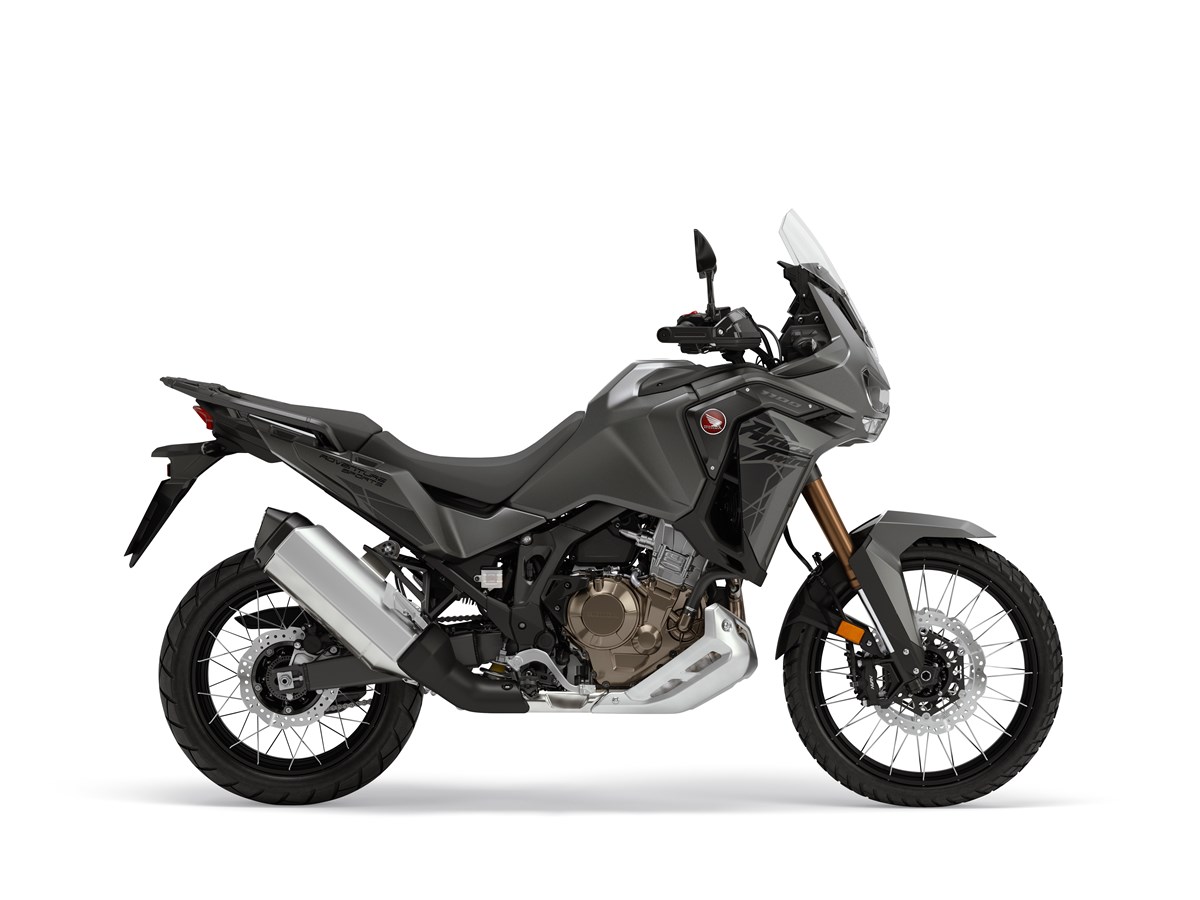 Model updates: With the performance and options to transport you across a continent, the fundamentals of the Africa Twin Adventure Sports’ enduringly popular specification carry on unchanged for 23YM. A lightweight chassis and torque-heavy 1084cc engine; a full electronics package uses a six-axis Inertial Measurement Unit to manage HSTC, cornering ABS, Wheelie Control, Rear Lift Control and cornering detection functionality on the DCT version. Practicality comes in the shape of multiple riding modes, standard fit cruise control, heated grips, USB port, ACC charger and full colour 6.5-inch TFT touchscreen incorporating Apple CarPlay®, Android Auto® and Bluetooth connectivity. Dual LED headlights feature Daytime Running Lights (DRL) and Cornering Lights. There’s also the option of Showa Electronically Equipped Ride Adjustment (Showa EERA™).
For 23YM, a striking, new, contemporary Mat Gray colour option will be available alongside the ‘Pearl Glare White’ Tricolor to further elevate the Africa Twin Adventure Sport from its competition.
Contents: 1 Introduction 2 Model overview 3 Key features 4 Accessories 5 Technical specifications
It’s been well over three decades since the Honda XRV650 Africa Twin first rolled into Europe and while the motorcycle that now bears its name – launched in 2016 as the CRF1000L Africa Twin – was a brand-new motorcycle from the wheels up, it fully inherited the essence and spirit of what made the original so popular.
It was the balance between power and weight that was at the heart of the original bike’s appeal, just as it was for the new model. With its unique, athletic appearance, an enjoyable, usable engine and capable, comfortable chassis, the CRF1000L Africa Twin proved itself a true modern-day all-rounder and has been hugely popular with round-the-world adventurers, around-town commuters and weekend tourers alike, with over 85,000 units sold.
2018 saw the Africa Twin, in both manual transmission and Dual Clutch Transmission (DCT) form, receive Throttle By Wire (TBW) control plus 4 riding modes, expanded Honda Selectable Torque Control (HSTC) options, as well as intake and exhaust development for improved engine response and sound. The platform also expanded: the Africa Twin Adventure Sports – with the same updates but featuring improved wind protection, greater tank range and longer-travel suspension – extended the machine even further into long-range off-road territory.
For 20YM, the introduction of a bigger capacity, longer stroke 1084cc engine marked another landmark in the evolution of the Africa Twin. The CRF1100L Africa Twin* itself was comprehensively redrawn with an aggressive, compact rally style and even sharper off-road focus. Meanwhile, the touring comfort, technology and ability of the CRF1100L Africa Twin Adventure Sports were also further enhanced – including the option of the cutting-edge Showa Electronically Equipped Ride Adjustment (Showa EERA™) suspension.
For 22YM, the Africa Twin Adventure Sports (which accounted for 57% of all Africa Twin sales in 2021) was equipped with refined DCT settings for even smoother handling in 1st and 2nd gears, a new, more compact screen design and striking ultra-modern ‘Cracked Terrain’ graphics. Although there are no specification changes for 23YM, the addition of a new Mat Iridium Gray Metallic colour adds further to the Africa Twin Adventure Sports’ appeal.
*See separate CRF1100L Africa Twin Press Kit.
2. Model Overview
The CRF1100L Africa Twin Adventure Sports shares the frame, engine and riding position of the off-road focussed CRF1100L Africa Twin but has a role very much of its own: to offer riders real continent-crossing long-haul ability and practicality both on and off-road. This comes in the shape of a large 24.8L fuel tank, extensive wind protection (from both the fairing and fairing side panels), height-adjustable screen, large engine sump guard, aluminium rear carrier plus tubeless wheels and tyres. ACC charger and heated grips are also standard fit.
There’s 75kW power with 105Nm torque available from the1,084cc parallel twin cylinder engine, while the steel frame is the foundation of its handling prowess; it also uses a bolt-on bolt-on aluminium subframe. The aluminium swingarm references that of the CRF450R moto-crosser.
A six-axis Inertial Measurement Unit (IMU) controls not only the 7-level HSTC but also 3-level Wheelie Control, cornering ABS (with off-road setting), Rear Lift Control and DCT cornering detection. There are four default riding modes: URBAN, TOUR, GRAVEL and OFF-ROAD.
For cutting edge suspension damping front and rear the Africa Twin Adventure Sports is also available with Showa EERA™ as an option. Four default modes – SOFT, MID, HARD and OFF-ROAD – cover every type of riding situation, and there’s a USER mode for further fine-tuning. Rear spring preload can also be adjusted while stationary.
Tailored for complete control, the riding position features a slim-section seat and high-set handlebars. Dual LED Daytime Running Lights (DRL) feature three-stage Cornering Lights – that automatically adjust the field of illumination depending on the lean angle, giving optimum visibility for improved safety. Cruise control and heated grips are standard-fit. A full colour Multi Information Display (MID) 6.5-inch TFT touch screen brings immersive engagement with the machine’s systems, plus Apple CarPlay®, Android Auto® and Bluetooth connectivity.
For 23YM the CRF1100L Africa Twin Adventure Sports will be available in the following paint options:
**NEW** Mat Iridium Gray Metallic Pearl Glare White
3. Key Features
3.1 Styling & Equipment
Designed for the long-haul, the Africa Twin Adventure Sports has an extensive front fairing with 5-level adjustable screen – a compact design that opens up vision while still offering plenty of wind and weather protection. Sharing the 850-870mm seat height of the Africa Twin, the 1182mm handlebars give an upright, high-visibility riding position and comfortable control, whether standing or seated.
The tail section is extremely slim, and the narrow seat carefully contoured to allow easy back and forth movement as well as good ground reach. Holding 24.8L, the fuel tank offers a potential range of over 500km, thanks to fuel economy of 4.9L/100km (20.4km/L) MT and 4.8L/100km (20.8km/L) DCT (WMTC mode). A large engine sump guard and aluminium rear carrier are included in the specification.
Dual LED headlights are set high, delivering a penetrating beam and also feature Daytime Running Lights (DRL) that automatically adjust to ambient light intensity, improving safety, no matter the conditions. For additional security, the CRF1100L Africa Twin Adventure Sports features three-stage Cornering Lights that use speed and lean angle (controlled by the IMU) to automatically adjust the area illuminated when cornering. Large knuckle guards are standard.
The full colour Multi Information Display (MID) 6.5-inch TFT touch screen keeps the rider in control of all of the Africa Twin Adventure Sports’ systems, with each of the riding modes selectable through the top left of the screen. The MID can also be customised to show various levels of information relative to the riding mode chosen and is easy to use even when wearing gloves.
It also incorporates Apple CarPlay® and Android Auto®, allowing use of a smartphone through the touchscreen. Navigation apps can also be accessed and displayed and, via a Bluetooth helmet headset, calls can be made or received. The smartphone itself plugs into a USB charging port on the right of the MID. Hands-free wireless Bluetooth connectivity is also an option and all control inputs are made from the left-hand switchgear.
The front and rear indicators have an Emergency Stop Signal (ESS) function. When braking suddenly over 50kph the hazard lights flash to warn other road users a hard stop is in process. The indicators include an auto-cancel function; rather than using a simple timer, the system compares front and rear wheel speed difference and calculates when to cancel the indication relative to the situation. The auto-cancel feature can be switched off using the MID. Standard-fit cruise control eases long-distance highway travel.
For 23YM, the CRF1100L Africa Twin Adventure Sports will be available in two paint options. The Pearl Glare White Tricolor continues for 23YM, with its classic, evocative colour scheme and striking gold wheels. It is joined by a stylish new Mat Iridium Gray Metallic, with black wheel rims.
3.2 Engine
The Africa Twin Adventure Sports’ 1,084cc, 8-valve parallel-twin engine produces 75kW @ 7,500rpm and peak torque of 105Nm @ 6,250rpm. Bore is set at 92mm with 81.5mm stroke and compression ratio of 10.1:1. 46mm throttle bodies feed the inlet ports and the bore and cylinder pitches are aligned to create a smooth air intake profile. The ECU setting and injector angle work in unison to deliver a direct spray into the twin-spark combustion chambers.
Honda’s SOHC Unicam valve train is a feature of the MX competition-specification CRF450R and the low-set position of the cast camshaft contributes to the compact nature of the cylinder head and entire engine package; inlet valves are 10.1mm diameter, exhaust valves 9.3mm. Aluminium cylinder sleeves save weight while the 270° phased crankshaft and uneven firing interval create the engine’s signature ‘throb’.
The crankcases are split horizontally; the water pump is housed efficiently within the clutch casing with a thermostat integrated into the cylinder head. Manual and DCT versions of the engine share common crankcases with only minor external differences; the water and oil pumps are both driven by the engine’s balancer shafts.
It’s a semi-dry sump design with in-tank lower crankcase oil storage. This allows a lower pan depth that keeps overall engine height low. As the pressure-fed pump is located within the tank where it delivers its oil from, there is no need for a pressure-feed passage. Secondary vibrations are neutralised by the mutually reciprocating motion of the pistons, while primary inertial and coupling vibrations are cancelled by the use of biaxial balance shafts.
The aluminium clutch centre and pressure plate use ‘assist’ cams to ease upshifts and ‘slipper’ cams for deceleration and downshifting; with the change to the 1100cc engine for 20YM, the clutch diameter was reduced in size compared to the previous design, with reduced spring tension for lighter lever feel. The six-speed manual gearbox uses the same shift-cam design as found on the CRF450R to ensure positive changes. A quickshifter remains available as an optional extra.
The exhaust end-can features a variable Exhaust Control Valve (ECV), very similar to the unit fitted to the Fireblade. It offers enhanced engine performance and efficiency as it opens at higher rpm and gives a pleasing exhaust note ‘pulse’ at lower rpm.
3.3 Engine & Chassis Management Electronics
Throttle By Wire (TBW) management and a six-axis Inertial Measurement Unit (IMU)* are at the heart of the electronic package. The system offers 4 levels of power and 3 levels of engine braking. There are seven levels of Honda Selectable Torque Control (HSTC) with each level’s amount of intervention being optimised to work with real-time input (yaw/roll angle and rate) from the IMU. The spacing of the levels is optimised to allow the rider a finer choice of the amount of rear tyre slide for off-road riding. HSTC can also be turned off completely.
Wheelie Control is another feature. With the IMU measuring pitch angle and rate, and controlling engine torque via TBW, the rider can choose between 3 levels of input. Level 1 allows for intended wheel lift but suppresses any sudden movement. Level 3 stops any front wheel elevation and level 2 is mid-way between the two. Wheelie Control can also be turned off completely.
There are four default riding mode settings: TOUR, URBAN, GRAVEL and OFF-ROAD to cover most riding conditions and situations plus two customisable USER settings. Even within the default riding modes, it’s possible to change some parameters – HSTC between levels 1-7 (plus off), Wheelie Control between levels 1-3 (plus off) and DCT S mode shift pattern levels 1-3.
TOUR employs the highest level of Power (1), for touring loaded with pillion and luggage plus mid-range Engine Braking (2) with active on-road cornering ABS.
URBAN suits wide-ranging riding requirements and uses mid-level Power (2) and Engine Braking (2) with active on-road Cornering ABS.
GRAVEL delivers the lowest level of Power (4) and Engine Braking (3). Cornering ABS is active with an off-road setting; in this setting, the rear brake ABS cannot be switched off.
OFF-ROAD uses lower-mid level Power (3) and the lowest amount of Engine Braking (3). Cornering ABS is active with an off-road setting; the rear brake ABS can be switched off.
USER 1 & 2 modes offer the rider a choice of two distinct personalized setups – choosing between Power levels 1-4 and Engine Braking 1-3, plus HSTC, Wheelie Control and ABS (on-road/off-road) parameters. USER 1 starts out with level 2 Power and Engine Braking, USER 2 uses level 4 Power and 3 Engine Braking.
*See the Chassis section 3.5 of this press kit.
3.4 Dual Clutch Transmission
Honda has sold over 200,000 DCT-equipped motorcycles across Europe since the system first appeared as an option on the VFR1200F in 2009. Testament to its acceptance in the marketplace, in 2021 DCT versions of Africa Twin (including Adventure Sports version) accounted for 51% of the model’s sales. For the Adventure Sports version itself, the figure rises to 61%.
The unique DCT system delivers consistent, super-fast seamless gear changes, and very quickly becomes second nature in use. It uses two clutches: one for start-up and 1st, 3rd and 5th gears: the other for 2nd, 4th and 6th, with the mainshaft for each clutch located inside the other for compact packaging.
Each clutch is independently controlled by its own electro-hydraulic circuit. When a gear change occurs, the system pre-selects the target gear using the clutch not currently in use. The first clutch is then electronically disengaged as, simultaneously, the second clutch engages.
The result is a consistent, fast and seamless gear change. Furthermore, as the twin clutches transfer drive from one gear to the next with minimal interruption of the drive to the rear wheel, any gear change shock and pitching of the machine is minimised, making the change feel direct as well as smooth.
The extra benefits of durability (as the gears cannot be damaged by missing a gear), impossibility of stalling, low stress urban riding, reduced rider fatigue and greater ability to focus on cornering lines and braking points add to DCT’s appeal.
Three modes of operation are available. MT mode gives full manual control, allowing the rider to shift with the handlebar trigger control buttons. Automatic D mode is ideal for city and highway riding and achieves optimum fuel efficiency. Automatic S mode offers three levels of sportier riding, as the ECU lets the engine rev a little higher before shifting up and shifts down sooner when decelerating for extra engine braking.
In either D or S mode, DCT offers immediate manual intervention if required – the rider simply selects the required gear using the up and down shift triggers on the left handlebar. At an appropriate time, DCT seamlessly reverts back to automatic mode, depending on throttle angle, vehicle speed and gear position.
DCT for the Africa Twin is also fully equipped to operate in an adventure environment, with off-road functionality enhanced by the G switch accessed via the TFT touch screen display. Activating the G switch in any riding mode improves the feel for available traction and machine control by reducing the amount of clutch slip during gear changes.
Further functionality for the DCT system comes in the form of incline detection, by means of which the gear shift pattern is adapted depending on the grade of an incline to provide optimum control.
The Africa Twin Adventure Sports’ DCT system also uses cornering detection; when the IMU recognises the bike is cornering, the system subtly adjusts the shifting programme for the most natural gear changes. The DCT settings are also optimised in first and second gears to allow smoother handling from a standing start and at very low speeds.
3.5 Chassis
At the very heart of the Africa Twin Adventure Sports’ elevated on and off-road performance is a Bosch MM7.10 six-axis Inertial Measurement Unit (IMU) tucked away at the centre of the machine, that measures – in real-time – roll angle/rate, pitch angle/rate and yaw angle/rate. It aids the management of rear wheel traction via TBW and HSTC, front braking grip through cornering ABS, front wheel lift through Wheelie Control and also adds Rear Lift Control.
The strength and rigidity balance of the steel semi-double cradle frame revolves around boosted off-road ability – at the same time reinforcing its all-round on-road manners. Rigidity around the steering head is optimised to enhance feel for front end grip; the main spars are slim and straight with no front cross pipe. Ground clearance is 250mm, with wheelbase of 1575mm and rake and trail of 27.5°/113mm. Wet weight is 238kg, with DCT at 248kg. The Showa EERATM adds a further 2kg in both Manual and DCT guises.
A bolt-on aluminium subframe allows a width of 195mm – crucial for easier ground reach. The lightweight aluminium swingarm – taking its direction from the design used by the CRF450R – improves rear wheel traction and rider feel.
To tailor damping force front and rear – and spring preload to suit load and riding conditions – Showa Electronically Equipped Ride Adjustment™ (Showa EERA™) is an option on the Africa Twin Adventure Sports. Showa EERA™ adjusts damping force relative to riding mode selected and aims to deliver high-quality suspension reaction in diverse and opposite conditions – riding comfort at slower speeds and stability at higher speeds.
Input is gathered from stroke sensors plus Inertial Measurement Unit (IMU). There are three road settings: SOFT has the lowest damping force for smoothest reaction, versatile MID operates as an all-round setting with HARD, using the highest damping force through low-to-high stroke speed, designed for sportier riding.
There is an OFF-ROAD setting that gradually raises front fork damping force as stroke speed rises and uses higher damping settings for the rear shock.
Rear spring preload can be electronically adjusted while stationary, through four default settings; 1) riding solo, 2) riding solo with luggage, 3) riding two-up and 4) riding two-up with luggage. A USER option allows for fine-tuning of damping force front and rear and 24 points of rear spring preload.
The Africa Twin Adventure Sports is also available with standard Showa suspension. With stroke length of 230mm, the 45mm cartridge-type inverted front fork offers long-travel bump absorption and features revised internal settings to improve all-round performance. Rebound and compression damping are fully adjustable. A cast aluminium top yoke and forged bottom yoke – with a hollow aluminium stem shaft – clamp the fork legs with two bolts each top and bottom.
Matching the front suspension, the Showa rear shock delivers 220mm axle travel and features a 46mm cylinder and remote reservoir for stable damping control under extreme off-road riding conditions. Spring preload can be adjusted via a dial on the shock body; rebound and compression damping are also fully adjustable.
The swingarm pivot points’ inner plates use 600MPa high-strength steel and the upper cross tube that connects them acts as the rear shock upper mount (through a pillow-ball joint) improving feel for rear wheel traction.
The IMU takes in lean angle, deceleration (from front/rear wheel speed sensors) and incorporates the slip rate of the front and rear wheels to manage braking pressure through the ABS; likewise if it detects sudden rear wheel lift, it finely controls brake force to maintain stability. When stationary the rear ABS can be cancelled for off-road riding.
Compact two-piece radial-mount four-piston calipers work dual 310mm ‘wave’ floating discs through sintered pads. The rear 256mm ‘wave’ disc features hole punching and shaping. 21/18-inch front rear (stainless steel) spoked wheels wear 90/90-21 and 150/70-18 tyres. Block pattern tyres (Continental 90/90-21M/C 54S and 150/70B 18M/C 70Q, rated at 180km/h and 160km/h respectively) are approved for fitment.
To make puncture repair easier when on tour the 21/18-inch front and rear (stainless steel) spoked wheels wear tubeless Bridgestone Battlax Adventurecross Tourer AX41T or Metzeler Karoo Street tyres, sized 90/90-21M/C 54H and 150/70R18 M/C 70H. Block pattern tyres (Continental 90/90-21M/C 54S and 150/70B 18M/C 70Q are also approved for fitment).
4 Accessories
A range of Honda Genuine Accessories is available for the Africa Twin Adventure Sports, available individually as well as in selected packs for convenience.
The Super Pack has been developed to enhance both long distance comfort and increase luggage capacity, with two luggage versions available: aluminium and plastic.
This pack includes
or
The Travel Pack maximises the Africa Twins long distance travelling abilities. Like the Super Pack, the Travel pack is also available in two versions, aluminium and plastic
or
Additional accessories are also available and include:
5 Technical Specifications
** Please note that the figures provided are results obtained by Honda under standardised testing conditions prescribed by WMTC. Tests are conducted on a rolling road using a standard version of the vehicle with only one rider and no additional optional equipment. Actual fuel consumption may vary depending on how you ride, how you maintain your vehicle, weather, road conditions, tire pressure, installation of accessories, cargo, rider and passenger weight, and other factors. Hornet design concept sketches hint at the sting in its tail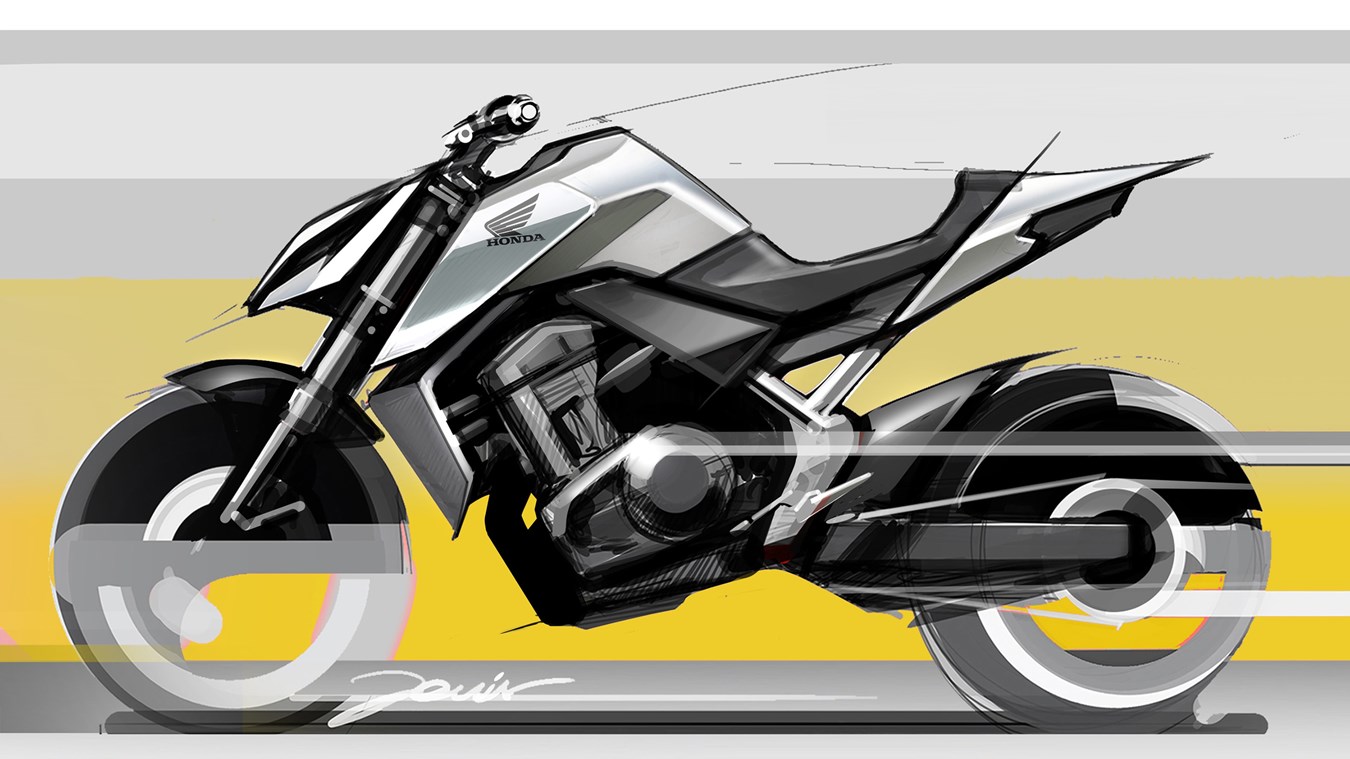
Following the news at EICMA 2021 that the illustrious Hornet name will be returning to its line-up, Honda has today released sketches that give further details of the design concept, showcasing the combination of technical beauty and aggression that run through its DNA. Creation of the concept sketches was led by Honda’s R&D Centre in Rome, which, in close collaboration with R&D in Japan, is already responsible for crafting the look of many of Honda’s recent successful European models, including the CRF1100L Africa Twin, CB650R and X-ADV, The designer for the new Hornet concept is 28 year old Giovanni Dovis, who most recently penned the distinctive lines of the new ADV350. Giovanni Dovis, Designer, Honda R&D Europe, Italy: “Honda’s design philosophy is to create something pure and functional in an uncomplicated way – models which are both beautifully simple and emotionally appealing. The sketches show how the Hornet design concept promises agility, dynamism and light weight thanks to its slim proportions, pointy tail section and super-sharp lines. It creates a new compactly proportioned look, and has hallmarks of tension and aggression from front to back, outlining the Hornet’s true sporting purpose.” HONDA WINS QUARTET OF RED DOT DESIGN AWARDS FOR AUTOMOBILE, MOTORCYCLE AND POWER PRODUCTS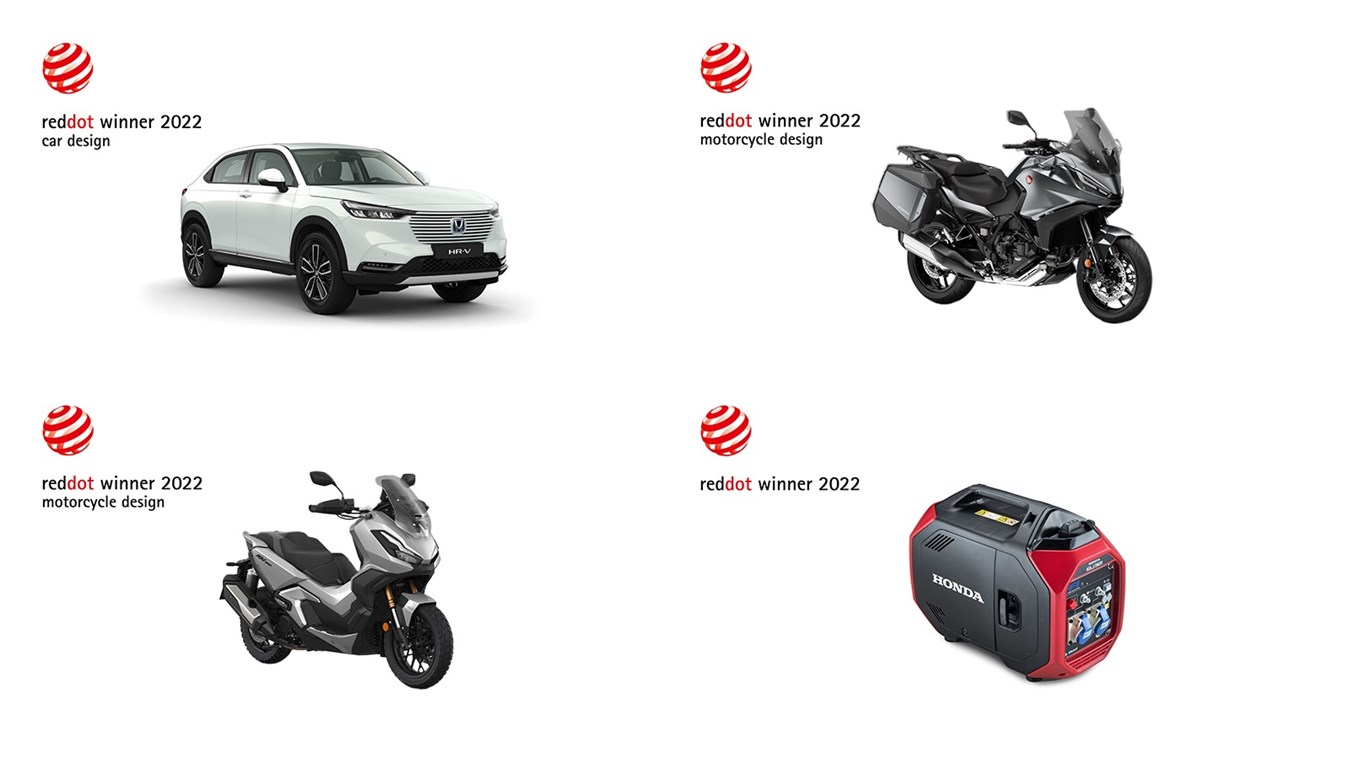
Honda’s all-new HR-V e:HEV compact SUV, NT1100 tourer motorcycle, ADV350 ‘adventure’ scooter and EU32i generator have all secured the Red Dot Award: ‘Product Design 2022’ – a first time for Honda to receive the award cross all product ranges, Motorcycle, Automobile and Power Products. This highly coveted distinction is only bestowed upon products that excel in design quality and innovation. The HR-V’s contemporary style echoes the ‘noiseless’, elegant design direction of other recent Honda models, which has been recognised through a series of international award wins over recent years. In the 2021 Red Dot competition, the Jazz e:HEV, Jazz Crosstar e:HEV and Forza 750 maxi-scooter all won in the Product Design category, while the Honda e secured the Best of the Best award the previous year. It was recognised alongside the Honda CBR1000RR-R Fireblade SP super sports motorcycle, which became the first Honda motorcycle to win a Red Dot award. The Red Dot Winner Label has become established internationally as one of the most sought-after marks of quality for product design. The annual awards are decided by a panel of 50 international experts who test, evaluate and discuss each entry, with judging criteria reappraised and adapted each year to reflect the latest technical, social, economic and ecological requirements. “We are pleased to receive a Red Dot Product Design Award in all Honda product ranges, Motorcycle, Automobile and Power Products for the first time,” said Toshinobu Minami, Chief Operating Officer, Design Center, Honda R&D Co. Ltd., “We believe this is a result of realising Honda’s desire to ‘serve people with technology, ideas and design through our products’, which has been a key principle since the company’s foundation. We will continue to take on challenges to deliver “surprises and excitement” to our customers.” When designing and developing the latest generation HR-V, Honda engineers completely reimagined the popular compact-SUV from the ground up. Honda’s research found that modern consumers choose products not only on the basis of competent performance or appealing aesthetics, but also on how it integrates with their lives and whether the product fulfils their individual requirements. As a result, the new-generation HR-V has a contemporary coupe-SUV body that achieves a desirable combination of premium and dynamic design and exceptional space efficiency. Both the interior and exterior embody Honda’s new simple, clean, modern design philosophy already seen in recent new models, and successfully extends the brand’s reputation for quality, functionality and practicality. Unveiled in October 2021, the NT1100 introduced a New Touring Era of motorcycling. A comfortable, agile and, most importantly, supremely enjoyable motorcycle, the NT1100’s styling drew on Honda’s rich heritage of tourers, aiming to attract both established riders and a new generation looking for the traditional tourer values of comfort and practicality without an overt ‘adventure’ look and feel. It was drawn at Honda’s Italian R&D centre in Rome by the pen of Maurizio Carbonara (also responsible for Honda’s hugely popular CRF1100L Africa Twin and X-ADV) with the guiding principle of ‘proactive comfort’. As such, its clean, elegant lines are complemented by a feeling of lightness thanks to its raised height and horizontal character lines, that hint strongly at a new level of riding enjoyment for a touring-focussed motorcycle. Honda’s other two-wheeled award winner, the ADV350 ‘adventure scooter’, draws faithfully on the look and feel of the 750cc X-ADV – which was quickly dubbed the ‘first two-wheeled SUV’ on its introduction in 2017 thanks to its rugged, angular design lines, multiple surfaces, high ground clearance, long travel suspension and scooter-like practicality. The ADV350 brings this innovative look to the mid-capacity scooter market under the banner of ‘New Urban Adventure’. Its off-road oriented appearance is matched with the genuine ability to deal with the roughest of tarmac thanks to its unique-in-class genuine motorcycle suspension. Completing the award-winning line-up is the recently launched EU32i generator, which offers immense power in a consumer-friendly, smartly designed package. It features a world-first integration of a high-output engine into a portable, fuel-injected generator, boasting an impressive 3,200 watts of power and continuous performance that was previously only found in cars and marine outboard engines. It even comes with a dedicated smartphone app and with Bluetooth connectivity, it enables users to monitor the status of the generator and control it remotely. Honda’s recent triumphs in the automobile section of the Red Dot awards builds on a long history of success in the programme, including the Honda S2000 in 2001, Civic in 2006 and European Accord Tourer in 2008. 23YM CRF1100L AFRICA TWIN
Model updates: Rugged, agile and highly capable, the fundamentals of the Africa Twin’s enduringly popular package carry on unchanged for 23YM. On offer is hard-edged off-road performance from an athletic, lightweight chassis with slim rally-style bodywork and characterful, torque-heavy 1084cc engine. A full electronics package uses a six-axis Inertial Measurement Unit to manage HSTC, cornering ABS, Wheelie Control, Rear Lift Control and cornering detection functionality on the DCT version. Practicality comes in the shape of multiple riding modes, standard fit cruise control, USB port and full colour 6.5-inch TFT touchscreen incorporating Apple CarPlay® and Bluetooth connectivity.
For 23YM, there are updates to two of the three available paint schemes – a full-stealth Black Metallic version and a new ‘Glint Wave Blue Metallic’ Tricolour.
Contents: 1 Introduction 2 Model overview 3 Key features 4 Accessories 5 Technical specifications
It’s been well over three decades since the Honda XRV650 Africa Twin first rolled into Europe and while the motorcycle that now bears its name – launched for 2016 as the CRF1000L Africa Twin – was a brand-new machine from the wheels up, it fully inherited the essence and spirit of what made the original so popular.
It was the balance between power and weight that was at the heart of the original bike’s appeal, just as it was for the new model. With its unique, athletic appearance, an enjoyable, usable engine and capable, comfortable chassis, the CRF1000L Africa Twin proved itself a true modern-day all-rounder and has been hugely popular with round-the-world adventurers, around-town commuters and weekend tourers alike, with over 85,000 units sold.
2018 saw the Africa Twin, in both manual transmission and Dual Clutch Transmission (DCT) form, receive Throttle By Wire (TBW) control plus 3 riding modes, expanded Honda Selectable Torque Control (HSTC) options, as well as intake and exhaust development for improved engine response and sound. The platform also expanded: the Africa Twin Adventure Sports – with the same updates but featuring improved wind protection, greater tank range and longer-travel suspension – extended the machine even further into long-range territory.
For the 20YM, the introduction of a bigger capacity, longer stroke 1084cc engine marked another landmark in the evolution of the Africa Twin. The touring comfort, technology and ability of the CRF1100L Africa Twin Adventure Sports* were further enhanced – adding the option of Showa Electronically Equipped Ride Adjustment (SHOWA EERA™) suspension, and the CRF1100L Africa Twin itself was comprehensively redrawn with an aggressive, compact rally style and even sharper off-road focus. Alongside the increase in power and torque from the new engine, it was also significantly lighter – in keeping with the first principles set out all those years ago.
22YM saw the Africa Twin equipped with refined DCT settings for even smoother handling in 1st and 2nd gears, standard fitment aluminium rear carrier and striking, ultra-modern ‘Big Logo’ graphics. Although there are no specification changes for 23YM, the evolution of two, ultra-cool paint choices add even more to the Africa Twin’s all-round desirability.
*See separate CRF1100L Africa Twin Adventure Sports Press Kit.
2. Model Overview
The CRF1100L Africa Twin is a motorcycle focused on core off-road ability with the look – and feel – of a true rally machine. Slim and lightweight, its 1,084cc parallel twin cylinder engine produces 75kW power with 105Nm torque, while the steel frame is the foundation of its handling prowess; it also uses a bolt-on aluminium subframe. The aluminium swingarm references that of the CRF450R moto-crosser.
At the centre of the Africa Twin, a six-axis Inertial Measurement Unit (IMU) controls not only the 7-level HSTC but also 3-level Wheelie Control, Cornering ABS (with off-road setting), Rear Lift Control and enhanced DCT cornering detection. There are four default riding modes: URBAN, TOUR, GRAVEL and OFF-ROAD.
Tailored for complete control, the riding position features a slim-section seat and high-set handlebars. Dual LED Daytime Running Lights (DRL) give optimum visibility, improving safety. Cruise control is standard-fit. A full colour Multi Information Display (MID) 6.5-inch TFT touch screen brings immersive engagement with the machine’s systems, plus Apple CarPlay®, Android Auto® and Bluetooth connectivity.
For 23YM CRF1100L Africa Twin will be available in the following paint options:
Grand Prix Red **NEW** Mat Ballistic Black Metallic – now with all-black frame **NEW** Glint Wave Blue Metallic Tricolour – with blue front ‘face’, and blue front fender and tail section with red and white detailing
3. Key Features
3.1 Styling & Equipment
Aggressive and compact. Two words that sum up the Africa Twin’s taut rally-style bodywork. And it’s for a reason – to work better off-road. The fixed screen is short to allow for easy scanning of the trail ahead and, with a seat height of 850-870mm, the high-set handlebars give an upright, high-visibility riding position and comfortable control, whether standing or seated. The tail section is extremely slim and the narrow seat carefully contoured to allow good ground reach and easy back and forth movement while an aluminium rear carrier is standard fit for convenient carrying ability.
Dual LED headlights are set high, delivering a penetrating beam, and also feature Daytime Running Lights (DRL) that automatically adjust to ambient light intensity, improving safety, no matter the conditions. Knuckle guards are standard.
The full colour Multi Information Display (MID) 6.5-inch TFT touch screen keeps the rider in control of all of the Africa Twin’s systems, with each of the riding modes selectable through the top left of the screen. The MID can also be customised to show various levels of information relative to the riding mode chosen and is easy to use even when wearing gloves.
It also incorporates Apple CarPlay® and Android Auto®, allowing use of a smartphone through the touchscreen. Navigation apps can also be accessed and displayed and, via a Bluetooth helmet headset, calls can be made or received. The smartphone itself plugs into a USB charging port on the right of the MID. Hands-free wireless Bluetooth connectivity is also an option and all control inputs are made from the left-hand switchgear.
The front and rear indicators have an Emergency Stop Signal (ESS) function. When braking suddenly over 50kph the hazard lights flash to warn other road users a hard stop is in process. They also auto-cancel; rather than using a simple timer, the system compares front and rear wheel speed difference and calculates when to cancel the indication relative to the situation. The auto-cancel feature can be switched off using the MID. Standard-fit cruise control eases long-distance highway travel.
For 23YM, the CRF1100L Africa Twin will be available in three paint options. The Mat Ballistic Black Metallic, new for 23YM, comes complete with a colour matched rear subframe. The classic Tricolore option is renamed as ‘Glint Wave Blue Metallic Tricolore’, as it features blue front ‘face’, and blue front fender and tail section with red and white detailing. The third colour is the classic ‘CRF’ Grand Prix Red, which pays homage to Honda’s off road racing heritage.
3.2 Engine
The 1,084cc, 8-valve parallel-twin engine produces 75kW @ 7,500rpm and peak torque of 105Nm @ 6,250rpm. Bore is set at 92mm with 81.5mm stroke and compression ratio of 10.1:1. 46mm throttle bodies feed the inlet ports and the bore and cylinder pitches are aligned to create a smooth air intake profile. The ECU setting and injector angle work in unison to deliver a direct spray into the twin-spark combustion chambers.
Honda’s SOHC Unicam valve train is a feature of the MX competition-specification CRF450R and the low-set position of the cast camshaft contributes to the compact nature of the cylinder head and entire engine package; inlet valves are 10.1mm in diameter, exhaust valves 9.3mm. Aluminium cylinder sleeves save weight while the 270° phased crankshaft and uneven firing interval create the engine’s signature ‘throb’.
The crankcases are split horizontally; the water pump is housed efficiently within the clutch casing with a thermostat integrated into the cylinder head. Manual and DCT versions of the engine share common crankcases with only minor external differences; the water and oil pumps are both driven by the engine’s balancer shafts.
It’s a semi-dry sump design with in-tank lower crankcase oil storage. This allows a lower pan depth that keeps overall engine height low. As the pressure-fed pump is located within the tank where it delivers its oil from, there is no need for a pressure-feed passage. Secondary vibrations are neutralised by the mutually reciprocating motion of the pistons, while primary inertial and coupling vibrations are cancelled by the use of biaxial balance shafts.
The aluminium clutch centre and pressure plate use ‘assist’ cams to ease upshifts and ‘slipper’ cams for deceleration and downshifting; with the change to the 1100cc engine for 20YM, the clutch diameter was reduced in size compared to the previous design, with reduced spring tension for lighter lever feel. The six-speed manual gearbox uses the same shift-cam design as found on the CRF450R to ensure positive changes. A quickshifter remains available as an optional extra.
The exhaust end-can features a variable Exhaust Control Valve (ECV), very similar to the unit fitted to the Fireblade. It offers enhanced engine performance and efficiency as it opens at higher rpm and gives a pleasing exhaust note ‘pulse’ at lower rpm.
3.3 Engine & Chassis Management Electronics
Throttle By Wire (TBW) management and a six-axis Inertial Measurement Unit (IMU)* are at the heart of the electronic package. The system offers 4 levels of power and 3 levels of engine braking. There are seven levels of Honda Selectable Torque Control (HSTC) with each level’s amount of intervention being optimised to work with real-time input (yaw/roll angle and rate) from the IMU. The spacing of the levels is optimised to allow the rider a finer choice of the amount of rear tyre slide for off-road riding. HSTC can also be turned off completely.
Wheelie Control is another feature. With the IMU measuring pitch angle and rate, and controlling engine torque via TBW, the rider can choose between 3 levels of input. Level 1 allows for intended wheel lift but suppresses any sudden movement. Level 3 stops any front wheel elevation and level 2 is mid-way between the two. Wheelie Control can also be turned off completely.
There are four default riding mode settings: TOUR, URBAN, GRAVEL and OFF-ROAD to cover most riding conditions and situations plus two customisable USER settings. Even within the default riding modes, it’s possible to change some parameters – HSTC between levels 1-7 (plus off), Wheelie Control between levels 1-3 (plus off) and DCT S mode shift pattern levels 1-3.
TOUR employs the highest level of Power (1), for touring loaded with pillion and luggage plus mid-range Engine Braking (2) with active on-road cornering ABS.
URBAN suits wide-ranging riding requirements and uses mid-level Power (2) and Engine Braking (2) with active on-road Cornering ABS.
GRAVEL delivers the lowest level of Power (4) and Engine Braking (3). Cornering ABS is active with an off-road setting; in this setting, the rear brake ABS cannot be switched off.
OFF-ROAD uses lower-mid level Power (3) and the lowest amount of Engine Braking (3). Cornering ABS is active with an off-road setting; the rear brake ABS can be switched off.
USER 1 & 2 modes offer the rider a choice of two distinct personalized setups – choosing between Power levels 1-4 and Engine Braking 1-3, plus HSTC, Wheelie Control and ABS (on-road/off-road) parameters. USER 1 starts out with level 2 Power and Engine Braking, USER 2 uses level 4 Power and 3 Engine Braking.
*See the Chassis section 3.5 of this press kit.
3.4 Dual Clutch Transmission
Honda has sold over 200,000 DCT-equipped motorcycles across Europe since the system first appeared as an option on the VFR1200F in 2009. Testament to its acceptance in the marketplace, in 2021 DCT versions of Africa Twin (including Adventure Sports version) accounted for 51% of the model’s sales.
The unique DCT system delivers consistent, super-fast seamless gear changes, and very quickly becomes second nature in use. It uses two clutches: one for start-up and 1st, 3rd and 5th gears: the other for 2nd, 4th and 6th, with the mainshaft for each clutch located inside the other for compact packaging.
Each clutch is independently controlled by its own electro-hydraulic circuit. When a gear change occurs, the system pre-selects the target gear using the clutch not currently in use. The first clutch is then electronically disengaged as, simultaneously, the second clutch engages.
The result is a consistent, fast and seamless gear change. Furthermore, as the twin clutches transfer drive from one gear to the next with minimal interruption of the drive to the rear wheel, any gear change shock and pitching of the machine is minimised, making the change feel direct as well as smooth.
The extra benefits of durability (as the gears cannot be damaged by missing a gear), impossibility of stalling, low stress urban riding, reduced rider fatigue and greater ability to focus on cornering lines and braking points add to DCT’s appeal.
Three modes of operation are available. MT mode gives full manual control, allowing the rider to shift with the handlebar trigger control buttons. Automatic D mode is ideal for city and highway riding and achieves optimum fuel efficiency. Automatic S mode offers three levels of sportier riding, as the ECU lets the engine rev a little higher before shifting up and shifts down sooner when decelerating for extra engine braking.
In either D or S mode, DCT offers immediate manual intervention if required – the rider simply selects the required gear using the up and down shift triggers on the left handlebar. At an appropriate time, DCT seamlessly reverts back to automatic mode, depending on throttle angle, vehicle speed and gear position.
DCT for the Africa Twin is also fully equipped to operate in an adventure environment, with off-road functionality enhanced by the G switch accessed via the TFT touch screen display. Activating the G switch in any riding mode improves the feel for available traction and machine control by reducing the amount of clutch slip during gear changes.
Further functionality for the DCT system comes in the form of incline detection, by means of which the gear shift pattern is adapted depending on the grade of an incline to provide optimum control.
The Africa Twin’s DCT system also uses cornering detection; when the IMU recognises the bike is cornering, the system subtly adjusts the shifting programme for the most natural gear changes. The DCT settings are also optimised in first and second gears to allow smoother handling from a standing start and at very low speeds.
3.5 Chassis
At the very heart of the Africa Twin’s elevated on- and off-road performance is a Bosch MM7.10 six-axis Inertial Measurement Unit (IMU) tucked away at the centre of the machine, that measures – in real-time – roll angle/rate, pitch angle/rate and yaw angle/rate. It aids the management of rear wheel traction via TBW and HSTC, front braking grip through cornering ABS, front wheel lift through Wheelie Control and also adds Rear Lift Control.
The strength and rigidity balance of the steel semi-double cradle frame revolves around boosted off-road ability – at the same time reinforcing its all-round on-road manners. Rigidity around the steering head is optimised to enhance feel for front end grip; the main spars are slim and straight with no front cross pipe. Ground clearance is 250mm, with wheelbase of 1574mm and rake and trail of 27° 30’/113mm. Wet weight is 229kg (DCT 240kg).
A bolt-on aluminium subframe allows a width of 195mm – crucial for easier ground reach. The lightweight aluminium swingarm – taking its direction from the design used by the CRF450R – improves rear wheel traction and rider feel.
With stroke length of 230mm the 45mm Showa cartridge-type inverted front fork offers long-travel bump absorption and with internal settings for high-quality on- and off-road performance. Rebound and compression damping are fully adjustable. A cast aluminium top yoke and forged bottom yoke – joined by hollow aluminium stem shaft – clamp the fork legs with two bolts each top and bottom.
Matching the front suspension, the Showa rear shock delivers 220mm axle travel and features a 46mm cylinder and remote reservoir for stable damping control under extreme off-road riding conditions. Spring preload can be adjusted via a dial on the shock body; rebound and compression damping are also fully adjustable.
The swingarm pivot points’ inner plates use 600MPa high-strength steel and the upper cross tube that connects them acts as the rear shock upper mount (through a pillow-ball joint) improving feel for rear wheel traction.
The IMU takes in lean angle, deceleration (from front/rear wheel speed sensors) and incorporates the slip rate of the front and rear wheels to manage braking pressure through the ABS; likewise if it detects sudden rear wheel lift, it finely controls brake force to maintain stability. When stationary the rear ABS can be cancelled for off-road riding.
Compact two-piece radial-mount four-piston calipers work dual 310mm ‘wave’ floating discs through sintered pads. The rear 256mm ‘wave’ disc features hole punching and shaping. 21/18-inch front rear (stainless steel) spoked wheels wear 90/90-21 and 150/70-18 tyres. Block pattern tyres (Continental 90/90-21M/C 54S and 150/70B 18M/C 70Q, rated at 180km/h and 160km/h respectively) are approved for fitment.
4 Accessories
A range of Honda Genuine Accessories is available for the Africa Twin, available individually as well as in selected packs for convenience to further enhance the Africa Twin riding experience.
The Off-Road Pack enhances the Africa Twin’s natural off-road ability and includes:
The Electric Pack contains all the electrical accessories needed for maximum comfort while riding and includes:
The Super Pack has been developed to enhance both long distance comfort and increase luggage capacity, with two versions available: aluminium and plastic.
This pack includes
or
Plus
The Travel Pack maximises the Africa Twins long distance travelling abilities. Like the Super Pack, the Travel pack is also available in two versions, aluminium and plastic
or
Plus
Additional accessories are also available and include:
5 Technical Specifications
** Please note that the figures provided are results obtained by Honda under standardised testing conditions prescribed by WMTC. Tests are conducted on a rolling road using a standard version of the vehicle with only one rider and no additional optional equipment. Actual fuel consumption may vary depending on how you ride, how you maintain your vehicle, weather, road conditions, tire pressure, installation of accessories, cargo, rider and passenger weight, and other factors. 23YM HONDA ST125 DAX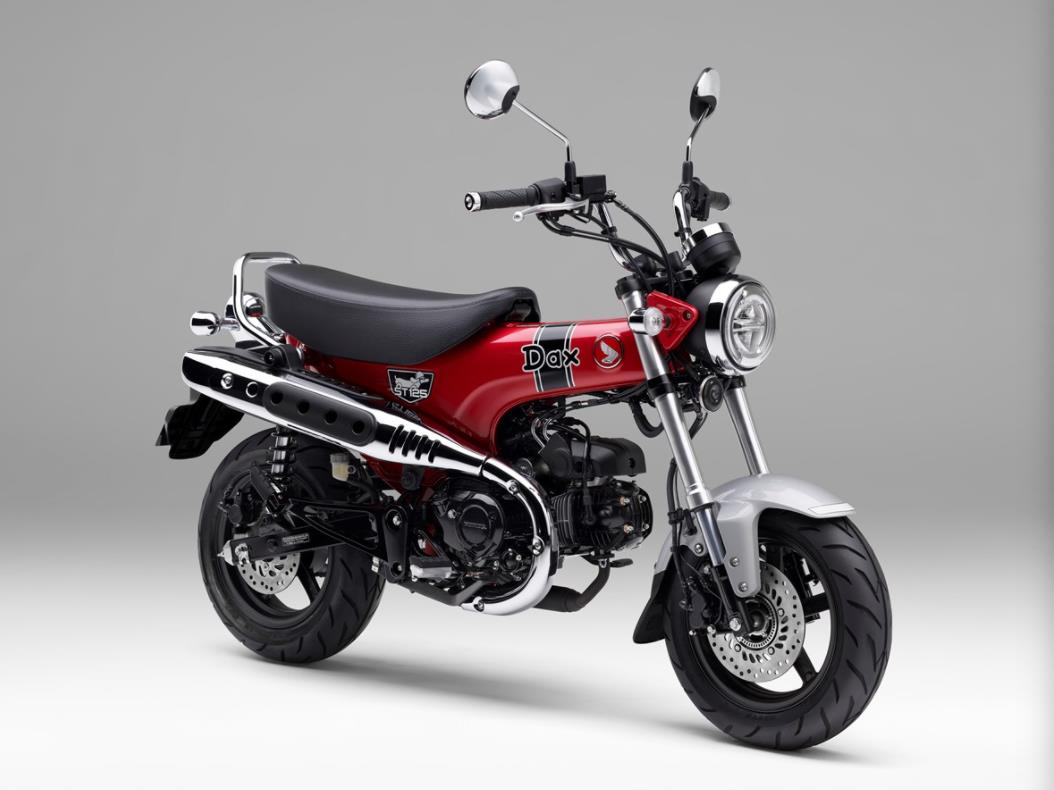 Model updates: Sprinting joyfully out of the traps – and after a 41-year absence from Honda’s European line-up – the new Dax joins the Monkey and MSX125 Grom in Honda’s mini-bike line-up. Authentic, robust and offering simple riding pleasure, it features a pressed steel frame, 31mm USD forks, 12-inch wheels and air-cooled SOHC two-valve engine with four-speed gearbox and centrifugal clutch. Full LED lighting, compact negative LCD display and pillion grab rail complete the full specification list, and the intangible and timeless appeal of the unmistakeable Dax styling is something no spec sheet can encapsulate.
Contents: 1 Introduction 2 Model overview 3 Key features 4 Milestones 5 Technical specifications
Honda’s pocketful of mini motorcycles has struck a chord with young and old riders alike. The re-imagined Monkey 125 tugs at heart strings that remember the golden 1970s while providing thoroughly modern, compact and funky urban transport for riders of any age. The MSX125 Grom serves up left-field, customisable style for ‘Generation Y’ but also as perfect paddock transport in the worlds of car and bike racing. For 23YM a new bike joins the fold. The ST125 Dax fully owns the genuine authenticity of the 1969 original* but brings thoroughly 21st century performance from chassis, engine and ergonomics. The most recent version of the Dax was produced from 1995 to 2003 for the Japanese market. The more recent European success of its siblings has hastened its return and its mischievous charm and easy-going riding proposition bless the ST125 Dax with an extra layer of desirability. Of course, nostalgia will play a part in the Dax’s appeal to riders now in middle age – riders who may have owned a Dax in their youth and are pleased to see it return. Equally, ‘retro’ is important to younger owners; that’s real retro, not faux. A certain style sets some machines apart and the Dax has just that in abundance thanks to the form of its iconic T-shaped frame. Which is also how the bike got its name: extending from under the seat to the handlebars, and sitting atop the small 12” wheels, the look is reminiscent of the universally-adored Dachshund. Or Sausage Dog, to give it its everyday English name… Unique, easy, usable and great fun. That’s the new Honda Dax. A faithful old friend is back. *See Dax Milestones below.
2. Model Overview As it should, the Dax keeps it simple. A steel frame provides strength and houses the fuel tank while 31mm USD forks, twin rear shocks and 12-inch wheels with chunky tyres provide light steering and good suspension performance. Braking is via hydraulic discs front and rear with ABS control. Robust and fuel efficient, the 124cc SOHC two-valve engine’s power is linear in delivery with smooth torque. A centrifugal clutch manages shifting between the four ratios so there’s no need for a handlebar-mounted clutch lever. It offers twist-and-go simplicity with the added entertainment of changes via a traditional left-foot gear lever. All lighting is LED and a circular LCD display shows exactly what the rider needs to know. The pillion gets a chromed grab rail, too. The 23YM Dax will be available in the following colour options: Pearl Nebula Red Pearl Cadet Grey 3. Key Features 3.1 Styling & Chassis
While the Dax is small, its proportions provide enough room to be comfortable for two adults to ride. The styling really is the frame; everything is attached to, or held within it, giving the Dax its unmistakeable retro look. As do all the other parts; the thick dual seat – seat height is just 775mm – chrome high-set handlebars and the 1970’s dirt bike-inspired upswept muffler with drilled, slotted and chromed heat shield. The frame’s mid-section wears a black stripe with ‘Dax’ picked out in quirky font, right next to the classic Honda Wing logo that marks its special heritage. A unique finishing touch comes in the form of a cartoon image of a Dachshund. A chromed mudguard leads and sits below the evocative, circular headlight. To add extra charm to the light, signature round LEDs are used and the front indicators/position lights sit snugly in between low and high beams. The compact instrument display is a round, negative LCD while the rear taillight and indicators take their cues from the headlight and are also LED. There’s a neat chrome grabrail for the passenger to hold while a cover seals the drive chain away from weather and loose clothing. A rear carrier and heated grips are available as optional extras. The iconic T-shaped frame design houses the fuel tank, is authentic in aesthetic detail and constructed in pressed-steel with modern engineering know-how. Rake and trail are set at 24.9°/84mm with wheelbase of 1020mm. Wet weight is just 107kg. 31mm USD forks provide supple suspension response and, combined with the wide upswept handlebar, easy steering. Twin rear shocks are tuned for smooth compliance, even with a pillion. Blacked-out 12-inch rims (from the super-cool MSX125 Grom) wear fat, balloon-like tyres; a 120mm wide front and 130mm rear. They add sure-footed grip allied to nimble agility. Single-channel ABS manages braking force. Hydraulic front and rear calipers grip 220/190mm diameter discs respectively.
3.2 Engine
Drawn from the new Super Cub C125 – so flexible, efficient and durable – the Dax’s 124cc air-cooled engine features a SOHC two-valve cylinder head, with relatively long stroke and high compression; bore is set at 50mm, stroke at 63.1mm with compression ratio of 10.0:1. Peak power of 6.9kW arrives @ 7,000rpm, with peak torque of 10.8Nm @ 5,000rpm. The engine’s strong performance means that even two-up a 90km/h cruising speed is achievable, with smart acceleration from low speed – just what’s needed for lively around-town amusement. On the left-hand side of the bike the distinctive oval air box, filter and connecting tube ensure smooth, efficient airflow through the clean side, delivering crisp throttle response and driveability. The upswept muffler and heat shield is evocative of that golden motorcycling era of the ‘70s. A single catalyser is all that’s necessary; thanks to precise ECU settings and the engine’s combustion efficiency, EURO5 compliance is achieved. In keeping with the laid-back, easy to ride feel the gearbox is a 4-speed unit (with neutral at the bottom) operated via centrifugal clutch, without the need for a clutch lever. At standstill the rider simply selects the gear required with the left-hand foot lever and, as the throttle is opened, the clutch operates automatically and does so through each ratio change, up or down. Various low-friction technologies, like an offset cylinder and roller-rocker arms in the head, ensure impressive fuel economy of 63.7km/l (WMTC mode). This gives the Dax a range of approx. 240km from the 3.8L fuel tank.
4. Origins of the Dax In 1967, The Monkey Z50M was introduced in response to the demand for a ‘leisure-oriented bike’ for the American and European markets. Although well received, especially in America, by adults and children alike, thanks to its adjustable seat height and foldable features which allowed it to be loaded into a car, for 1969 American Honda requested a larger bike for its customers, but one that was still filled with the spirit of Monkey. After visiting the US to better understand the requirements, engineers, inspired by the T-shaped frame of the CS90, which was a very popular bike in Japan, developed the Dax to have lower and longer proportions (compared to the Monkey) that allowed adults to have a more relaxed riding position as well as ride two up. The fuel tank, wiring and other components were housed in the T-shaped frame to create a unique, but also simple – and now iconic – design. 5. Dax Milestones 1969 ST50/70 Dax Honda Built for the export markets of Europe and the USA the original Dax was nifty, nimble and easy to ride. It appealed to both die-hard motorcyclists and recreational users as it was just plain fun. This is the bike that launched many two-wheeled journeys. The engine was based on the well-established Super Cub engine, but with the addition of modifications to both the intake and exhaust system to provide more torque at low-mid range. Available in both 50cc and 70cc versions, the Dax featured a 3-speed automatic centrifugal clutch, telescopic front suspension, hydraulic rear suspension and wide tyres with a unique tread pattern for stability and handling even when off-road.
1972 ST90 Mighty Dax The ST90 Mighty Dax featured a more rigid T-shape frame, wider, more upright custom style ‘mini ape’ bars, high level front mudguard and a bigger engine that packed more speed and acceleration. The new larger 14in wheels came fitted with semi-off road pattern tyres to increase handling performance and stability, even when off-road.
1973 CY50 Nauty Dax Aimed squarely at the RV (Recreational Vehicle) leisure market, the Nauty Dax was developed to offer even better riding performance and stability over rough terrain. Changes to the valve timing and the final drive – now with 4 speeds – increased torque in the low to mid range. With a new exhaust, fuel tank, side covers and unique rectangular shaped headlight, the Nauty Dax also featured a stepped seat and funky paint scheme. The new light and rigid diamond frame and the new fat balloon tyres made for easy rolling over rough campsite terrain
1995 ST50 Dax After 14 years, the Dax returned to the Japanese market. All the iconic design cues remained in place – a pressed steel backbone frame, telescopic suspension, wide foldable bars, chrome mudguard, muffler and block tyres – and were joined by the addition of a longer seat. The 50cc engine featured an automatic cam chain tensioner and magneto ignition for easy starting. Enjoying an eight-year production run, the ST50 Dax finally went off sale in 2003.
2022 ST125 Dax Straight out of the traps with a useful, usable 124cc engine, four speed gearbox and centrifugal clutch the Dax makes a welcome return to the Honda minibike fold, joining the Monkey and MSX125 Grom.
All specifications are provisional and subject to change without notice Please note that the figures provided are results obtained by Honda under standardised testing conditions prescribed by WMTC. Tests are conducted on a rolling road using a standard version of the vehicle with only one rider and no additional optional equipment. Actual fuel consumption may vary depending on how you ride, how you maintain your vehicle, weather, road conditions, tire pressure, installation of accessories, cargo, rider and passenger weight, and other factors. 2022 HONDA CB300R
Model updates: Honda’s CB300R Neo Sports Café lightweight gains 41mm Showa ‘Separate Function front Fork Big Piston’ (SFF-BP) USD forks, plus an assist/slipper clutch and EURO5 compliance for its 286cc liquid-cooled engine. Specification includes radial-mount 4-piston front caliper, floating disc, IMU-controlled ABS and preload adjustable monoshock. Full LED lighting complements a smartly updated LCD display.
Contents: 1 Introduction 2 Model overview 3 Key features 4 Technical specifications
Strip motorcycling down to its bare essentials and often less equals more. Honda has long understood this, and for 18YM created the CB300R. Part of the Neo Sports Café family – which includes the flagship CB1000R, A1 licence-friendly CB125R and recently updated CB650R four cylinder middleweight – it distils all of the excitement of two wheels into lightweight form.
Representing a major stepping-stone for any young or new rider, the CB300R is very much a first ‘big’ bike after a 125cc machine, offering as it does engaging response and sensations from both engine and chassis without the weight, cost and licence implications of a larger capacity motorcycle. It’s also a great introduction to Honda, with the brand’s engineering prowess, design philosophy, premium equipment and high build quality firmly on display. Conversely, the CB300R also offers an attractive proposition for experienced riders looking to downsize.
Fun to ride, easy and affordable to own, the CB300R receives some major upgrades for 22YM, including high-quality front suspension, assist/slipper clutch and EURO5 compliance for the engine. Just as before, it brings unique style to Europe’s city streets, with a bare-boned attitude that is guaranteed to turn heads.
2. Model Overview
Light weight – the CB300R tips the scales at a wet weight of just 144kg – gives Honda’s small-bore superstar an immediate performance advantage. Mix in a free-revving 286cc liquid-cooled single cylinder engine, with new assist/slipper clutch and EURO5 compliance for 22YM, plus the unique Neo Sports Café naked bike presence and the CB300R has the perfect formula to excite and inspire young riders.
The frame mixes pressed and tubular steel for a tuned rigidity balance that gives great feedback. For 22YM the CB300R now features, as standard equipment, 41mm Showa Separate Function front Fork Big Piston (SFF-BP) USD forks (the same high-quality specification as fitted to the CB650R, with spring rate and damping changes) as well as a radial-mounted 4-piston caliper, hubless floating front disc, IMU-controlled ABS and radial tyres.
A tapered steel handlebar, updated LCD instrument display and full LED lighting exude quality and add to pride of ownership.
The 22YM CB300R will be available in the following colour options:
Pearl Dusk Yellow ##NEW for 2022## Mat Pearl Agile Blue ##NEW for 2022## Mat Gunpowder Black Metallic Candy Chromosphere Red
3. Key Features
3.1 Chassis
Underpinning the CB300R’s minimalism is its tubular and pressed steel construction diamond-style frame. The swingarm is manufactured from steel plate, irregularly shaped in cross-section. Both are designed to achieve high longitudinal rigidity and control torsion from wheel deflection without excess rigidity or weight.
The chassis’ core strength is anchored by the pressed steel swingarm pivot plates and swingarm, allowing the frame to deliver agile handling with stability and feedback; rake and trail are set at 24.2°/90.2mm. 24.7° / 93mm
41mm Showa Separate Function Big Piston (SFF-BP) USD forks are a major new upgrade for 22YM. A pressure separation damper in one fork tube and spring mechanism in the other deliver high damper performance and lighter weight. Together with the use of a larger sized piston the result is increased feel, bump absorption and control. The rear shock offers 5-step spring preload adjustment.
A 49.6% front/50.4% rear weight bias provides a positive feel for front-end grip and easy steering which is also helped by the low, 144kg wet weight and compact 1,352mm wheelbase. Seat height is set at 799mm.
Braking is managed by a 296mm hubless floating front disc, worked by a radial-mounted Nissin 4-piston caliper, the rear 220mm disc via a single-piston caliper. Both are modulated by 2-channel ABS. The high specification system works through an IMU (Inertial Measurement Unit) to give precise front and rear distribution of ABS operation depending on the vehicle behaviour.
A 150/60R-17 radial rear tyre matches the 110/70R-17 radial front.
3.2 Styling & Equipment
Styling is true to Honda’s Neo Sports Café naked bike design language, putting the CB300R’s blacked-out hardware on display. It’s also brutally neat; the cutaway tail unit is barely there, and supports separate rider and pillion seat. The seat features a new revised cover thickness for additional comfort and both rider and pillion footpeg hangers are aluminium.
A thin (23.5mm and weighing just 230g) full function LCD instrument display provides speed, engine rpm and fuel level, with gear position now highlighted in its own, negative form for 22YM. Warning lights are arranged across the top. Full LED lighting – including indicators – gives a premium feel and contributes to mass centralisation. The headlight uses a dual bar light signature, upper for low beam and lower for high beam and the taillight is extremely thin.
The 10L fuel tank is hidden underneath an angular cover and shrouds and houses an aircraft-style filler cap. With fuel economy of 30.2km/l (WMTC mode), the CB300R can cover over 320km from full.
Valerio Aiello, of Honda’s Rome R&D Department on the Neo Sports Café design aesthetic:
“The entire current Neo Sport Café range from Honda is the result of the CB4 Concept model presented at EICMA in 2015. Our desire was to explore the world of the café racer and reinterpret it in a modern key.
All the models of this CB series are not simply retro-vintage motorcycles, but rather neo-classics – that is, modern motorbikes showcasing classic design styles combined with modern techniques.
We wanted to create a new stylistic dimension, different from the muscular streetfighters of the last few years, and at the same time, far from the simpler café-racer style. The end result is that none of the bikes from the competition resemble the Neo Sports Café range and, like them or not, they are easily recognisable as Hondas. The competitors have classic or very modern motorcycles in their ranges, but in my opinion, not something that goes in the wake of both styles.
During development of the CB4 concept, I found inspiration from outside the world of motorcycles, in watches. I’ve always liked their technicality and one of the key concepts used during the Neo Sports Café design was ‘Mechanical Art’.
‘Mechanical Art’ is the desire to show the beauty of the various mechanical elements to which Honda has always given great importance. Watches do this very well indeed, with their mechanics always creating a certain charm.”
3.3 Engine
The CB300R’s compact, 286cc DOHC 4-valve liquid-cooled single cylinder engine is a diminutive jewel that has won many fans for its free-revving and responsive nature. And while it may pump adrenaline as revs rise it’s also an engine that works well in real-world road riding conditions, around town or out on the highway. Peak power of 22.9kW arrives @ 9,000rpm, with peak torque of 27.5Nm delivered @ 7,750rpm.
New for 22YM, an assist/slipper clutch allows super-smooth shifts and manages rear wheel ‘hop’ on rapid downshifting and hard braking. The 6-speed gearbox offers an even spread of gears for strong acceleration and the gear change mechanism employs an adjustable rose joint linkage.
Bore and stroke is set at 76 x 63mm, with compression ratio of 10.7:1. PGM-FI fuel injection – with 38mm throttle bore and straight-shot intake path – delivers crisp throttle response across the rev range. For EURO5 compliance – alongside an OBD2-compatible crank sensor – the underslung exhaust mid-section has been redesigned and incorporates a new larger catalyser. The right-side exit muffler also features a new, simpler internal structure.
To reduce maintenance costs – an important factor for younger riders – the engine is also designed with the minimum number of moving parts. Details like the low-friction piston rings, high-density core radiator and iridium spark plug help increase fuel efficiency.
4. Technical Specifications
# Please note that the figures provided are results obtained by Honda under standardised testing conditions prescribed by WMTC. Tests are conducted on a rolling road using a standard version of the vehicle with only one rider and no additional optional equipment. Actual fuel consumption may vary depending on how you ride, how you maintain your vehicle, weather, road conditions, tire pressure, installation of accessories, cargo, rider and passenger weight, and other factors. The 22YM CB300R completes Honda’s unique Neo Sports Café family, joining the CB1000R, CB650R and CB125R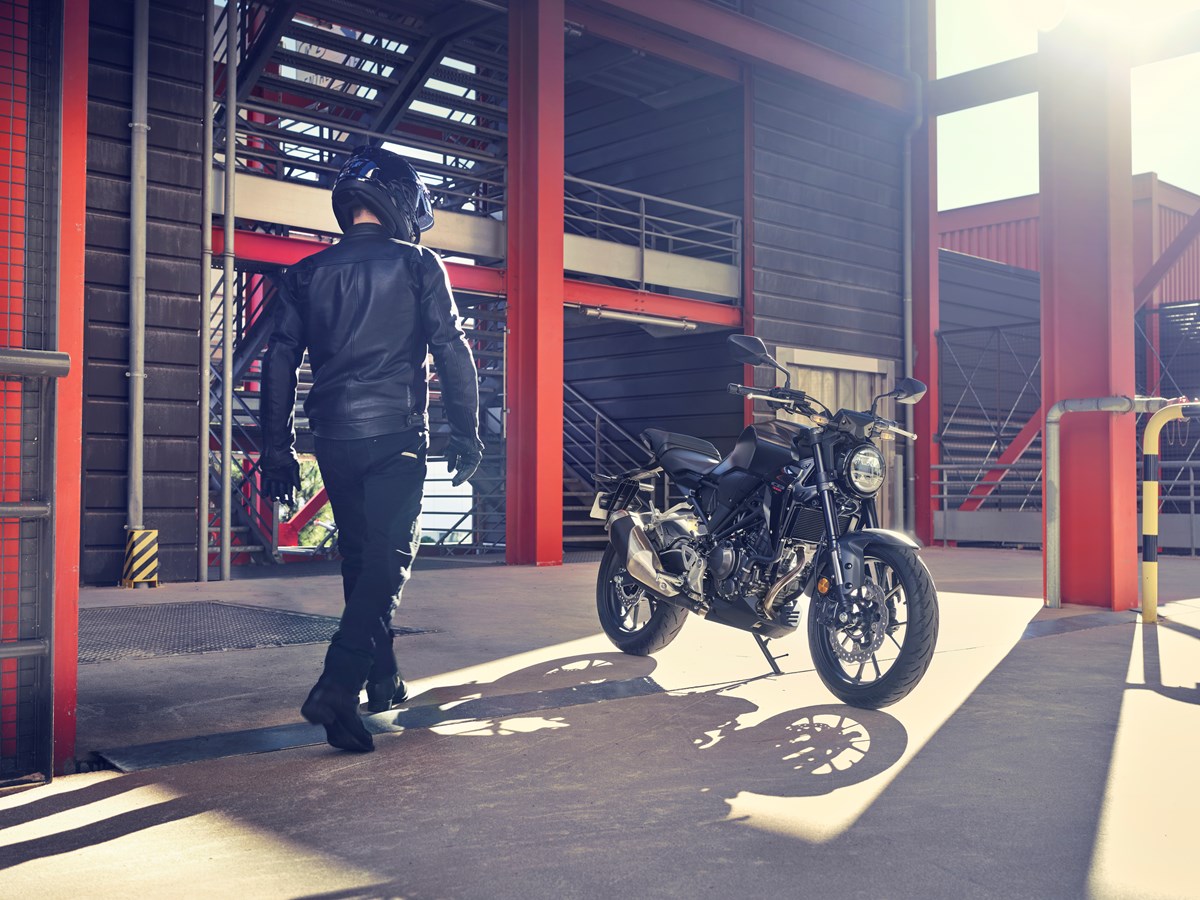
The new 22YM CB300R joins its siblings, the CB1000R, CB650R and CB125R in Honda’s unique Neo Sports Café naked line up. Honda’s new lightweight superstar – tipping the scales at just 144kg wet – features a free-revving, EURO5-compliant DOHC 4V 286cc liquid-cooled, single-cylinder engine that produces 22.9kW peak power and 27.5Nm torque. The addition of an assist/slipper clutch allows smooth shifts and manages rear wheel ‘hop’ on rapid downshifting and hard braking. The frame mixes pressed and tubular steel for a tuned rigidity balance that gives great feedback to the rider. And, just like its larger siblings, the CB300R now features SFF-BP USD forks with 41mm diameter that offer increased feel, bump absorption and control. The front radial-mounted 4-piston caliper, hubless floating disc, IMU-controlled ABS and radial tyres add to the specification, as do a tapered steel handlebar, updated LCD instrument display and full LED lighting. Honda’s Neo Sports Café range reinterprets the café racer for the modern day, with ‘Mechanical Art’ key words in a design language originating in Honda’s R&D base in Rome. With beautiful engineering, classic touches and cutting-edge manufacturing techniques, it’s a concept that draws a firm line of attitude and style around each model. King of the Neo Sports Café range is the CB1000R. Updated most recently for 21YM, it features minimalist, purposeful ‘hunched forward’ styling and an exciting Fireblade-derived engine. The CB1000R Black Edition amplifies the aggressive outlook even further, complementing the lines with a hand-crafted ‘custom’ look, thanks to the Deep Graphite Black paint scheme and black headlight bezel, fly-screen, fork stanchions, radiator shrouds, airbox covers, exhaust and muffler details. The CB650R, which for 22YM sees the introduction of the new Sword Silver Metallic colour scheme, continues the desirability of the range and offers a lively, four-cylinder middleweight choice. For those starting out, the CB125R (which gained a new DOHC 4V engine and SFF-BP forks for in 21YM) is a truly original first riding option. The 22YM CB300R will be available in new Pearl Dusk Yellow and Mat Pearl Agile Blue colour schemes, alongside the Mat Gunpowder Black Metallic and Candy Chromosphere Red. 22YM HONDA MSX125 GROM
Model updates: Honda’s pocket-sized funster rides into 22YM with its retro-cool style, quick-detach body panels, LCD dash and EURO5-specification air-cooled engine driving through a five-speed gearbox. A fresh new colour – Pearl Queen Bee Yellow – sweetens the deal.
Contents: 1 Introduction 2 Model overview 3 Key features 4 Technical specifications
Easy to use, fun and functional, the original leisure motorcycle was defined by Honda in 1963 with the iconic, small-wheeled Monkey bike and carried on – redefined for each respective generation – with the Dax, Ape and the Monkey, itself reborn in 18YM.
The formula has found resonance with the new breed of young riders. Known as ‘Generation Y’ in the USA, ‘Dek Neaw’ in Thailand and ‘Street-Kei’ in Japan, they have grown up in the borderless internet age, and share a culture, outlook and spirit that defies convention.
Instinctively drawn to motorcycling, they need their first two-wheeled transport to be exciting but not unduly challenging, with a design that sets them apart and a reasonable price tag. In 13YM Honda introduced the MSX125 (Mini Street X-treme 125) to cater specifically for such young riders.
A truly global product the MSX125 (known as the ‘Grom’ in Japan and USA) has been a hit across the world. In its first sales season the MSX125 joined the CBF125 in the ranks of Europe’s top 5 best-selling 125cc motorcycles. And, over the last few years, it has established itself as a firm favourite, whether used for simple urban transport or as a heavily customised style statement by its target market.
After 6 years of quiet success and several small styling evolutions, with an eye on the next wave of young riders, 21YM saw a new MSX125 hit the streets with an even cooler direction of travel, and a new name – the MSX125 Grom. For 22YM, a new colour sees it remain Honda’s little machine that continues to brim with big dreams.
2. Model Overview
21YM’s completely redesigned bodywork gave the MSX125 Grom a new design language: fresh and fun, and also easily removed ready for an owner’s creativity to get to work. The LCD dash was also updated to include a rev-counter and gear position indicator.
A new air-cooled engine maintained usable, real-world performance but added a fifth gear to help longer-range riding. And the chassis – tried and tested – offers the same small-bike dimensions with big-bike suspension, braking and handling qualities.
The 22YM MSX125 Grom will be available in the following colour options:
Pearl Queen Bee Yellow **NEW** Mat Gunpowder Black Metallic Gayety Red
3. Key Features
3.1 Styling & Equipment
There’s a cool kind of quirkiness about the MSX125 Grom’s bodywork; a distinctive individuality that mixes the modernity of sleek LED headlight, pared-down seat unit and subframe with the retro of the super-compact side panels and tank covers. And, influenced by customers’ ongoing efforts to make their bike unique, the MSX125 Grom is designed around the concept of adaptability and easy customisation – all of the bodywork attaches with six bolts each side, a detail highlighted by large bolt surrounds for another unique design touch.
The gold finish to the USD front forks, and yellow shock spring stand out in bright contrast to the blacked-out engine, exhaust, wheels and swingarm. Easy to read for its compact size the LCD digital dash includes a rev-counter and gear position indicator, alongside the speedometer, twin trip meters, fuel gauge and clock. Resetting of the trip meters and clock, or alternation between odometer and trip meter, is managed by the switches either side of the display.
3.2 Engine
The MSX125 Grom’s 125cc, two-valve air-cooled engine uses a 50mm bore and 63.1mm stroke, with compression ratio of 10.0:1. Peak power of 7.2kW arrives at 7,250rpm, with peak torque of 10.5Nm at 5,500rpm.
It packs a perfect blend of zippy roll-on performance with useful, accessible all-round ability. Really, this unit all about the fun of twisting a throttle; the five-speed gearbox amplifies the pleasure (and usability) and allows top speed of 94km/h.
Manual clutch operation imparts a full-sized motorcycle experience, while the 15T gearbox sprocket, 38T final drive sprocket and 12-inch wheels deliver lively around-town response plus the ability to travel slowly in a high gear – perfect for threading easily through tight traffic.
It’s also economical, returning 66.6km/l (WMTC mode) by using low-friction technologies, such as an offset cylinder and roller-rocker arm for the valve gear. Sophisticated PGM-FI guarantees highly efficient combustion, and works in conjunction with both air intake and exhaust to deliver an involving experience at the throttle. A large, 2.5L airbox and panel-type, wet paper filter provide reliable and quiet airflow; the filter itself has a life of 10,000 miles. The exhaust downpipe and muffler are two separate parts.
The MSX125 Grom is homologated for EURO5, which from January 1st 2020, introduced significantly stricter engine emissions standards compared to EURO4. These requirements include substantial reductions in permitted carbon monoxide emissions, an over 40% decrease in total hydrocarbon emissions, tougher misfire detection and the introduction of a particulate matter limit.
3.3 Chassis
The MSX125 Grom’s well-proven chassis was essentially unchanged during its 21YM makeover, and the original priorities of design remain relevant: provide the base for a practical bike that new riders could use – and park – with ease in an urban environment, but be just as useable and enjoyable out of town, and also readily accept a pillion.
A steel mono-backbone frame ensures the MSX125 Grom’s core strength. Its rigid, square-section tube joins the headstock directly to the swingarm pivot plates and every other part in effect hangs visibly from the frame, greatly contributing to the minimalist look. Specifically tuned vertical/horizontal rigidity and flex in the swingarm pivot and engine hanger plates provides the perfect balance of comfort and confidence.
The frame structure also enables efficient storage of PGM-FI-related components and electrical parts inside the tank cover and fuel capacity is increased (6.0L). Wheelbase is a snug 1200mm, with rake and trail of 25°/81mm. Kerb weight is reduced to 103kg. A low 761mm seat height makes the MSX125 Grom very manageable; its size also ensures that motor home owners find it easy to load/unload, transport and use.
Suspension front and rear delivers ‘beyond class’ quality. The 31mm USD fork reduces unsprung weight and, thanks to the pistons’ greater pressure-bearing area (compared to a standard telescopic fork) offers improved damping feel throughout the stroke. The top and bottom yokes are full-sized, further enhancing handling and rider feel while a lightweight and robust single rear shock operates a simple and tough H-shape, 50mm x 25mm steel box section swingarm.
Fundamental to the MSX Grom’s form and function are its 5-spoke (re-styled) 12-inch cast aluminium wheels, which feature wide 2.5-inch rims. Front 120/70-12 and 130/70-12 rear tyres also inject dynamic looks and performance. Hydraulic dual piston front (finished in gold) and single piston rear brake calipers work front 220mm and rear 190mm discs. The ABS system operates through an IMU.
4. Technical Specifications
All specifications are provisional and subject to change without notice. # Please note that the figures provided are results obtained by Honda under standardised testing conditions prescribed by WMTC. Tests are conducted on a rolling road using a standard version of the vehicle with only one rider and no additional optional equipment. Actual fuel consumption may vary depending on how you ride, how you maintain your vehicle, weather, road conditions, tire pressure, installation of accessories, cargo, rider and passenger weight, and other factors 22YM HONDA FORZA 350
Model updates: Honda’s mid-size sporty/GT sit-in scooter benefitted from increased engine capacity for 21YM and with it faster top speed and improved acceleration. The enhanced Smart Power+ (eSP+) engine also became EURO5 compliant. Standard specification includes HSTC, electric screen adjustment, USB Type-C socket, storage space for two full-face helmets, full LED lighting and Smart Key operation. As an option, the Forza 350 can wirelessly connect its rider to various smartphone functions via the Honda Smartphone Voice Control system. A new colour option adds fresh appeal for 22YM.
Contents: 1 Introduction 2 Model overview 3 Key features 4 Accessories 5 Technical specifications
The Forza name has long been a powerful force in Honda’s two-wheeled line-up. Its history as a premium, mid-size scooter goes back to the year 2000: the first model set the template, delivering a lively ride, plenty of storage room and an innovative combined braking system. It was well received throughout Europe, where owners found its multi-role capability useful in every aspect of daily life.
While retaining its trademark mix of sporty and GT character, the Forza 300 has constantly evolved, aiming to exceed owners’ expectations with every upgrade. In 04YM it gained Honda’s S MATIC electronically controlled CVT (Continuously Variable Transmission), a theft-deterring Smart key, highly efficient PGM-FI fuel injection for the engine and space for two full-face helmets under the seat.
05YM saw the addition of ABS brakes and, in 08YM, luxurious touches like an audio package and speakers plus upgraded S MATIC (with phased auto shift mode) and Combined ABS brakes were added. In 16YM it moved on again, as the Forza 300 with a new ‘sit-in’ design large enough to carry two people in total comfort, even at highways speeds.
18YM marked the unveiling of a radically revised Forza 300 – lighter, smaller, sharper and sportier – following in the hugely successful wheel tracks of its little sibling, the Forza 125, while retaining all the best attributes of its ‘GT’ nature. A ‘Limited-Edition’ model with Grey/Gloss Black colour scheme and matching Smart top box added an exclusive choice in 2020.
In 21YM it was time for another advance – the Forza 350. Faster, even more useful – with new features like Bluetooth connectivity and Honda Smartphone Voice Control system – and, of course, stylishly desirable with it.
Mechanically unchanged for 22YM, a premium new colour option adds further appeal.
2. Model Overview
Developing 21.6kW and 31.9Nm, the Forza 350’s 330cc engine is strong all the way through its rev-range, delivering crisp acceleration and a top speed of 137km/h. It’s also EURO5 compliant.
Alongside the new engine, in 21YM, cosmetic and aerodynamic updates were applied to the front fairing sides, mirrors, rear side panels and engine cover for a sleeker overall look with even more premium appeal. The chassis was unchanged but connected to a lighter swingarm, and the adjustable electric screen gained an extra 40mm travel to improve wind protection.
The instrument panel was also refreshed, with the Forza 350 rider having the possibility of linking to their smartphone via Bluetooth via the Honda Smartphone Voice Control system which is available as an option from new.
A USB Type-C socket provides convenient charging, with room for two full-face helmets in the under seat storage compartment.
The 22YM Forza 350 will be available in the following colour options:
Mat Carnelian Red Metallic **NEW** Mat Pearl Pacific Blue Pearl Cool White Matt Cynos Gray Metallic Pearl Falcon Gray
3. Key Features
3.1 Styling & Equipment
The Forza 350’s lines flow back from its electric screen (controlled by a switch on the left handlebar) which adjusts through 180mm. It’s designed to provide wind protection, with airflow directed around and over the rider’s head, and reduce wind noise. Stability and comfort at higher speeds – and long distances – can be instantly exchanged for a greater sense of freedom around town, by lowering the screen. For comfort at higher speeds a larger front air duct manages negative pressure in front of the rider, reducing the natural effect of the wind pushing the rider back.
Sculpted for both style and aerodynamic efficiency, the Forza 350’s sharp design lines give a clean, smooth modernity, creating an impression of energetic sportiness and premium desirability. The styling team’s key words of ‘aggressive, technical and powerful’ find expression in a new spoiler-type surround below the headlight, refreshed fairing side panels with a distinctive ‘Z’ design line, and a steeply descending character line for the rear side panels that create a forward-looking, purposeful aesthetic.
Two full-face helmets can be stored under the seat, and it’s also possible to partition the storage area to house a helmet and/or rain gear and A4 sized bags. The front left inner fairing pocket is lockable, and its internal space can be arranged for the rider’s convenience, to hold a phone and water bottle, for instance. It also houses a USB socket. All lighting is premium LED.
Keeping its rider fully connected, the Forza 350 also has the Honda Smartphone Voice Control system available as an option from new, which links the rider to their smartphone while on the move and allows voice management of phone calls and music. A helmet-mounted headset is needed and the smartphone connects via Bluetooth; management of Honda Smartphone Voice Control System is from the left switchgear and dash.
The Forza 350’s Smart Key – as well as controlling the main ignition switch knob and compartment locking – also manages the optional 45L Smart top box. With the Smart Key in the rider’s pocket the box is unlocked, and automatically locks when the rider walks away. It can also be locked from the key. To maintain the internal volume of the box the actuator mechanism is located in the rear body of the machine.
The front and rear indicators of the Forza 350 have an auto-cancelling Emergency Stop Signal feature. Once the ABS modulator detects sudden braking, the rear indicators flash at high speed to warn other vehicles.
Instruments present analogue speedometer and rev-counter flanking a digital display that can switch between 3 modes: 1) odometer, range remaining and current mpg, 2) trip meter, average mpg and timer and 3) ambient temperature thermometer and battery sensor.
3.2 Engine
The Forza 350’s eSP+ engine achieves both high environmental performance and strong output characteristic through comprehensive adoption of technologies for friction reduction.
Liquid-cooled the 330cc, fuel-injected SOHC four-valve unit produces peak power of 21.6kW @ 7,500rpm, with maximum torque of 31.9Nm @ 5,250rpm. Top speed is 137km/h and, from a standing start, the Forza 350 will cover 200m in 10.4s.
Bore is set at 77mm with stroke of 70.7mm; compression ratio is set at 10.5:1. Roller-type rocker arm, plain journal crank bearings and sealed crankcases deliver long-term reliability together with strong performance. To enhance piston cooling, an oil jet, as used on the CRF450R, sprays oil right to the back of the piston, advancing ignition timing and improving combustion performance. Oil capacity is 1.8 litres.
Air is supplied via a 5.5 litre airbox which feeds a 36mm throttle body. The intake port draws air efficiently, utilising a ‘tumble’ flow within the cylinder for more consistent fuel combustion. Exhaust gases are expelled via a straight exhaust port and, to reduce exhaust gas resistance, the muffler consists of two distinct chambers.
Internal friction is reduced through a 5mm offset cylinder, a hydraulic cam chain adjuster and the use of a scavenger pump. Used on high performance machines, the pump lowers the internal pressure within the engine, reduces oil agitation and decreases pumping losses and internal rotational friction. A balancer shaft further reduces vibration and contributes to a smooth enjoyable ride.
An automatic centrifugal clutch works a V-Matic transmission (with ratios set for fast low speed reaction and smart acceleration) and belt final drive.
The Forza 350’s engine is equipped with Honda Selectable Torque Control (HSTC). The system detects any difference between the front and rear wheel speeds, calculates the slip ratio and then controls engine torque via the fuel injection to regain rear wheel traction. HSTC can be switched ON-OFF via a switch on the left handlebar. A ‘T’ indicator in the digital display flickers when the system is working to manage grip.
The engine is homologated for EURO5, which from January 1st 2020 introduced significantly stricter engine emissions standards compared to EURO4. These requirements include substantial reductions in permitted carbon monoxide emissions, an over 40% decrease in total hydrocarbon emissions, tougher misfire detection and the introduction of a particulate matter limit.
Fuel economy is a frugal 30km/l (WMTC mode); the 11.5L tank capacity gives a potential 340km+ range.
3.3 Chassis
A sturdy, yet lightweight, tubular steel frame is at the heart of the Forza 350’s reassuring feel on the road. Wheelbase is 1510mm, rake is 26.5° and trail 89mm. The radiator is located in front of the fuel tank for better cooling performance, and the battery is found between the fuel tank and the under-seat storage area, focusing mass to the centre. Wet weight is 184kg.
Seat height is 780mm and the riding position naturally upright, promoting excellent all-round visibility. Handlebar width is 754mm, with front width of 580mm and mirror width of 860mm; compact dimensions that make slipping through traffic-heavy streets easy.
Rigid 33mm telescopic forks are matched by twin rear shock absorbers – adjustable through 7-stage spring preload – working through 1-piece aluminium swingarm.
The cast aluminium 15-inch front wheel is fitted with a 120/70-15 tyre while the 14-inch rear wears a 140/70-14 tyre, offering maximum traction and ride comfort. A 256mm single disc performs stopping duties up front, mated to a 240mm rear, with the benefit of 2-channel ABS for braking control on slippery surfaces.
4. Accessories
A range of Genuine Honda Accessories are available for the Forza 350. They include:
45-litre Smart top box Rear carrier rack (direct fitment) Inner bags Heated grips Alarm
5. Technical Specifications
All specifications are provisional and subject to change without notice.
*Please note that the figures provided are results obtained by Honda under standardised testing conditions prescribed by WMTC. Tests are conducted on a rolling road using a standard version of the vehicle with only one rider and no additional optional equipment. Actual fuel consumption may vary depending on how you ride, how you maintain your vehicle, weather, road conditions, tire pressure, installation of accessories, cargo, rider and passenger weight, and other factors. 22YM HONDA SH125i
Model updates: The SH125i is one of Europe’s most popular scooters for a reason: its rich specification includes a four-valve eSP+ engine with Honda Selectable Torque Control (HSTC) and Idling Stop, sleek signature SH style with flat floor design, LCD dash, full LED lighting, 28L storage space, USB Type-C socket and Smart Key operation. Two new paint options for 22YM add further appeal.
Contents: 1 Introduction 2 Model overview 3 Key features 4 Accessories 5 Technical specifications
22YM HONDA FORZA 125
Model updates: Honda’s premium sports/GT Forza 125 scooter maintains its place in the spotlight with new colour options for 22YM. Standard specification includes HSTC, electric screen adjustment, USB Type-C socket, storage space for two full-face helmets, full LED lighting and Smart Key operation.
Contents: 1 Introduction 2 Model overview 3 Key features 4 Accessories 5 Technical specifications
Honda’s Forza 125 was designed specifically for discerning European customers who demand the very most out of their scooter in every respect. And right from its introduction in 2015 it has met and exceeded all expectations, evolving year on year in response to owner feedback, and selling over 80,000 units to date.
Straight out of the crate the Forza 125 hit the ground rolling, proving an instant sales hit thanks to its comprehensive mix of sporty and ‘GT’ elements wrapped up in a distinctive design package. A lively new four valve version of Honda’s eSP (‘enhanced Smart Power’) engine, compact dimensions, sports-oriented attitude and handling ability provided traffic-busting agility around town, while its sit-in comfort, wind protection and strong top end power made easy work of longer-range highway commuting. Add in plenty of storage, premium features front to back, a new sharp-edged design aesthetic and Honda build quality, and the reasons for its immediate popularity are clear.
Fittingly, it’s never stood still, either. In 18YM – maintaining a steep development curve – the Forza 125 received a complete, sporty re-style and rider-focused upgrades that included full LED lighting and electric screen. 21YM saw the addition of enhanced desirability and practical functionality. 2. Model Overview
For 21YM, cosmetic updates were applied to the front and side fairings, mirrors, rear side panels and engine covers to refresh the Forza 125’s styling, creating a sleeker overall look, and improving aerodynamics. The re-shaped electric screen adjusted with an extra 40mm travel to maximise wind protection. And a USB socket replaced the ACC charger.
The chassis remained unchanged, but the four-valve water-cooled SOHC engine received Honda Selectable Torque Control (HSTC) to maintain rear tyre grip. It also gained EURO5 compliance.
For 22YM, two striking new colour options add further desirability and style. 3. Key Features
3.1 Styling & Equipment
The Forza 125’s lines flow back from its electric screen (controlled by a switch on the left handlebar) which adjusts through 180mm. It’s designed to provide wind protection, with airflow directed around and over the rider’s head, and reduce wind noise.
Stability and comfort at higher speeds – and long distances – can be instantly exchanged for a greater sense of freedom around town, by lowering the screen. For comfort at higher speeds a larger front air duct manages negative pressure in front of the rider, reducing the natural effect of the wind pushing the rider back.
Sculpted for both style and aerodynamic efficiency, the Forza 125’s sharp design lines give a clean, smooth modernity, creating an impression of energetic sportiness and premium desirability. The styling team’s key words of ‘aggressive, technical and powerful’ find expression in a new spoiler-type surround below the headlight, refreshed fairing side panels with a distinctive ‘Z’ design line, and a steeply descending character line for the rear side panels that create a forward-looking, purposeful aesthetic.
Handlebar width remains 750mm as does mirror height of 1125mm, the perfect dimensions for slipping through congested city streets. Seat height is also unchanged at 780mm; there’s plenty of room for two and the riding position cups the rider securely. All lighting is LED.
Two full-face helmets can be stored under the seat, and it’s also possible to partition the storage area to house a helmet and/or rain gear and A4-sized bags. The front left inner fairing pocket is lockable and its internal space can be arranged for the rider’s convenience to hold a phone and water bottle, for instance. A USB socket replaces the ACC 12V charging point.
The Forza 125’s Smart Key – as well as controlling the main ignition switch knob and compartment locking – also manages the optional 45L Smart top box. With the Smart Key in the rider’s pocket the box is unlocked, and automatically locks when the rider walks away. It can also be locked from the key. To maintain the internal volume of the box the actuator mechanism is located in the rear body of the machine.
Instruments present analogue speedometer and rev-counter (with redesigned dials) flanking a digital display that can switch between 3 modes: 1) odometer, range remaining and current mpg, 2) trip meter, average mpg and timer and 3) ambient temperature thermometer and battery sensor.
The 22YM Forza 125 will be available in the following paint options:
Pearl Falcon Grey **New for 2022** Mat Pearl Pacific Blue **New for 2022** Pearl Nightstar Black Mat Cynos Grey Metallic Mat Carnelian Red Metallic
3.2 Engine
The Forza 125’s enhanced Smart Power (eSP) four-valve, water-cooled SOHC powerplant delivers 11kW@ 8,750rpm, with peak torque of 12.2Nm @ 6,500rpm. Bore and stroke is set at 53.5 x 55.5mm with compression ratio of 11.5:1.
From a standing start the Forza 125 accelerates rapidly (0-200m is covered in just 13.3s) while sharp mid-range makes for responsive roll-on performance in the typical 40-60km/h around-town speed range. It will cruise happily around 90km/h and V-max is 108km/h.
Honda’s eSP low-friction technologies are found throughout the engine. A compact combustion chamber and PGM-FI fuel injection – fed by 4.7-litre airbox and 26mm diameter inlet duct – optimise combustion velocity and cooling performance. Clever packaging of items like the oil pump (which is built in to the crankcase) help to further heighten the efficiency.
An offset cylinder reduces friction caused by contact between piston and bore, efficiently transmitting combustion energy to the crankshaft. A ‘spiny’ cast-iron sleeve – with tiny surface extensions – keeps in check any distortion of the inner bore diameter. This design lowers tension in the piston ring, reducing friction.
A high-efficiency radiator – integrated into the exterior of the right-side crankcase – employs a small, light fan that reduces frictional losses and lowers drag. Rolling resistance within the transmission unit is reduced by the use of three low-friction main bearings, all designed to deal with the loads they individually receive. The drive pulley features a fin design that lowers air resistance and the follower pulley reduces pressure on the drive belt, cutting transmission losses.
The electronically controlled, brushless ACG starter is an integrated component mounted directly on the end of the crankshaft, serving as starter motor and alternator. It spins the engine directly, eliminating any noise from gear engagement or meshing. The redesigned engine cover and swingarm for 21YM, complement the new bodywork.
Idling Stop automatically stops the engine running after three seconds at idle when the Forza is stationary and the brakes applied, and re-starts it instantly when the throttle grip is twisted. It’s seamless in use thanks to ACG and the swing-back system that returns the crank to its position before air intake, and a decompression mechanism that negates cranking resistance from compression. It has the functionality to ‘read’ the battery charge and turns itself off to avoid excessive drain. The battery is a long-life YTZ8V unit.
One of the original aims of the Forza 125 is that the trip to the fuel station should happen just once a week for the average user, and a near 500km tank range is possible thanks to the engine’s fuel efficiency of approximately 42.7km/l (WMTC mode) and 11.5-litre tank.
The engine is homologated for EURO5, which from January 1st 2020 introduced significantly stricter engine emissions standards compared to EURO4. These requirements include substantial reductions in permitted carbon monoxide emissions, an over 40% decrease in total hydrocarbon emissions, tougher misfire detection and the introduction of a particulate matter limit.
An additional technology to boost rider confidence in wet conditions is the inclusion of Honda Selectable Torque Control (HSTC), which works in the background to deftly manage rear wheel traction. A ‘T’ indicator flickers on the dash when HSTC is actively reducing wheelspin, and the system can be turned off completely.
3.3 Chassis
Unchanged for the 22YM year model, the tubular steel frame that underpins the Forza 125’s chassis provides the necessary rigidity and strength for the broad variety of riding conditions it will face. Sturdy 33mm telescopic forks are matched by twin rear shock absorbers – adjustable through 7-stage spring preload – working through a 1-piece aluminium swingarm.
The Forza 125’s light weight, just 161kg, makes it easy to manage at walking speeds, and easy to park. A wheelbase of 1,505mm provides stability; the steering geometry – 26.5° rake and 89mm trail – delivers nimble steering.
The cast aluminium 15-inch front wheel is fitted with a 120/70-15 tyre while the 14-inch rear wears a 140/70-14 tyre, offering maximum traction and ride comfort. A large 256mm single disc performs stopping duties up front, mated to a 240mm rear, with the benefit of ABS for extra braking control on slippery surfaces.
4. Accessories
A range of Genuine Honda Accessories are available for the Forza 125. They include:
45-litre Smart top box 35-litre top box Rear carrier rack (direct fitment) Inner bags Heated grips
5. Technical Specifications
All specifications are provisional and subject to change without notice.
*Please note that the figures provided are results obtained by Honda under standardised testing conditions prescribed by WMTC. Tests are conducted on a rolling road using a standard version of the vehicle with only one rider and no additional optional equipment. Actual fuel consumption may vary depending on how you ride, how you maintain your vehicle, weather, road conditions, tire pressure, installation of accessories, cargo, rider and passenger weight, and other factors. 22YM HONDA SH150i
Model updates: It’s one of Italy’s most popular scooters for a reason: its rich specification includes a four-valve eSP+ engine with Honda Selectable Torque Control (HSTC) and Idling Stop, sleek signature SH style with flat floor design, LCD dash, full LED lighting, 28L storage space, USB Type-C socket and Smart Key operation. Two new paint options for 22YM add further appeal.
Contents: 1 Introduction 2 Model overview 3 Key features 4 Accessories 5 Technical specifications
Part of the million-selling SH family whose founding member, the SH50, went on sale in 1984, the four-stroke Honda SH150 first hit the market in Europe in 2001. Ever since it has quietly and consistently gone about its mission to provide stylish, fun and fuss-free transport – becoming one of the continent’s favourites along the way.
That first machine laid down the blueprint for success: a frugal-natured but lively engine that could deal with highway as well as town use tied to nimble, sure-footed handling underpinned by the stability that large diameter 16-inch wheels deliver – all wrapped in elegant, premium styling.
Fuel injected with PGM-FI in 05YM, over the last 14 years the SH150i and its 125cc sibling have come to represent the ultimate in urban transport with the perfect balance of style, reliability, economy and downright usability.
And of course its story is one of constant, careful evolution reflecting the developing needs and expectations of owners, and Honda’s desire to keep on giving them an even better version of their SH. In 13YM it gained Honda’s eSP (enhanced Smart Power) low friction engine and Idling Stop, boosting both power delivery and fuel economy. And in 2017 the look was refreshed with more chiselled design lines, and LED front/rear lights and Honda Smart Key added.
In 20YM the SH150i – manufactured at Honda’s Atessa factory in Italy – and immensely popular in the Italian market due to legislation that prohibits 125cc machines from motorways was, effectively, a brand-new scooter. Standing squarely on the shoulders of its forbears the SH150i instantly became faster, even more stylish, comfortable, convenient to use and as cost effective as ever to own and run. Of course, it could never be anything else. It is an SH, after all.
For 22YM, two stylish new colour options, featuring unique red logos and black wheels give a more sporty edge and make the SH150i even more desirable.
2. Model Overview
While the SH150i carries on mechanically unchanged for 22YM it’s worth a recap of the 20YM update because finding improvement was no easy goal – it is one of Italy’s favourite scooters for a reason. But more power, torque and improved fuel-efficiency from a EURO5-compliant four-valve eSP+ engine was a good place to start. The addition of HSTC was also a bonus for any owner’s peace of mind.
A redesigned frame allowed extra and ever-useful storage space (plus inclusion of a USB charger) and optimisation of the rear suspension geometry enhanced comfort. And premium new bodywork and stylish front signature redefined and reinforced the SH150i’s presence, with full LED lighting and crisp LCD dash.
Five configurations are available:
Standard SH150i without accessories SH150i with Smart top box SH150i with Smart top box, knuckle guards and windscreen SH150i with standard top box SH150i with standard top box, knuckle guards and windscreen.
Two brand-new colours feature unique red logos, black wheels and more aggressive detailing, to add further contemporary appeal for 22YM.
Mat Pearl Cool White **NEW** Mat Rock Gray **NEW** Pearl Nightstar Black Timeless Gray Metallic Pearl Splendor Red
3. Key Features
3.1 Styling & Equipment
Smooth and solid are two words that describe a sleek, unified body style with the tension between the two reinforcing a premium presence. And the SH150i’s ‘face’ sets it apart – the fairing-mounted headlight (almost an LED ‘H’) features a central main beam splitting dual dip beams, while position lights reside above on the handlebar nacelle.
The elegant looks are matched to effortless practicality. The overall compactness, flat floor and upright riding position (essential for ease-of-use and visibility in busy town traffic) are conspicuous hallmarks of the SH look. Less obvious is the 28L of under seat storage, capable of holding a full-face helmet. A USB charging point is also included.
The flat seat provides plenty of support and room to move around and its carefully contoured shape, plus slim floor width, makes reaching the ground easy. As many journeys around town involve a pillion there’s plenty of room for two; retractable aluminium pillion footplates tuck away when not in use and provide a stable platform – especially under braking – when needed for the passenger.
The rear light is LED with a chrome surround, matching the front, and the LCD dash presents all warning lights – including Smart Key, HSTC/ABS and Idling Stop operation – neatly around a central digital speedo/odometer display. All operations on the dash are carried out via A/B buttons on the left handlebar.
The SH150i’s Smart Key resides in the rider’s pocket and does away with the need to constantly insert and withdraw a key for ignition, fuel cap and seat. It has two switches: the smart function on/off and ‘answer back’, which flickers the indicators for identification from a distance.
With the Smart Key present one push of the machine-mounted main switch powers it up and makes it possible to turn, giving the rider control of the ignition and steering lock, and, via two rocker switches, the fuel cap and seat. It also illuminates when pushed – or from the answer back function of the Smart Key – with a blue light.
3.2 Engine
The SH150i’s 157cc liquid-cooled four-valve enhanced Smart Power+ (eSP+) engine produces peak power of 12.4kW 8,500rpm with 14.9Nm torque delivered at 6,500rpm.
Fuel economy (without Idling Stop activated) is 44.7km/l (WMTC mode). And just as important to owners and for a machine that will spend most of its time in an urban environment, the SH150i’s engine is EURO5 compliant; the allowable limits for exhaust tailpipe pollutants such as carbon monoxide, hydrocarbons and nitrous oxide specified by EURO5 are drastically reduced compared to those of EURO4.
Technology to boost rider confidence in wet conditions is Honda Selectable Torque Control (HSTC) that works in the background to deftly manage rear wheel traction. An indicator flashes on the dash when HSTC is actively reducing wheelspin and the system can also be turned off completely.
Bore is set at 60mm with stroke of 55.5mm; compression ratio is 12.0:1. The compact engine is a masterpiece of mass centralisation. The radiator, rather than being mounted at the front of the machine is built into the engine itself for a simple, light layout. Its highly efficient core allows for the use of an ultra-compact, light cooling fan.
Low-friction technologies are employed internally; the cylinder sleeve uses minute splines on its outer surface to keep oil consumption low and improve cooling and the cylinder is offset to keep frictional losses to a minimum. Rolling resistance within the transmission is kept in check by the use of three main bearings, all designed to deal with the loads they each individually receive.
A key fuel-saving technology incorporated into the SH150i is Idling Stop. It’s operated via a switch on the right handlebar and, when enabled, automatically stops the engine running after three seconds at idle, and re-starts it instantly when the throttle grip is twisted.
It is seamless in use, thanks to a swing-back system that returns the crank to its position before air intake, and a decompression mechanism that negates cranking resistance due to compression. The ACG starter also generates electricity, doing away with a conventional system’s motor and gears.
3.3 Chassis
The high-tensile tubular steel underbone frame sites the 7L fuel tank under the floor beneath the rider’s feet which frees up 10L additional space. Wheelbase is set at 1,350mm with rake and trail of 26°/85.2mm. Seat height is 799mm with wet weight of 134.1kg.
For ride comfort the engine hanger link angle and rear suspension angle are optimised to reduce rotational load toward the engine link, making for more-supple bump-absorption and control.
Lightweight 16-inch aluminium die-cast wheels have always been key to the SH150i’s sure-footed handling ability and stability on a variety of road surfaces and mount Michelin City Grip tubeless tyres sized 100/80-16 front and 120/80-16 rear.
The rear shocks feature 5-step preload adjustment with 83mm axle travel. The 33mm telescopic front forks, with 89mm of travel, ensure excellent road holding and are tuned to give a compliant, yet controlled ride. ABS is fitted as standard; both front and rear discs have a 240mm diameter; the front caliper is a two piston design, the rear a single piston.
4. Accessories
Alongside the standard top box are the redesigned screen and knuckle guards for enhanced weather protection. The Smart top box – which operates together with the Smart Key – and opener kit can also be retro-fitted.
5. Technical Specifications
All specifications are provisional and subject to change without notice ** Please note that the figures provided are results obtained by Honda under standardised testing conditions prescribed by WMTC. Tests are conducted on a rolling road using a standard version of the vehicle with only one rider and no additional optional equipment. Actual fuel consumption may vary depending on how you ride, how you maintain your vehicle, weather, road conditions, tire pressure, installation of accessories, cargo, rider and passenger weight, and other factors. 22YM HONDA CB650R
Model updates: Honda’s Neo Sports Café middleweight continues to carve out a strong following. Specification includes 41mm Showa Separate Function Big Piston USD forks, high-revving four-cylinder engine, HSTC, assist/slipper clutch and LCD dash. Minimal styling makes a bold statement, and includes practicality of a USB Type-C socket under the seat. The choice of colours grows to four for 2022, with the addition of a Sword Silver Metallic option.
Contents: 1 Introduction 2 Model overview 3 Key features 4 Accessories 5 Technical specifications
Honda has always thrived on exploring new boundaries – in design as well as engineering. In 18YM, the CB1000R, CB300R and CB125R brought a fresh identity to its naked motorcycle line-up, mixing café racer inspirations with a forward-looking ultra-minimalist look under the ‘Neo Sports Café’ design theme.
One segment remained for the new aesthetic to find expression: the hugely competitive naked middleweight arena and, in 19YM, the CB650R confidently took on this role. Aimed at a young demographic that looks to show off in style and enjoy to the maximum a combination of exhilarating four cylinder engine performance and light, versatile, refined chassis handling, it has proved a great success.
Building on the momentum, in 21YM the CB650R received a major front suspension upgrade, plus a range of detail improvements to enhance comfort, usability and practicality. For 22YM, the CB650R gains a cool new colour option.
Valerio Aiello, of Honda’s Rome R&D Department on the Neo Sports Café design aesthetic:
“The entire current Neo Sport Café range from Honda is the result of the CB4 Concept model presented at EICMA in 2015. Our desire was to explore the world of the café racer and reinterpret it in a modern key.
All the models of this CB series are not simply retro-vintage motorcycles, but rather neo-classics – that is, modern motorbikes showcasing classic design styles combined with modern techniques.
We wanted to create a new stylistic dimension, different from the muscular streetfighters of the last few years, and at the same time, far from the simpler café-racer style. The end result is that none of the bikes from the competition resemble the Neo Sports Café range and, like them or not, they are easily recognisable as Hondas. The competitors have classic or very modern motorcycles in their ranges, but in my opinion, not something that goes in the wake of both styles.
During development of the CB4 concept, I found inspiration from outside the world of motorcycles, in watches. I’ve always liked their technicality and one of the key concepts used during the Neo Sports Café design was ‘Mechanical Art’.
‘Mechanical Art’ is the desire to show the beauty of the various mechanical elements to which Honda has always given great importance. Watches do this very well indeed, with their mechanics always creating a certain charm.”
2. Model Overview
The CB650R received a significant refresh for 21YM. The major news was the application of 41mm Showa Separate Function Big Piston (SSF-BP) USD forks – high quality suspension that really elevates the bike’s handling ability.
EURO5 compliance for the engine was achieved with no loss of top end power; other detail improvements included slightly more forward-set handlebars, improved visibility for the LCD display and USB Type-C charging socket under the seat. New side panels and rear mudguard were also minor cosmetic changes.
The 22YM CB650R will be available in the following colour options, all now with a black front mudguard:
Sword Silver Metallic **NEW** Mat Gunpowder Black Metallic Candy Chromosphere Red Mat Jeans Blue Metallic
3. Key Features
3.1 Chassis
The CB650R’s steel diamond frame uses pressed swingarm pivot plates and twin elliptical spars with a rigidity balance specifically tuned (stiffer around the headstock and more flexible in the spar sections) to deliver balanced handling characteristics, with high levels of rider feedback. Rake is set at 25.5° with trail of 101mm and wheelbase of 1,450mm. Kerb weight is 202.5kg.
Showa’s Separate Function Big Piston (SFF-BP) 41mm USD forks offer high-quality reaction. A pressure separation damper in one fork tube and spring mechanism in the other deliver high damping performance and lighter weight. Together with the use of a larger sized piston the result is increased feel, bump absorption and control. Adjustable for 10-stage spring preload, the single-tube monoshock operates directly on the curvaceous gravity die-cast aluminium swingarm.
Four-piston radial-mount front brake calipers work 310mm wave-pattern floating discs, and are paired with a single-piston rear caliper and 240mm disc. The ABS is a two-channel system.
Cast aluminium wheels mount 120/70-ZR17 and 180/55-ZR17 front and rear tyres.
3.2 Styling & equipment
Tightly wrapped and aggressive, the CB650R’s Neo Sports Café style features the signature compact ‘Trapezoid’ proportion of short, stubby tail and short overhang headlight. The long fuel tank is a key motif of the family design; its smooth lines accentuate the solidity of real metal surfaces and crown the engineering of the four cylinder powerplant. It also houses the ignition.
A 35° handlebar angle makes tight, slow-speed turns and U-turns straightforward. Compact side panels accentuate the minimalism, as does the steel rear mudguard. There’s a USB Type-C socket located under the seat, for easy charging of a mobile device; seat height is set at 810mm.
The round headlight is one of the key words of the Neo Sports Café design language. It’s LED, as is the rest of the lighting. Sharp LCD instruments use the CB1000R as a baseline and include Shift Up, Gear Position and Peak Hold indicators.
3.3 Engine
The 649cc, DOHC 16-valve engine is tuned to create the purest, most enjoyable mid-sized four cylinder performance possible, with the classically fast ‘pick-up’ through the rev range and hard-hitting, high-revving top end for which Honda’s in-line’s fours are renowned. Peak power of 70kW arrives @ 12,000rpm with peak torque @ 63Nm delivered at 9,500 rpm. An easy 35kW conversion is available for A2 licence holders. EURO5 compliance required revisions to the ECU, cam lobes, intake timing, exhaust pipe, catalyser and silencer, as well as the addition of a crank pulsar.
Direct cam actuation makes for a compact cylinder head; bore and stroke is set at 67mm x 46mm with compression ratio raised of 11.6:1. Iridium spark plugs are employed and twin air ducts – either side of the fuel tank – feed the airbox and produce a throaty intake roar.
Asymmetric piston skirts minimise bore contact and reduce friction. Ferrous spines on the outer surface of the cylinder sleeves reduce oil consumption (and friction) with improved heat transfer and a silent SV cam chain reduces frictional losses by using a Vanadium coating on its pins. Internal water channelling from cylinder head to cylinders does away with most of the exterior hoses.
The engine uses a compact internal architecture, stacked six-speed gearbox and starter layout with the cylinders canted forward 30°. An assist/slipper clutch eases upshifts while managing rear-wheel lock up under hard braking and rapid downshifts. Honda Selectable Torque Control (HSTC) is fitted to manage rear wheel traction; it can be turned off should the rider choose.
Fuel consumption of 20.4km/l (WMTC mode) gives a range of over 300km from the 15.4L fuel tank. 4. Accessories
A range of Genuine Honda Accessories are available for the CB650R:
Several aluminium parts and aluminium inserts to maximise the Neo Sport Café design that CB650R and CB1000R have in common (meter visor, front mudguard panels, shroud covers, side covers, seat cowl).
Under cowl Wheel stripes Tank bag and seat bag – the same as those for Honda’s naked flagship, the CB1000R Quick shifter Front visor 12V socket Heated grips Tank pad
5. Technical Specifications
# Please note that the figures provided are results obtained by Honda under standardised testing conditions prescribed by WMTC. Tests are conducted on a rolling road using a standard version of the vehicle with only one rider and no additional optional equipment. Actual fuel consumption may vary depending on how you ride, how you maintain your vehicle, weather, road conditions, tire pressure, installation of accessories, cargo, rider and passenger weight, and other factors. | |||||||||||||||||||||||||||||||||||||||||||||||||||||||||||||||||||||||||||||||||||||||||||||||||||||||||||||||||||||||||||||||||||||||||||||||||||||||||||||||||||||||||||||||||||||||||||||||||||||||||||||||||||||||||||||||||||||||||||||||||||||||||||||||||||||||||||||||||||||||||||||||||||||||||||||||||||||||||||||||||||||||||||||||||||||||||||||||||||||||||||||||||||||||||||||||||||||||||||||||||||||||||||||||||||||||||||||||||||||||||||||||||||||||||||||||||||||||||||||||||||||||||||||||||||||||||||||||||||||||||||||||||||||||||||||||||||||||||||||||||||||||||||||||||||||||||||||||||||||||||||||||||||||||||||||||||||||||||||||||||||||||||||||||||||||||||||||||||||||||||||||||||||||||||||||||||||||||||||||||||||||||||||||||||||||||||||||||||||||||||||||||||||||||||||||||||||||||||||||||||||||||||||||||||||||||||||||||||||||||||||||||||||||||||||||||||||||||||||||||||||||||||||||||||||||||||||||||||||||||||||||||||||||||||||||||||||||||||||||||||||||||||||||||||||||||||||||||||||||||